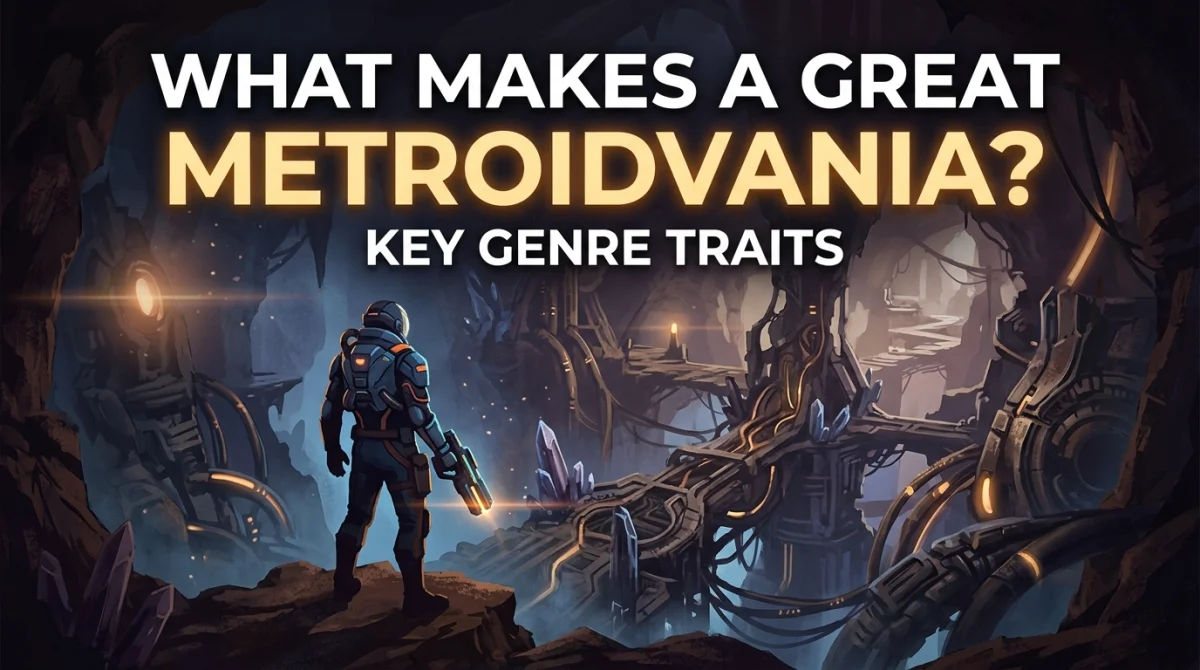
What Makes a Great Metroidvania? Key Genre Traits
Keep reading: What Is an Immersive Sim? Genre Explained, What Is a Roguelike? A Beginner's Guide to the Genre, What Is a Soulslike? Key Traits That Define the Genre, and Tower Defense Games: Why They're More Popular Than Ever.
You unlock a double jump, and suddenly half the map you thought you knew makes sense that is the metroidvania moment, and nothing else in gaming delivers it. A metroidvania is an action-adventure game built around one interconnected map whose paths are gated by abilities, so new powers open previously unreachable areas and reward you for remembering where they were. In this guide you will learn what defines a great metroidvania, where the term comes from, and the best games to start exploring.
Quick answer: A metroidvania is an action-adventure game with one interconnected map whose areas are blocked by ability gates, so new powers like double jumps or wall climbs open previously unreachable paths. The name fuses Metroid and Castlevania: Symphony of the Night, the two games that defined the formula. Expect heavy backtracking, secret rooms, and a map you will learn to read like a roadmap.
Where the Name Metroidvania Comes From
The portmanteau "Metroidvania" blends two of gaming's most influential series. Metroid (1986) pioneered the idea of a large, non-linear world you explore with expanding abilities, and Super Metroid (1994) perfected it with its moody atmosphere and clever map design. Meanwhile, Castlevania: Symphony of the Night (1997) took the same loop and added RPG-style upgrades, equipment, and secrets.
The term itself was coined by fans on early gaming forums in the 2000s, and developers eventually adopted it themselves proof that a genre name can be born from community slang. Since then, the formula has become a favorite playground for indie studios, because a great metroidvania can be built by a tiny team with strong map design.
What Actually Makes a Metroidvania Great?
Great metroidvanias live and die by a handful of design choices:
- Ability-gated exploration. The world is one connected map, but walls, gaps, and locked doors only open with the right power-up. This is the single defining trait of the genre.
- Backtracking that feels rewarding. Revisiting old areas only works when there is something new to find there an upgrade, a boss, or a shortcut that makes the trip worth it.
- A readable map. Players constantly cite map clarity as the difference between a great game and a frustrating one. Clear markers for blocked paths and secrets are gold.
- Meaningful upgrades. New abilities should change how you move and fight, not just inflate numbers. The double jump, dash, and wall climb are the genre's classics.
- Secrets everywhere. Hidden rooms, breakable walls, and missable upgrades reward curiosity. A great metroidvania punishes nothing and rewards everything.
- A sense of place. The best worlds have distinct zones you can navigate by memory, not just a blur of corridors.
The result is a loop of explore, get stuck, find a power, remember a blocked door, and loop back each cycle making you feel cleverer.
The Breadth of the Modern Metroidvania
The genre has splintered into several flavors worth knowing before you choose your first game:
| Style | Example | The Twist |
|---|---|---|
| Pure classic | Hollow Knight | Huge world, precise combat, tough bosses |
| Story-driven | Ori and the Blind Forest | Gorgeous art, tight platforming, emotional pacing |
| Soulslike-adjacent | Blasphemous | Slow, deliberate combat and a grim world |
| Roguelite hybrid | Dead Cells | Metroidvania movement with run-based roguelite loops |
Each variant keeps the core promise exploration gated by abilities while swapping the combat, pacing, and difficulty to taste.
Great Metroidvanias to Start With
If you are new to the genre, these four are the best on-ramps:
- Super Metroid (1994) the genre's foundation, still unmatched in atmosphere. A SNES classic that holds up beautifully.
- Hollow Knight (2017) the modern crown jewel. A massive hand-drawn world, razor-sharp combat, and endless secrets. Expect a challenge.
- Ori and the Blind Forest (2015) gentler, stunningly beautiful, and built around smooth platforming rather than punishing combat.
- Castlevania: Symphony of the Night (1997) the other half of the genre's DNA, with RPG loot and the iconic inverted castle twist.
Any of these will teach you to think like a metroidvania player: mark the map, memorize the locks, and come back stronger.
Tips for Exploring Like a Pro
- Talk to the map. If the game lets you pin notes, mark every blocked path you pass you will thank yourself later.
- Check your corners. Breakable walls, hidden crawlspaces, and secret alcoves are the genre's love language.
- Prioritize movement upgrades. Damage helps, but the dash, double jump, and climb open the world and make every future fight easier.
- Boss fights are curriculum. In most metroidvanias, bosses reward you with the exact ability you need next. Treat them as gatekeepers, not filler.
- Get lost on purpose. Dead ends often hide upgrades; a "wrong" path is usually just a secret with a health boost.
Key Takeaways
- A metroidvania is defined by ability-gated exploration through one interconnected map.
- The name combines Metroid and Castlevania: Symphony of the Night, and the formula dates back to the mid-1980s.
- Great map clarity, meaningful upgrades, and rewarding secrets separate the classics from the forgettable.
- The genre now spans classic, story-driven, soulslike-adjacent, and roguelite hybrids.
- Super Metroid, Hollow Knight, and Ori are the perfect starting points.
Frequently Asked Questions
What does metroidvania mean?
A metroidvania is a side-scrolling action-adventure game where exploration is gated by abilities you unlock, forcing you to backtrack through one interconnected map. The name merges Metroid and Castlevania.
Is Hollow Knight a metroidvania?
Yes, Hollow Knight is widely considered a modern metroidvania. It uses one huge interconnected map, ability-gated paths, and heavy backtracking, all wrapped in tight boss combat.
What is the best metroidvania for beginners?
Ori and the Blind Forest is the friendliest on-ramp thanks to its gentle difficulty and forgiving design. Super Metroid is the classic pick if you want the pure original experience.
What is the difference between a platformer and a metroidvania?
A platformer is any game built around jumping, while a metroidvania is a specific structure: one connected map gated by abilities that forces backtracking. Celeste is a platformer; Hollow Knight is a metroidvania.
Why do metroidvanias make you backtrack?
Backtracking is the genre's core loop. New abilities open previously blocked areas, so revisiting old zones with a new power is how the game delivers upgrades, secrets, and shortcuts.
Conclusion
A great metroidvania makes you feel like an explorer, not a tourist every locked door is a promise, and every new ability is a key. You now know the defining traits, the history, and the best games to prove the formula to yourself. Mark your map, memorize the blocked paths, and go find every secret the genre has to offer.
Which metroidvania moment sold you on the genre that first double jump, or the moment the map finally clicked? Drop it in the comments, share this guide with a friend who still thinks backtracking is boring, and subscribe so you never miss another genre deep-dive.
Ready to play?
Puzzle, arcade, 3D, word & sports games for every age — instant play, no registration.
Comments
No comments yet. Be the first to share your thoughts!