How to Switch From Arcade Racing Games to Sim Racing
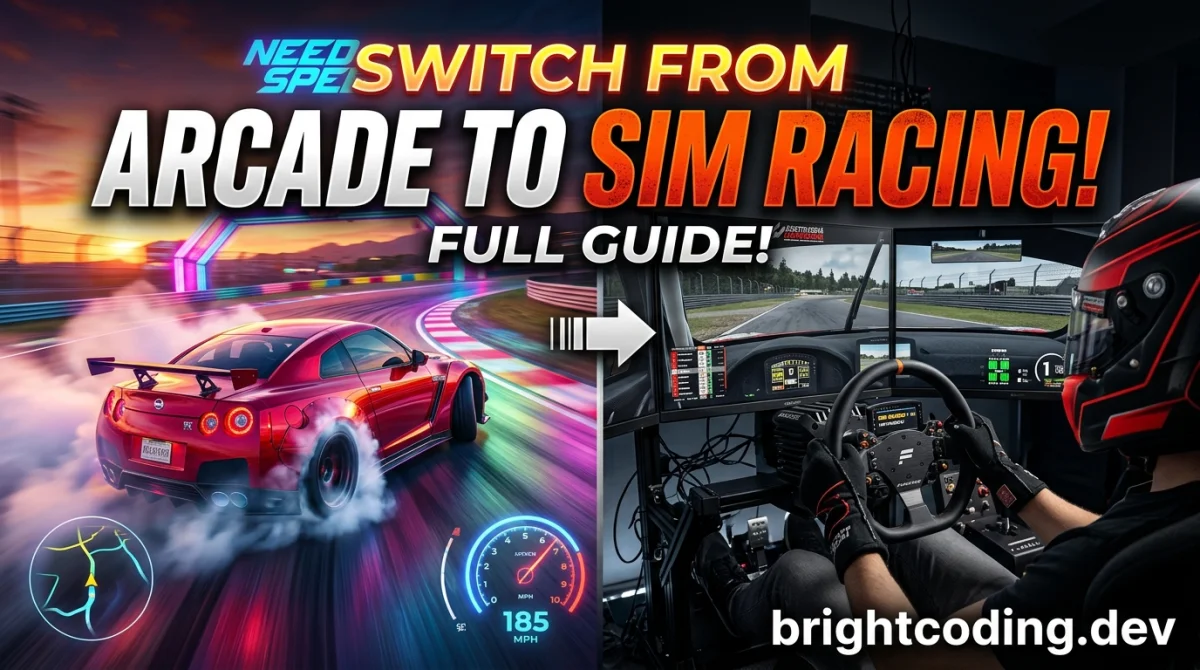
You can win every race in a arcade racer, throw a car into a corner at 200 mph, and still spin out on your first lap of a proper sim. That is not a skill problem. It is a habit problem, and it is one of the most common walls people hit when they try to move from arcade racing games to sim racing.
This guide is about knocking that wall down without wasting money or rage-quitting in week one. We will look at why your arcade instincts betray you, what your real options are, and a step-by-step plan you can start tonight.
Why does sim racing feel so hard after arcade games?
Arcade racers are built to make you feel fast and heroic. Sim racing is built to make you feel accountable. That is the whole difference, and it explains almost every crash you are about to have.
In an arcade game, the car forgives. You can brake late, turn while braking, bounce off a wall, and still win. The physics are tuned for fun, not realism.
In a sim, the car remembers everything. Brake too hard and the tires lock. Turn while braking and you lose the front. Get on the throttle too early and the rear steps out. None of this means you are bad. It means you are learning a new language, and your old vocabulary is getting you into trouble.
The core problem: your muscle memory is lying to you
Here is what usually happens. A confident arcade player buys a sim, picks a fast car, and expects to be quick within an hour. Instead they spin on lap three, get frustrated, and either refund the game or blame the wheel.
The mistake is not the car or the setup. It is expecting arcade speed with sim consequences. Two habits cause most of the pain:
- Braking too late and too hard. Arcade games let you mash the brake at the last second. Sims punish it with lockups and long slides.
- Steering like it is a joystick. Arcade inputs are on or off. Sims reward smooth, gradual steering and gentle corrections.
Fix those two and you will suddenly look like you know what you are doing. Everything else is refinement.
The solutions: three realistic ways to make the jump
There is no single right path. Your budget, your patience, and whether you already own a wheel decide most of it.
Option 1: Stay on the controller and pick a forgiving sim
What it is: You keep your existing controller and start with a sim that supports it well, on lower assist settings.
How it works: Most modern sims and simcades (think games that sit between arcade and full simulation) support gamepads. You learn the physics with assists on, then slowly turn them off.
Advantages: Zero extra spend. You find out if you actually enjoy sim racing before buying hardware.
Disadvantages: A controller cannot give you the fine steering and throttle control a wheel can. You will hit a ceiling.
When it makes sense: You are curious, not committed. This is the smartest starting point for most people.
Rough cost: Whatever the game costs. Expect roughly the price of a normal AAA title (verify current pricing, it moves around).
If you want to sharpen your general racing instincts while you decide, the tips, tricks and guides hub has plenty of fundamentals that carry over between genres.
Option 2: Entry-level wheel and pedals
What it is: A force-feedback wheel and pedal set, the biggest single upgrade most people make.
How it works: Force feedback tells your hands what the front tires are doing. That feedback alone teaches you more in a week than a month of controller driving.
Advantages: Real immersion, real feedback, and a genuine skill jump. This is the point where sim racing clicks for most people.
Disadvantages: Cost, desk or rig space, and a learning curve as you get used to the pedals.
When it makes sense: You have played a sim on controller for a few weeks and still want more.
Rough cost: Entry force-feedback wheels commonly land in the low hundreds (estimates vary by region and model, so check current prices). A basic stand or clamp setup adds more.
Option 3: Full rig and load-cell pedals
What it is: A proper cockpit, a stronger wheel base, and pedals with a load cell brake.
How it works: A load cell measures brake pressure rather than pedal travel, which makes consistent braking far easier.
Advantages: The most authentic experience and the most room to improve.
Disadvantages: Expensive, bulky, and complete overkill if you are still deciding whether you like sims.
When it makes sense: You are already hooked and racing regularly.
Rough cost: Easily into four figures once you add a cockpit, wheel base and pedals. Treat any number you see as an estimate and verify before buying.
Which option actually fits you?
If you are unsure, start with Option 1 for two weeks. If you find yourself thinking about braking points at work, move to Option 2. Only consider Option 3 once you are racing several times a week and know you will stick with it.
The mistake is buying the full rig on day one. Plenty of expensive wheels end up gathering dust because the owner skipped the "do I enjoy this" stage. For a sense of how different racing game styles compare, the game genres explained hub is a good place to orient yourself.
Step-by-step action plan
- Pick one forgiving sim or simcade. Do not start with the most hardcore title on the market. Give yourself a soft landing.
- Turn assists on. Traction control, ABS, and racing line on. You are learning, not auditioning.
- Drive one car on one track for a full session. Repetition beats variety when you are learning.
- Brake earlier than feels right. Then brake earlier again. You will be shocked how much time late braking costs you.
- Steer with your fingertips, not your whole arm. Smooth inputs, small corrections.
- Learn one corner properly. Pick the trickiest corner on the track and do it fifty times until it feels boring.
- Turn off one assist at a time. Remove the racing line first, then traction control, then ABS.
- Watch your own replays. You will spot the late braking instantly.
- Only then consider a wheel. If you are still hooked after a few weeks, it is money well spent.
If you want a low-pressure way to keep your reflexes sharp between sim sessions, the free browser games hub and the daily challenge are handy for quick breaks that do not eat your evening.
Common mistakes to avoid
- Starting with the fastest car. Pick something slower and more forgiving. Fix: drive a modest car for your first ten hours.
- Braking at the last second out of habit. Fix: brake at the marker, not past it, until it becomes natural.
- Turning while hard on the brakes. Fix: brake in a straight line, then turn.
- Leaving every assist on forever. Fix: remove one assist per week so you actually learn the physics.
- Buying a full rig before you know you love sims. Fix: prove it on a controller first.
- Chasing lap times on day one. Fix: chase clean laps instead. Speed follows consistency.
Expert takeaway
The single most important lesson: sim racing rewards patience over bravery. Your arcade instincts told you to be aggressive everywhere. Sims reward the driver who brakes a touch early, steers a touch smoother, and finishes the lap clean. Get boring and consistent first, and the speed shows up on its own.
FAQ
Do I need a wheel to start sim racing?
No. A controller works fine to learn the basics, and many sims support it well. A wheel helps a lot once you are committed, but it is not the entry ticket.
How long does it take to get comfortable switching from arcade to sim?
Most people feel steady within a few weeks of regular practice. Genuine pace takes months. Do not measure yourself against people who have been sim racing for years.
Which sim should I start with?
Pick a forgiving sim or simcade rather than the most hardcore option. Start with assists on and remove them gradually.
Is sim racing more expensive than arcade gaming?
It can be, mainly because of hardware. You can start cheaply on a controller and only spend more once you know you enjoy it.
Will arcade skills help me at all in a sim?
Yes, in one way: racecraft. Knowing when to overtake and how to defend carries over. What does not carry over is the braking and steering style, so be ready to unlearn those.
Ready to play?
Puzzle, arcade, 3D, word & sports games for every age — instant play, no registration.
Comments
No comments yet. Be the first to share your thoughts!