How to Beat Your Friends Every Time in Racing Games
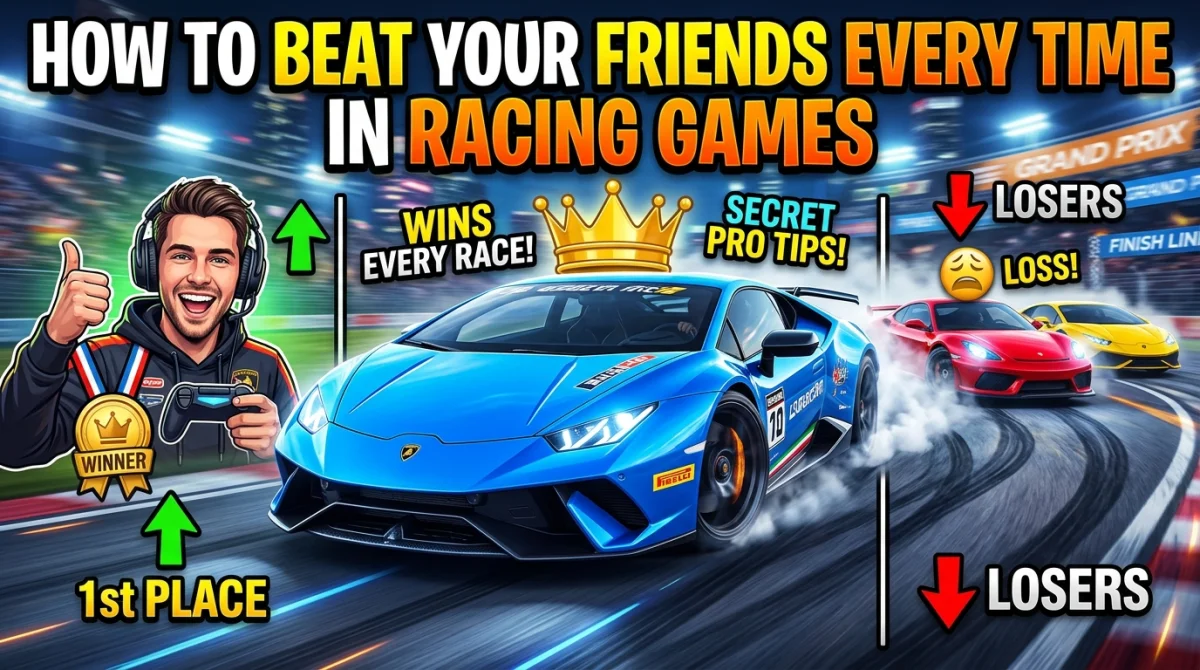
Your friend keeps winning. Not because they have better reflexes, but because they know the track, they brake earlier than you, and they picked a car that suits the circuit. All of that is learnable.
By the end of this guide you'll have a repeatable process: learn a track properly, tune the car to your driving style, defend a lead without crashing, and win the mental battle before the lights go out. Give it a couple of evenings of focused practice (roughly 2 to 4 hours total, spread across a few sessions) and you'll notice the gap closing. In most pick-up races against friends, that's enough to start finishing ahead.
What you need before you start
Nothing expensive. Here's the honest list:
- A game you'll actually stick with for a week. Switching titles every night is the fastest way to stay average at all of them.
- A controller or wheel you're comfortable with. A wheel is not mandatory; plenty of very fast players use a pad.
- A way to record your own gameplay. Console share features or OBS (free) on PC. You cannot fix what you cannot see.
- Headphones. Engine and tyre audio tell you more about grip than the screen does.
- 20 to 30 minutes per session where nobody is talking over you.
- Ideally, a practice mode or time trial with no traffic. Most racing games have one.
Step 1: Pick one car and one track, and stop changing them
Before you race your friends again, spend one session on a single car and a single circuit. Drive 15 to 20 laps. Boring? Yes. Effective? Extremely.
Why it matters: competitive racing is mostly pattern recognition. Your friends are beating you because they recognise the corner before it arrives. Changing cars every race resets that learning to zero.
Practical tip: keep a note on your phone with the lap number where you first feel the car slide, and which corner it is. That's your priority list for next session. Approximate time: 30 to 40 minutes. Approximate cost: nothing.
Step 2: Learn the track in three passes, not one
Don't try to be fast on lap one. Break the circuit into three learning passes:
- Sight lap. Slow, no braking points. Just note corner order, kerbs, and where the track narrows.
- Braking lap. Pick a brake marker for every corner (a kerb, a sign, a shadow, a specific barrier). Write them down.
- Commit lap. Brake at your markers every time, even when it feels too early. Consistency beats heroics.
Why it matters: your friends aren't braking later than you. They're braking in the same place every lap, so they can build speed from a stable base. You're guessing, lap after lap.
Practical tip: use a fixed visual reference, not a distance. "Just after the third white line" is repeatable; "about here" is not. If you want more structured drills for building habits like this, the rank-up competitive guides hub has more of this kind of thing.
Step 3: Fix your braking before you chase top speed
Most amateur losses happen on entry, not exit. If you're overshooting corners, you're braking too late and then fighting the car for the rest of the lap.
Why it matters: a clean entry means you can get on the throttle earlier, and exit speed carries down the whole straight. One good exit is worth more than a few km/h of top speed.
Practical tip: for one session, deliberately brake about 10 to 15 percent earlier than you think you need to. You'll feel the car settle. Then move the marker forward in small steps until you find the limit. Approximate time: 20 minutes.
Step 4: Tune the car to your hands, not to a forum post
Copy-pasting someone else's setup is a trap unless you drive exactly like them. Start with the default setup and change one thing at a time.
A rough order that works in most racing games (verify in your specific title, since the menus differ a lot):
| Change | Try this first | What it fixes |
|---|---|---|
| Brake bias | Shift slightly rearward | Car won't rotate on entry |
| Tyre pressures | Small adjustment, one end at a time | Car feels floaty or snappy |
| Downforce | More rear for stability | Loose on fast corners |
| Gearing | Lengthen for long straights | Hitting the limiter too early |
Why it matters: a car you trust lets you brake later. A car you don't trust makes you cautious, and caution loses races.
Practical tip: change one setting, do five laps, and note whether the car got easier or harder to place. If you can't feel a difference, revert it. Don't stack three changes at once.
Step 5: Learn to defend without losing time
When you're ahead, the goal changes. You're not trying to be fastest anymore, you're trying to make passing you expensive.
Why it matters: most friends lose a lead by defending too hard, running wide, and handing the place back.
Practical tip: cover the inside line into the corner before they're alongside, not after. Then get back on the racing line as early as you safely can, so you don't lose exit speed. If they're already alongside, give room. A crash costs you both, and if you're leading, a crash costs you more.
Step 6: Watch your own replay, once, with a purpose
Record a race, then watch it back at normal speed. Look for one thing only: where did you lose the most time? Usually it's one or two corners.
Why it matters: you can't fix a lap you can't see. Replays expose the lazy habits you don't notice while driving, like turning in too early or coasting through the middle of a corner.
Practical tip: pause at the apex of your worst corner and compare it to a clean lap. The difference is usually your steering input, not your speed. Approximate time: 10 minutes per race.
Step 7: Race the clock, not your friends
Time trial is where you get faster. Multiplayer is where you get tested. Keep them separate.
Why it matters: racing friends makes you reactive. Racing the clock makes you deliberate. You need both, but the deliberate part is what raises your ceiling.
Practical tip: set a target of beating your own best lap by a small margin each session, not by a huge leap. Steady gains stack. If you want a low-stakes way to warm up your hands and eyes before a session, the free browser-games hub is handy for a quick five minutes.
Step 8: Control the start and the first lap
A huge share of casual races are decided in the first 30 seconds. Nail the launch and you're fighting for position instead of recovering from it.
Why it matters: driving in traffic costs time. Getting clean air early means you can run your own pace.
Practical tip: practice race starts specifically, five or six times in a row. Learn the exact moment to apply throttle in your game (it's rarely "hold it flat"). Then, on lap one, brake earlier than your markers. Cold tyres and a full field are a bad combination.
Pro tips
- Brake in a straight line, turn after. Trail braking is fast, but only once you're consistent. Get the basics right first.
- Look two corners ahead. Your hands follow your eyes. Staring at the corner you're in makes you late for the next one.
- Turn off the racing line assist once you know the track. It teaches you the wrong braking points for your car.
- Use the daily challenge habit. Short, repeated attempts at one thing build muscle memory faster than long sessions. The daily challenge is a decent low-pressure way to keep the reps up.
- Learn one rival's habits. If your friend always dives up the inside into turn three, you know exactly where to cover.
- Change your camera view for one session. It forces you to relearn reference points, and you'll often spot a better line you'd stopped seeing.
Common pitfalls
Chasing the fastest setup before you can drive the default. You'll blame the car for your mistakes. Fix your braking points first, then tune.
Practising only in races. Racing friends is testing, not training. You need quiet laps to actually improve.
Braking later every lap instead of at the same point. That's not progress, that's gambling. Repeatable markers win races.
Ignoring tyre temperature and wear. In games that model them, cold tyres will bite you on lap one and worn tyres will betray you at the end. Learn the warning signs in the audio and the handling.
Over-defending and losing the place anyway. If you're slower, you'll lose the position eventually. Defend cleanly and keep your race intact rather than crashing out of spite.
Useful resources
- Your game's built-in time trial and replay tools. Free, and the most underused feature in racing games.
- OBS Studio for recording on PC (free), or your console's share button.
- Official game subreddits and forums for setup discussions, keeping in mind that setups are personal.
- The tips, tricks and guides hub for broader mechanical advice that transfers across genres.
- The gaming deals and free games hub if you want to try a different racing title without spending much.
FAQ
How long until I actually beat my friends? If they're casual players, a few focused sessions is often enough. If they're genuinely quick, expect a few weeks of deliberate practice. There's no shortcut past learning the track.
Do I need a racing wheel to win? No. A controller is competitive in most multiplayer racing games. A wheel adds immersion and finer input, but it won't fix bad braking points.
Is it cheating to use assists? That depends on your group's rules. If assists are allowed in the lobby, use them. If you're serious about improving, wean yourself off the racing line assist first, since it teaches you someone else's braking points.
What's the single fastest improvement I can make? Pick consistent braking markers and brake at them every lap. It sounds dull. It works.
How do I stop choking when I'm leading? Stop thinking about winning and focus on your next braking marker. Narrow attention kills nerves. Also, defend the inside early and give room when you're beaten, so you don't throw away a good result.
One last thing
You don't need to be the fastest driver in the lobby. You need to be the one who makes the fewest avoidable mistakes. Learn one track properly this week, fix your braking, and watch what happens next time you load up a race with your friends. Then come back and tell us how it went.
Ready to play?
Puzzle, arcade, 3D, word & sports games for every age — instant play, no registration.
Comments
No comments yet. Be the first to share your thoughts!