How to Learn Any Racing Track Like a Professional Driver
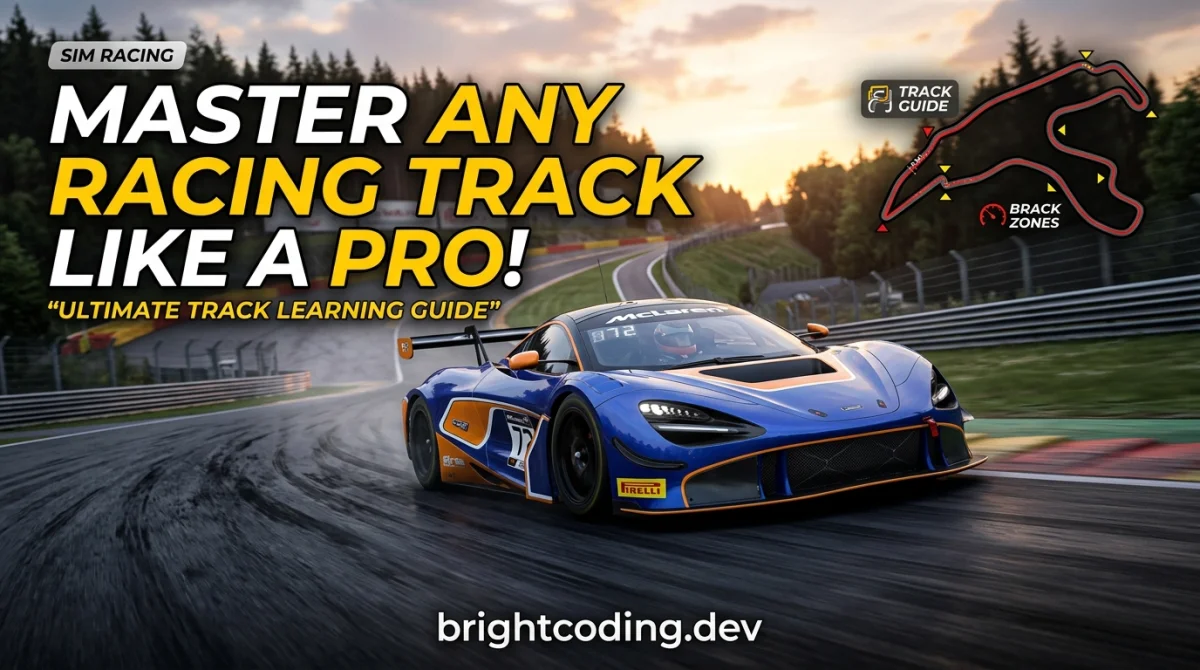
You can learn a new racing track well enough to be quick and consistent in roughly 30 to 60 minutes of focused practice. Not world-record quick, but quick enough to stop guessing which way the next corner goes and start actually racing.
By the end of this guide you will know a repeatable process: how to read a circuit on your first lap, build a mental map, find your braking points, and lock it all in so the layout sticks in your memory instead of leaking out the next day. It works on Gran Turismo, Assetto Corsa, iRacing, F1 games, Forza, and anything else with four wheels and a lap timer.
What you need before you start
- A track you can run alone, ideally in a practice or time trial mode with no traffic.
- Telemetry or at least a lap delta display. Most sims have this built in; check your HUD settings.
- A way to record your laps (console capture, OBS, ShadowPlay, or the game's own replay export).
- A ghost or reference lap, either your own best or a known clean lap you can load.
- About an hour, split into short sessions. Twenty minutes three times beats two hours straight.
No special gear required. A controller is fine. A wheel helps with precision but it will not teach you the track for you.
Step 1: Do a slow lap and just look around
Forget lap times. Drive at maybe 60 to 70 percent of what feels fast, and treat the first lap as a sightseeing trip. Your only job is to notice what the corners actually do.
Why it matters: most people's first ten laps are wasted because they are reacting to corners they have never seen. If you already know a corner tightens at the exit, you brake earlier the first time you arrive at speed.
Practical tip: say the corner shape out loud. "Right, right, tightens." Naming it forces you to actually process it instead of staring at the tarmac two meters ahead.
Step 2: Break the track into named sections
A 5 km circuit is too much to hold in your head at once. Six to ten sections is not. Divide it by landmarks: the long straight, the hairpin complex, the fast esses, whatever the layout gives you.
Why it matters: pro drivers do not memorize 40 corners, they memorize a handful of sequences. Chunking is how your brain stores the lap.
Practical tip: use real corner names when you can find them (most tracks publish a map), and invent your own for the rest. "The one that looks like a shopping trolley" is a perfectly good name if it works.
Step 3: Find your braking reference for each corner
This is the single biggest time saver. Pick a fixed object before each braking zone: a marker board, a tree, a patch of different-colored kerb, a bridge shadow. Not "about here."
Why it matters: braking points are what separate a clean lap from a scrappy one, and they only work if they are repeatable. A reference you can hit within a meter every lap is worth more than a perfect one you cannot find twice.
Practical tip: start conservative. Brake a car length early, then move the reference forward one small step at a time until you start running wide. Then back up one step and stay there.
Step 4: Learn the corners in reverse order
Here is the one most people skip. After you have a rough idea of the lap, work backwards from the last corner to the first.
Why it matters: the exit of one corner decides the entry of the next. If you learn the final corner first, you instantly know how much speed you can carry out of the second-to-last, and so on. It is how you build a lap that flows instead of a lap that is fast in isolated pieces.
Practical tip: spend a full session on just the last two corners. It feels weird. It works.
Step 5: Run short stints and reset often
Do five clean laps, then stop and take a minute. Repeat. Do not grind forty laps in a row hoping one sticks.
Why it matters: your concentration falls off a cliff after a few laps, and tired laps teach you bad habits as strongly as good ones. Short stints with a reset keep the quality high.
Practical tip: if you crash twice in a row, pit and take a breath. Frustrated driving is just rehearsing mistakes.
Step 6: Watch your own replay next to a faster lap
Load a reference lap and compare it to yours, corner by corner. You are looking for two things: earlier braking than you thought, and different lines through the slow stuff.
Why it matters: you cannot feel a tenth of a second, but you can see it. Side-by-side comparison turns vague "I am losing time somewhere" into "I am losing it at turn four."
Practical tip: if you are new to reading replays, our guide on the tips, tricks and guides hub is a decent starting point for building that habit across other games too.
Step 7: Add one change per lap, no more
Pick a single thing to improve, do it for three laps, then pick the next. Braking point at turn one, then line through turn three, then throttle timing at turn seven.
Why it matters: changing three things at once means you cannot tell which one helped. One variable at a time is slower to feel, faster to actually learn.
Practical tip: keep a note on your phone. "T1 brake at the 100 board, T5 turn in later." Written notes survive; memory does not.
Step 8: Raise the difficulty, not the track count
Once you can run ten consistent laps, add traffic, weather, or a faster car. Do not jump to a brand new circuit yet.
Why it matters: consistency under pressure is the actual skill. A track you know cold with a car you do not is a better test than a fresh track with a car you have mastered.
Practical tip: this is also the step where rank and rating systems start rewarding you. Our rank-up competitive guides cover how to translate raw pace into results when it counts.
Step 9: Sleep on it and come back
Do not judge a new track on day one. Come back the next day and run five laps cold.
Why it matters: your brain consolidates motor patterns overnight. The lap that felt impossible yesterday often feels obvious today, and that is not luck, it is how learning works.
Practical tip: if you only have twenty minutes on day two, use them here. It is the highest-value twenty minutes you will spend on a new circuit.
Pro tips
- Brake in a straight line, then turn. Trail braking is a skill to add later, not a tool for learning a track. Get the basics boring first.
- Use the visual width of the track. Pros often turn in earlier than you expect because they use the full width on entry. Your line is probably narrower than it needs to be.
- Turn your HUD off for a few laps. Without the timer staring at you, you will naturally drive smoother, and smoother is faster.
- Learn the pit entry and exit. Sounds dull, but knowing how to rejoin cleanly after a mistake saves you a lap every session.
- Pick one car and stay in it. Switching cars while learning a track doubles the variables and halves the learning.
- Short-shift out of slow corners. In most sims it settles the car and prevents wheelspin on exit, and it costs you almost nothing.
Common pitfalls
Chasing the leaderboard too early. A world-record ghost will teach you nothing if you cannot even hit the braking boards yet. Use a ghost that is close to your own pace, then graduate.
Memorizing corners instead of sequences. If you know turn nine but not what leads into it, you will keep arriving at it badly. Learn the flow, not the list.
Grinding when tired. Forty sloppy laps undo twenty good ones. Stop when your hands get lazy.
Skipping the slow lap. Everyone wants to go fast immediately. The sightseeing lap is the cheapest time you will ever spend on a new circuit.
Never reviewing. Driving without watching your replay is like studying without checking answers. You will repeat the same mistake for hours and call it "practice."
Useful resources
- Your sim's built-in telemetry, delta bar, and replay tools. Free, and usually better than you think.
- Official track maps and corner names, often published by the circuit or the game's own track guide.
- Community telemetry comparison sites for your specific sim, if you want data beyond your own laps. Availability varies by game, so verify what works for yours.
- Our free browser games hub if you want a low-pressure way to practice car control between serious sessions, and the GamingUp blog for more of this kind of breakdown.
FAQ
How long does it take to learn a new track? For a rough, safe lap: 20 to 30 minutes. For a genuinely quick and consistent lap: several hours spread over a few days. Complex circuits like the Nordschleife take far longer, and that is normal.
Do I need a wheel? No. A controller is fine for learning layouts and braking points. A wheel makes fine inputs easier, but it will not replace the process above.
Should I learn one track at a time or rotate? One at a time until you are consistent, then rotate. Rotating early feels productive but slows the learning, because you never get the overnight consolidation working in your favor.
How many laps before I move on? When you can run ten laps within a second of each other without crashing. That is your signal that the track is in your head, not just your hands.
Does this work for arcade racers? Yes, the process is the same. Arcade games are more forgiving on braking points, so you can move through the steps faster, but the order still holds.
Go learn one
Pick a track you have always avoided because it looked intimidating. Give it the hour. Run the slow lap, name the sections, find your boards, and come back tomorrow. You will be shocked how much of it your brain quietly sorted out while you slept. Then go find a friend who thinks they are fast and enjoy the next race.
Ready to play?
Puzzle, arcade, 3D, word & sports games for every age — instant play, no registration.
Comments
No comments yet. Be the first to share your thoughts!