10 Hidden Driving Skills That Transfer Between Every Racing Game
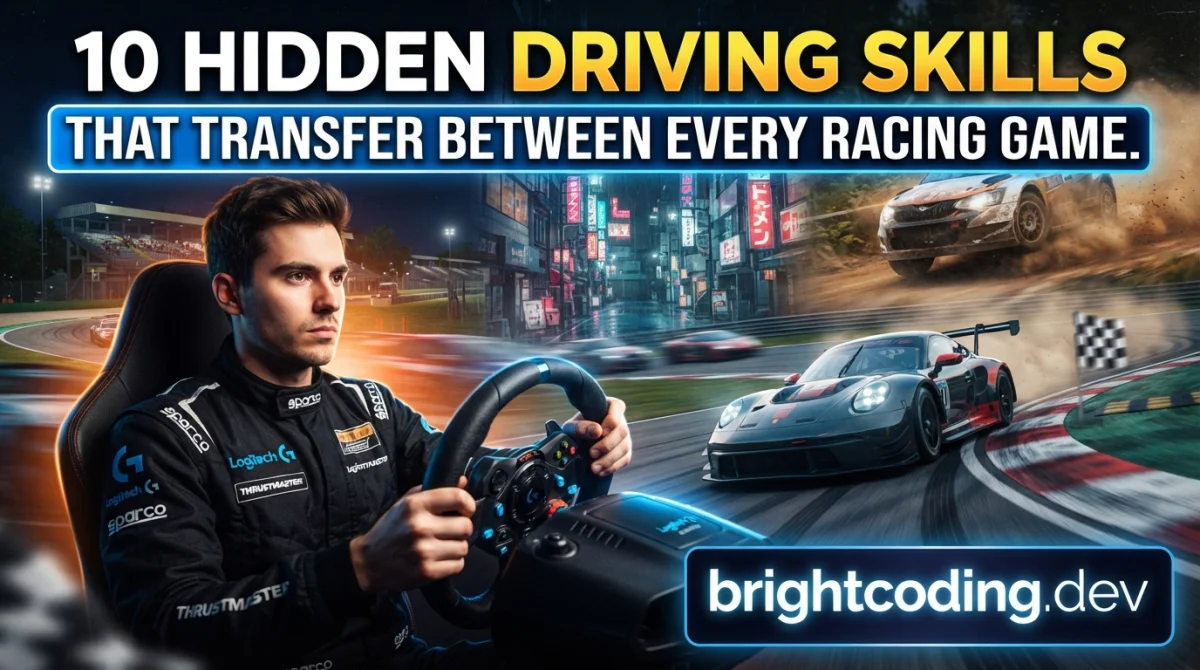
10 Hidden Driving Skills That Transfer Between Every Racing Game
I clipped the same wall three times in a row on a rainy hairpin, and on the third try I caught myself lifting off the throttle a heartbeat before the tires even thought about sliding. Nobody taught me that. It just showed up, the way a song lyric you heard once comes back years later. That was the moment I realized the hours I'd sunk into one racing game were quietly paying off in a completely different one.
I'm not fast. I'll say that now. But I've logged enough time across arcade racers, sims, rally games and the browser stuff I play with a coffee going cold on the desk to notice something: a handful of skills keep following me from game to game like a stray dog. Here are the ten I actually feel working.
The backstory
I started on arcade racers as a kid, the kind where you drift by mashing the handbrake and the game forgives almost everything. Years later I tried a proper sim, got humbled, and quit for a month. When I came back I expected to start from zero. Instead, weird fragments stuck. Braking before the corner, not in it. Looking where I wanted the car to go. Being gentle on the wheel.
That gap between "I should be bad at this" and "actually I'm sort of okay" is what this piece is about.
The ten skills, told through the moments I noticed them
1. Braking in a straight line before you turn
I learned this the hard way in a sim on PC, probably around the twenty-hour mark, after spinning into a gravel trap for the dozenth time. The trick is boring: get most of your slowing done while the wheel is straight, then turn in. It sounds like nothing. It changes everything. Every racing game rewards it, from hardcore sims to the loose arcade stuff on the free browser-games hub, because physics engines all agree on one thing: tires can grip or they can turn, but asking for both at once is how you end up facing backward.
2. Looking where you want to go, not at the wall
For a week I kept hitting the same barrier on a rally stage. I was staring right at it, willing myself not to touch it. Guess what happened. When I finally forced my eyes down the road to the exit, the car followed. Your hands copy your eyes. It's the single cheapest skill to practice and it works in every racer I've touched. If you only fix one habit, fix this one. There's more of this kind of thing in the tips, tricks and guides hub if you want to go deeper.
3. Throttle control is a dimmer switch, not a light switch
Early on I drove every car like it had an on/off button. Full gas or full brake, nothing between. The moment I started feeding the throttle in gradually, especially out of slow corners, my lap times dropped without me getting any braver. Most modern racers, sim or arcade, model weight shifting, so a smooth squeeze keeps the rear planted. Mashing it spins you. Same lesson, different game, every time.
4. Learning a track beats brute force
I used to think getting faster meant driving harder. It doesn't. It means knowing which corner comes next and where the car wants to be. I now spend my first few laps deliberately slow, memorizing braking points and noticing the bumps. It feels like wasting time. It isn't. This is the same skill that carries into the daily challenge when you get a track you've never seen, because you already know how to read a corner instead of panicking at it.
5. Reading the car's weight, not just the speedometer
There's a feeling when a car's weight shifts to the outside and the nose goes light. You can sense it through the controller or wheel even in arcade games with forgiving handling. Once you notice it, you start using it: lifting slightly to rotate, easing off to settle the rear. I can't fully explain it in words, and I've stopped trying. It's a feel thing, and it transfers because it lives in your hands, not the game's code.
6. Smooth inputs beat fast inputs
My early laps looked like a nervous tic: constant tiny steering corrections, jerky braking. A friend watching over my shoulder said, "You're fighting the car." That stung, but he was right. Smooth steering, one clean input instead of five panicked ones, made me quicker and less tired. I could suddenly do a longer session without my thumbs aching. That's not a small thing when you're grinding a ranked ladder, and the rank-up competitive guides make the same point in their own way.
7. Managing your tires and fuel (or whatever the game calls stamina)
Not every racer has tire wear, but the ones that do teach a transferable patience. I learned to stop going flat out for the first half of a race and to save a little grip for the end. That mindset carried into games with fuel limits, into arcade racers with boost meters, even into how I pace a long session. Conserve early, attack late. It applies almost everywhere once you've felt the payoff.
8. Restarting is a skill, and so is not restarting
I had a bad habit of hammering restart the instant I made a mistake, which meant I never learned to recover. The real skill is salvaging a ruined lap: getting the car pointed the right way, calming down, carrying on. Games with damage and long races force this on you. Arcade games let you get away with restarting forever, and honestly that's a trade-off. The forgiveness is nice, but it can hide a weakness. Practicing recovery in the stricter games made me a calmer driver everywhere.
9. Learning a new handling model fast
Every game has its own personality. One car understeers like a shopping trolley, another snaps its tail out at the mere suggestion of a corner. The transferable skill isn't knowing any specific car. It's the routine you run to figure out a new one: a few gentle laps, push a little, find the limit, back off, push again. I now do this automatically, and it means jumping between genres doesn't scare me the way it used to. If you're curious how different genres weight these skills, the game genres explained hub is a good place to see the landscape.
10. Patience with yourself
This one sounds soft. It isn't. Racing games punish frustration, because a tense driver makes tense inputs and tense inputs make mistakes. The single biggest improvement I made was learning to take a breath after a bad lap instead of trying to "fix it" with anger. That's the skill nobody lists. It's also the one that took me the longest, and the one I'm still working on.
Honest pros & cons
The upside of these transferable skills is real: once you have them, a new racing game stops feeling like a mountain. You get a head start on the learning curve, and that early competence is genuinely fun.
The downside is that some games actively spoil you. Forgiving arcade handling lets sloppy habits slide, and if that's all you play, you'll plateau without noticing. I've also found that skills transfer unevenly. Reading weight and braking points travels well; specific car setups and tuning knowledge mostly don't. And there's a quiet trap: assuming you're good at a new game because you were good at the last one, then getting smug and spinning into a wall on lap one. Ask me how I know.
What I learned
- The skills that transfer are the boring ones. Braking, looking ahead, being gentle. Nobody puts those on a poster.
- Feel beats theory. I can read about weight transfer all day, but my hands only learn it by driving.
- Forgiveness in a game is a gift and a crutch. Use it, but don't only play forgiving games.
- Recovery matters more than the perfect lap, because perfect laps are rare and mistakes are constant.
- Patience is a driving skill. I resisted that idea for years. I was wrong.
Quick practical tips
- On a new track, do three deliberately slow laps before you try to be fast.
- If you keep hitting something, look further down the road, not at the obstacle.
- Brake before the corner, not during it, until it becomes automatic.
- When you spin or crash, finish the lap anyway. Practice the recovery.
- Swap genres now and then. A rally game will teach you things a circuit racer won't.
- Warm up with a few minutes of easy driving before a serious session, the same way you'd stretch.
FAQ
Do these skills really carry over from arcade games to sims? Partly. The mental habits (braking points, looking ahead, smooth inputs) carry over well. The specific feel of a car doesn't, so expect to relearn handling even if your instincts help.
How long before the transferable skills actually show up? In my experience it's gradual. You'll notice small things after a few sessions in a new game, not after one. Give it roughly a dozen hours before you judge yourself.
Does a wheel and pedals matter for learning these? It helps with throttle and steering feel, but it's not required. I learned most of this on a controller. A wheel is a nice upgrade if you're serious; expect around a few hundred dollars for a decent entry-level setup, though prices move, so check current listings.
Which game should I start with to build these skills? Any game you'll actually keep playing. Motivation beats optimization. If you want something free to warm up, the browser games are a low-pressure place to practice looking ahead and staying smooth, and the blog has more write-ups like this one if you want to keep going.
I still clip that rainy hairpin sometimes. But now I know why, and I know what to do about it, and that quiet little bit of knowing is the whole reason I keep coming back.
Ready to play?
Puzzle, arcade, 3D, word & sports games for every age — instant play, no registration.
Comments
No comments yet. Be the first to share your thoughts!