Cockpit View vs Chase Camera: Which Is Better for Racing?
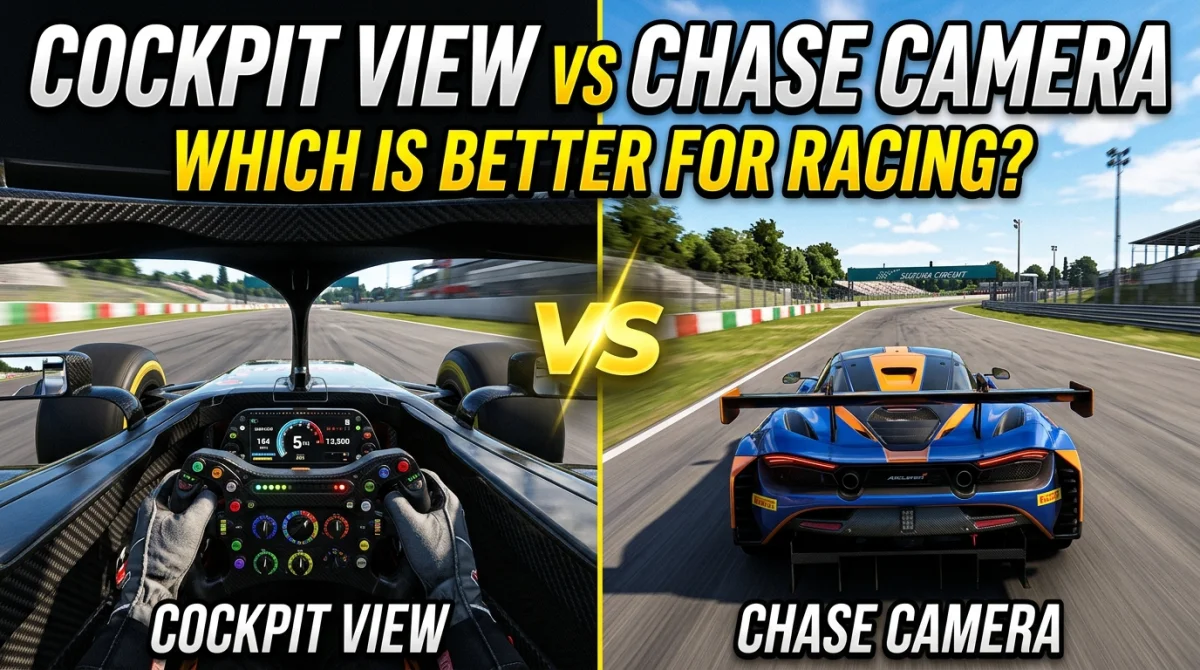
Cockpit View vs Chase Camera: Which Is Better for Racing?
You are three corners from the finish, the car is starting to slide, and you have a split second to decide whether to correct or commit. What you see in that moment depends entirely on which camera you picked in the options menu. That is the real weight of this choice. It is not cosmetic. It changes how the car feels, how early you spot trouble, and how quickly you learn a track.
The dilemma is simple on paper: sit inside the car and look through the windshield, or float behind the bumper where you can see everything. In practice, most racing games default you into one and you never think about it again, which is a mistake. Let us look at what each camera actually gives you, where it hurts you, and which one fits the way you play.
Cockpit View: Immersion With a Blind Spot
Cockpit view puts you behind the wheel, dashboard in front of you, mirrors at the edges of the screen. In games with strong audio and detailed interiors, it is the most convincing way to drive. You feel the suspension move, you hear the engine right in your ears, and a good corner feels earned because you had to read it through a narrow window.
The trade-off is information. You see less of the road ahead and almost nothing to your sides. Your mirrors help, but in a tight pack they are small and easy to miss. On a single monitor, the sense of speed can also feel lower, because the car body stays mostly still while the world moves. That can make you brake later than you should until you learn the track.
Cockpit view tends to reward players who already know a circuit. If you have done fifty laps of the same layout, the limited view stops being a problem because you are driving from memory and feel. It is a rough place to start, though.
There is also a hardware angle. A wheel and pedals make cockpit view sing, and that setup is not cheap. A decent entry-level force-feedback wheel plus pedals typically runs somewhere in the region of 200 to 400 dollars or euros depending on brand and region, and it climbs fast from there. Treat those numbers as a rough guide and check current prices, since they move. If you are not ready to spend that, cockpit view still works on a controller, it just loses some of its magic.
Chase Camera: All the Information, Less of the Feel
The chase camera, sometimes called third-person or bumper-adjacent view, floats behind and above the car. You see your vehicle, the road ahead, and a chunk of what is happening around you. For most players this is the default for a reason: it is forgiving. You spot a corner earlier, you see traffic in a pack race, and you can judge the car's rotation because you can see the whole body.
It is the better teacher. If you are learning a new track or a new car, the chase camera shows you your mistakes. You can see understeer and oversteer as they happen, not just feel them through your hands. That feedback loop matters when you are trying to get faster, and it pairs well with the kind of deliberate practice we cover in the rank-up competitive guides.
The cost is immersion and, for some, precision. The camera lags slightly behind the car's movement, which can make fine corrections feel a touch disconnected. Hardcore sim racers often find it floaty. And the sense of being in the car is gone. You are watching a car, not driving one.
Chase camera is also the friendlier option for shared screens and casual sessions. Hand a controller to a friend who has never played the game and they will cope far better in third person than staring at a dashboard they cannot interpret.
The Criteria That Actually Decide It
Forget brand loyalty and forget what the pros use. Four things matter when you pick a camera, and they pull in different directions.
Visibility and awareness. Chase camera wins outright. More of the road, more of the pack, fewer surprises.
Immersion and feel. Cockpit view wins. The car has weight and presence, and the audio lands correctly.
Learning speed. Chase camera is the better coach early on. Cockpit view rewards knowledge you already have.
Hardware fit. Cockpit view benefits most from a wheel and a larger screen or triple-monitor setup. Chase camera is comfortable on a controller and a modest display.
One more factor worth naming: motion sickness. Some players get queasy with cockpit view because the horizon tilts and shakes close to their eyes. Others find the chase camera's swinging motion worse. There is no rule here. Try both for a few laps and trust your stomach.
Side by Side
| Criterion | Cockpit View | Chase Camera |
|---|---|---|
| Road visibility | Limited, mirrors help | Wide, easy to read |
| Awareness of nearby cars | Tight, easy to miss | Strong |
| Immersion | High | Moderate |
| Sense of speed | Lower on one screen | Higher |
| Learning a new track | Harder | Easier |
| Rewards existing track knowledge | Yes | Less so |
| Best input | Wheel and pedals | Controller or wheel |
| Motion sickness risk | Varies, can be high | Varies, often lower |
| Screen demands | Large or multi-screen helps | Fine on any screen |
| Casual and shared play | Less friendly | Very friendly |
Which One Should You Choose?
No single answer fits everyone, so match the camera to your situation.
If you are casual and play in short bursts, stay with the chase camera. You will spend less time fighting the view and more time racing. It is the lower-friction choice, and friction is what kills a quick session.
If you are chasing lap times and leaderboards, learn on chase and graduate to cockpit once a track is in your head. Many fast players keep both mapped to a button and switch depending on the corner or the race type. That hybrid approach is underrated. A quick look at the tips, tricks and guides hub will show you plenty of other small habits that add up.
If you are on a tight budget, do not let cockpit view talk you into buying a wheel. Chase camera on a controller is a complete, competitive way to play. Spend nothing, enjoy the racing. If you want free racing in your browser without any setup, the free browser-games hub is a good place to test which camera feels natural to you before committing to a purchase.
If you are a parent buying for a kid, pick a game with a solid chase camera and skip the expensive hardware. Kids adapt quickly, and the third-person view keeps frustration low when they are still learning to brake.
If immersion is the whole point, cockpit view all the way, ideally with a wheel. That is the setup that makes a sim feel like a sim.
FAQ
Is cockpit view harder to drive in? Generally yes, at first. You see less and have to rely on mirrors and track memory. Most players adjust within a few hours on a familiar circuit.
Do professional sim racers use cockpit view? Many do, but not all, and it varies by game and discipline. Do not treat any single camera as the "correct" competitive choice. Test both and keep what gives you cleaner laps.
Can I switch cameras mid-race? In most racing games, yes, usually with a button or a quick menu. Mapping it to an easy key lets you use chase for overtaking and cockpit for clean laps.
Does cockpit view make you faster? Not by itself. It can improve consistency once you know a track, because the feel is more direct. On unfamiliar layouts it usually slows you down.
Which camera is better for motion sickness? It depends on the person. Try short sessions in each and stop if you feel off. A wider field of view setting sometimes helps in both views.
Final Takeaway
There is no universal winner here, and anyone who tells you otherwise is describing their own habits. Chase camera gives you information and forgiveness. Cockpit view gives you feel and immersion. The smart move is to stop treating it as a permanent setting. Learn tracks in third person, race them in first, and switch when a corner demands it. If you want more comparisons like this one, the GamingUp blog has plenty, and the daily challenge is a low-stakes way to put your camera choice to the test today.
Ready to play?
Puzzle, arcade, 3D, word & sports games for every age — instant play, no registration.
Comments
No comments yet. Be the first to share your thoughts!