Drag Racing vs Street Racing: How Your Driving Strategy Must Change
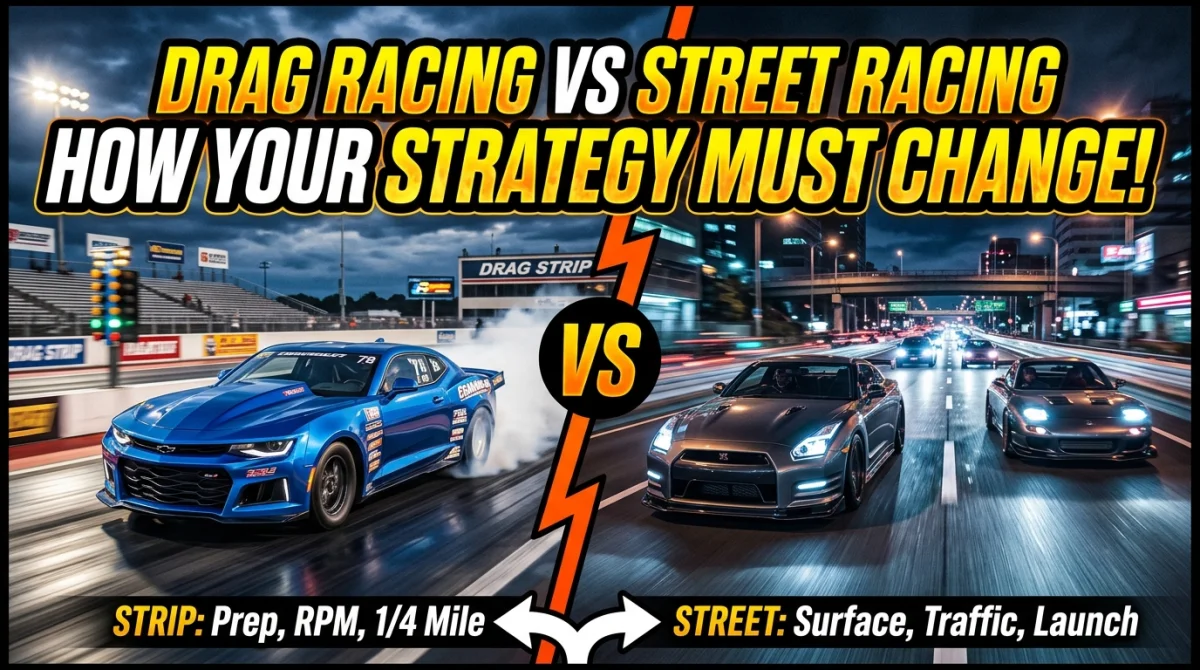
You've watched the videos. Two cars, a stretch of road, a flag. It looks simple until you're the one holding the wheel and realize the prep, the launch, and the consequences are completely different depending on whether there's a timing tower or a stoplight.
This isn't a moral lecture, and it's not a tutorial on breaking the law. It's about the actual strategic shift between drag racing and street racing: why the same car and the same driver can feel unbeatable in one and completely lost in the other. Whether you're a sim racer trying to understand the discipline, a fan figuring out what you're watching, or someone who wants to stop guessing at the line, this breaks down how your approach has to change.
What Actually Changes Between Drag Racing and Street Racing?
Drag racing is a measured, repeatable sport. You get a prepped surface, a defined distance, timing equipment, and rules. Street racing is improvised. The surface is whatever the road gives you, the distance is whatever you agreed on, and nobody is handing out timeslips.
That single difference, repeatability versus improvisation, rewrites almost everything: how you launch, how you shift, how you read your opponent, and how much margin you leave for error. Most people who struggle at the line aren't bad drivers. They're running a drag racing strategy on a street racing problem, or the reverse.
The Real Problem: You're Driving the Wrong Race in Your Head
Here's the pattern. Someone learns to launch on a prepped strip, where the tires hook and the car goes straight. Then they line up somewhere else, on cold asphalt with a crown in the middle and a little dust, and the same launch spins the tires and they lose by three car lengths. They blame the car. It wasn't the car.
The mistakes cluster around a few things:
- Copying strip techniques (hard launches, aggressive tire pressure, full sends) onto surfaces that can't take them.
- Treating reaction time as the whole game when traction and gearing decide more races than reflexes.
- Ignoring the road surface, temperature, and camber until the car is already sideways.
- Overbuilding power before learning to put down what's already there.
If you're newer to racing games or sims and want the fundamentals first, the tips, tricks and guides hub is a better starting point than any single video.
Why It Happens: The Physics Don't Care About Your Intentions
Two things separate these disciplines more than anything else: grip and information.
Grip. A drag strip is prepped with traction compound so the rubber actually sticks. Street asphalt varies by the meter: sealed patches, painted lines, manhole covers, gravel at the edges, oil in the center of the lane. Your launch has to be tuned to the surface you're on, not the surface you wish you were on.
Information. At a strip you get a Christmas tree, a staged position, and a timeslip that tells you exactly what happened. On the street you get a count, a guess, and a story. You're making decisions with a fraction of the data, which means your strategy has to lean harder on reading the situation before the run even starts.
There's also the human side. Strip racing rewards consistency; you're racing a number as much as a person. Street racing is psychological, and a lot of losses happen because someone let the other driver dictate the terms. More on that below.
The Solutions: Three Ways to Approach It
Option 1: Master Drag Racing Fundamentals First
What it is: Learning the disciplined version, on a strip or in a sim, so you understand launch control, staging, gearing, and how to be consistent.
How it works: You practice the same launch dozens of times, adjust tire pressure and RPM, and use timing data to make small changes. Consistency becomes your edge.
Pros: Repeatable feedback, safe environment, and skills that transfer to any form of straight-line racing.
Cons: Costs add up. A track day entry fee is often in the range of tens to low hundreds of dollars depending on the venue and region (verify locally), plus tires, fuel, and wear. Sim racing is far cheaper and surprisingly close on the mental side.
When it makes sense: Almost always as a foundation. If you can't launch consistently with data, you won't do it without.
Option 2: Build Street-Smart Adaptability
What it is: Training yourself to read the surface, the conditions, and the opponent before you commit to a strategy.
How it works: You walk or drive the stretch first. You check temperature, look for debris and paint, note the crown and any bumps. You dial your launch back to match the grip, then decide whether to win on the launch or the top end.
Pros: Makes you competitive in unpredictable conditions and keeps you out of trouble.
Cons: Hard to practice safely, and the feedback is unreliable because you can't measure what happened. This is where sims and games earn their keep, because they let you rehearse judgment without real-world risk.
When it makes sense: As a mental layer on top of fundamentals. It's the difference between a fast driver and a smart one.
Option 3: Learn It Through Sims and Browser Racing Games
What it is: Using racing games to build reaction time, launch feel, and race reading at near-zero cost.
How it works: You pick a game with realistic launch and shift mechanics, run the same car and track repeatedly, and treat your telemetry or lap times as data.
Pros: Cheap, safe, endlessly repeatable, and genuinely useful for the mental reps. The free browser-games hub has quick racers you can jump into for reaction practice, and the rank-up competitive guides cover the mindset side that transfers to real racing.
Cons: No real consequences, so bad habits can go unpunished. Games also forgive mistakes that real physics won't.
When it makes sense: For anyone learning the strategy without a track budget, or as off-season practice.
The Best Choice Depends on Which Race You're Actually Running
There's no single winner here, because the right approach maps to your situation.
| Your situation | Best starting point | Why |
|---|---|---|
| Total beginner, no track access | Sims and browser racers | Cheap reps, safe mistakes, learn the language |
| Planning real track days | Drag racing fundamentals | Data, consistency, and a controlled environment |
| Want to be sharp in any condition | Street-smart adaptability | Judgment is the skill that travels |
| Competitive sim player | All three, layered | Fundamentals, judgment, and reaction time together |
If you want to actually get fast, stack them: fundamentals first, adaptability second, sims as continuous practice. If you just want to understand the sport better, start with the fundamentals and watch a few runs with a timeslip in front of you. The game genres explained hub is a good place to find racers that model this stuff properly.
Step-by-Step Action Plan
- Pick your discipline honestly. Are you prepping for a strip, a sim, or an unpredictable stretch? Your answer changes everything below.
- Learn the launch before the power. Practice a clean, controlled launch on your surface until it's boring. Boring is repeatable.
- Read the surface before every run. Temperature, debris, paint, camber, and bumps. Two minutes of looking saves a whole run.
- Set your gearing and tire pressure to the grip you have, not the grip you want. If the tires spin, you're already losing.
- Decide your win condition in advance. Launch, mid-range, or top end. Racing without a plan means the other driver picks it for you.
- Use sims for mental reps. Same car, same track, ten runs. Watch what changes when you adjust one variable.
- Review after every run. What actually happened versus what you felt happened. They're rarely the same.
For a daily habit that keeps your reaction sharp, the daily challenge is a low-commitment way to stay in practice.
Common Mistakes to Avoid
- Launching like it's a prepped strip. Fix: dial the launch back to the surface in front of you.
- Racing the other driver instead of the clock. Fix: know your target time and run your own race.
- Skipping the surface check. Fix: walk or drive the stretch first, every time.
- Adding power before mastering traction. Fix: spend a season learning to put down what you already have.
- Letting someone else set the terms. Fix: agree the distance, the surface, and the count before you line up.
- Treating games as pure fun. Fix: treat a few runs as deliberate practice and review them.
- Ignoring your own nerves. Fix: build a short pre-run routine you repeat every time.
Expert Takeaway
The single most important lesson: drag racing rewards consistency, street racing rewards adaptability, and the fastest way to lose is to bring one mindset to the other discipline. Learn to launch like a pro, then learn to read the road like a survivor. The drivers who win in both are the ones who change their strategy before the flag drops, not after.
FAQ
Is drag racing the same as street racing? No. Drag racing is organized, measured, and run on a prepped surface with timing equipment. Street racing is unsanctioned and unpredictable. The strategies share some DNA but demand very different decisions.
What's the biggest strategic difference at the launch? Grip. A strip's prepped surface lets you launch harder. On the street, a hard launch usually just spins the tires, so you have to be gentler and more precise.
Can I practice racing strategy without a real car? Yes. Sims and browser racing games build reaction time, launch feel, and race reading at almost no cost. They won't replace real seat time, but they're excellent for mental reps.
How long does it take to get consistent at launching? It varies wildly by driver and practice volume. Many people see real improvement after a handful of focused sessions with feedback, but consistency over many runs takes longer. Don't trust anyone who promises a fixed timeline.
Do I need expensive gear to start? No. Sim racing can start cheap, and track days cost more but don't require a race car. Set a realistic budget, verify local track fees, and spend on tires and seat time before power.
If you want to keep sharpening the mental side between real runs, the GamingUp blog and the best games ranked lists are worth a browse.
Ready to play?
Puzzle, arcade, 3D, word & sports games for every age — instant play, no registration.
Comments
No comments yet. Be the first to share your thoughts!