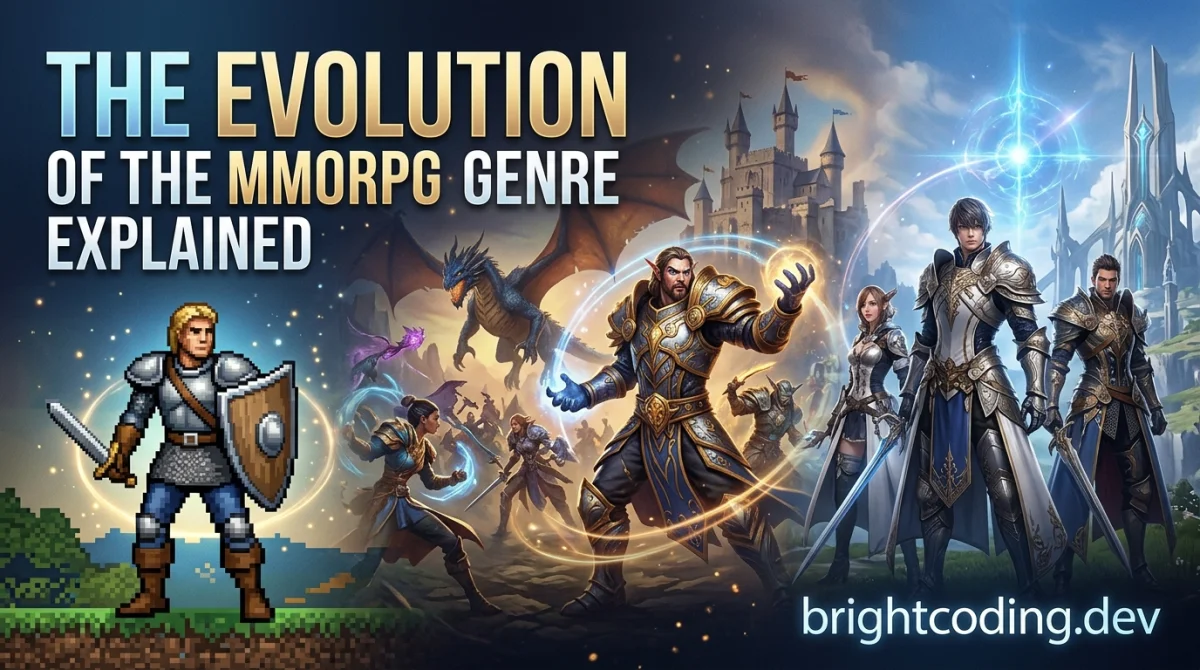
The Evolution of the MMORPG Genre Explained
Keep reading: Why Mobile Gaming Keeps Stealing PC and Console Players, Why Live-Service Games Keep Shutting Down What's Next, Cross-Platform Play in 2026 and the Games That Support It, and Esports Scenes to Watch This Year 2026 Guide.
Logging into a world that kept living while you slept felt like magic, and it still does that is the promise of the MMORPG. An MMORPG, or massively multiplayer online role-playing game, drops thousands of players into one persistent world where they level up, team up, and build lives together. In this guide you will learn how the genre evolved from 1970s text adventures to today's cross-platform live-service giants, and where it is heading next.
Quick answer: An MMORPG is a massively multiplayer online role-playing game where thousands of players share one persistent world, level characters, and team up for dungeons and raids. The genre evolved from text-based MUDs in the 1970s through graphical hits like Ultima Online and EverQuest to World of Warcraft, which still defines the genre. Today's MMOs are cross-platform live services with seasonal content, cosmetics, and console audiences.
What Does MMORPG Actually Mean?
The acronym packs four ideas into one genre: massively multiplayer, online, role-playing, and game. The defining features that set an MMORPG apart from a normal RPG or shooter are:
- A persistent world. The server keeps running whether you are online or not; quests, economies, and other players continue without you.
- Thousands of simultaneous players. You share the world with real people, which is the whole point.
- Character progression. Levels, gear, and skills grow over months or years, giving every login a long-term goal.
- Social systems. Guilds, group finders, trade, chat, and housing turn a game into a community.
- Player economy. Crafted gear, auction houses, and market chaos are player-driven systems the developer only referees.
The Text Origins: From MUDs to the First Graphics
The genre's roots are humble. MUD1 (1978), created by Roy Trubshaw and Richard Bartle at Essex University, was a text-based multiplayer dungeon where players typed commands to explore, fight, and chat. MUD stands for Multi-User Dungeon, and its blend of role-playing and shared worlds is the direct ancestor of everything that followed.
The 1990s added graphics and scale. Neverwinter Nights (1991) brought the formula to AOL subscribers in 2D, while Meridian 59 (1996) is widely credited as one of the first 3D graphical MMORPGs. These experiments proved that a shared graphical world was technically and commercially possible setting the stage for the genre's golden age.
The Golden Age: Ultima Online to World of Warcraft
The late 1990s and early 2000s turned MMOs from a niche into an industry:
| Year | Title | Why It Mattered |
|---|---|---|
| 1997 | Ultima Online | First big hit; famous for its player-driven economy and open PvP |
| 1999 | EverQuest | The game that made MMOs mainstream, with brutal dungeon crawls |
| 2001 | RuneScape | Browser-based accessibility that welcomed millions of casual players |
| 2003 | EVE Online | A single-shard space sandbox famous for player-run empires |
| 2004 | World of Warcraft | Smoothed every rough edge and became the genre's defining touchstone |
World of Warcraft (2004) is the pivot point of the entire genre. It made the game accessible, fun, and social in a way no predecessor had managed, and its raids, talent trees, and auction house became the template every later MMO copied. Nearly two decades later, it still sets the standard against which new MMOs are measured.
The Modern Era: Live Services and Cross-Platform Worlds
The genre has spent the last decade adapting to shifting player expectations:
- Solo-friendly design. Games like Final Fantasy XIV (2013's A Realm Reborn) and Guild Wars 2 (2012) respect your time with dungeon finders, world events, and story you can finish alone.
- Console and cross-platform. MMOs now ship on console, and cross-play between PC, PlayStation, and Xbox is standard for new releases.
- Free-to-play and cosmetic economies. Subscription-only models have given way to free entry with paid cosmetics and battle passes.
- Global launches. Lost Ark (2022 in the West) and Throne and Liberty (2024) launched worldwide on day one, a stark contrast to the staggered regional releases of the golden age.
- Live-service content cadence. Patches, seasonal updates, and expansions keep worlds moving and players subscribed.
The result is a genre that looks very different from 2004: friendlier, cross-platform, and built around a content treadmill, yet still chasing the same dream of a shared world.
The Defining Mechanics of Every MMORPG
No matter the era, every MMORPG leans on the same core systems:
- Leveling and classes. Choose a role, gain experience, and unlock abilities along a class tree.
- Group content. Dungeons, raids, and world bosses that require coordinated teams the social glue of the genre.
- Gear grind. Progress beyond max level lives in item levels, stat tiers, and drop-chasing that motivates daily play.
- Guilds and community. Guild halls, voice chat, and endgame schedules turn strangers into regular raid teams.
- Player-driven economy. Auction houses and crafting markets where prices are set by supply, demand, and occasional market chaos.
How the Genre Keeps Evolving
- Mobile MMOs bring persistent worlds to phones, trading complexity for pick-up-and-play sessions.
- AI companions and systems may fill group roles for solo players, keeping worlds alive for smaller populations.
- Console-native design continues, with controller-first UIs and cross-play becoming table stakes.
- "MMORPG-lite" live games blur the line, borrowing persistent worlds and seasons while dropping the subscription and class systems.
The through-line is clear: each era made the shared world bigger, smoother, and easier to enter, without ever abandoning the social core that defines the genre.
Tips for Picking Your First MMO
- Choose by social scene, not hype. Ask what your friends play; a world is only as good as the people in it.
- Start with a modern game. Final Fantasy XIV and Guild Wars 2 are the friendliest on-ramps for newcomers today.
- Respect the group-finder. Dungeons are smoother with matchmaking, but the best memories come from a consistent guild.
- Ignore the FOMO. Live-service pressure to log in daily burns people out; play on your schedule.
- Try before you subscribe. Almost every major MMO has a free trial that lasts dozens of hours.
Key Takeaways
- An MMORPG is defined by a persistent world, thousands of simultaneous players, and long-term character progression.
- The genre descends from 1978's MUD1 and hit its golden age with Ultima Online, EverQuest, and World of Warcraft.
- Modern MMOs favor solo-friendly design, cross-platform play, and free-to-play cosmetic economies.
- Leveling, group content, gear grind, guilds, and player economies are the genre's core mechanics.
- Final Fantasy XIV and Guild Wars 2 are the best entry points for new players today.
Frequently Asked Questions
What does MMORPG stand for?
MMORPG stands for massively multiplayer online role-playing game. It describes an online game where thousands of players share one persistent world and progress characters together.
What was the first MMORPG?
There is no single first, but Meridian 59 (1996) is widely cited as one of the first graphical MMORPGs, and Ultima Online (1997) was the genre's first mass-market hit. Text-based MUDs from the 1970s are the true ancestors.
Is World of Warcraft still the most popular MMORPG?
World of Warcraft remains the genre's defining game and one of its largest communities, even as Final Fantasy XIV rivals it in active players. current player counts and rankings.
Why did MMORPGs lose popularity?
MMOs did not die they changed. Shorter sessions, solo-friendly design, free-to-play economies, and live-service genres borrowed their best ideas, shrinking the classic subscription MMO audience.
Are MMORPGs free to play?
Many are. Final Fantasy XIV and World of Warcraft use subscriptions (with long free trials), while Guild Wars 2 is buy-to-play and many others are fully free-to-play with cosmetic shops.
Conclusion
From a text dungeon in 1978 to cross-platform worlds with millions of residents, the MMORPG has spent four decades doing the same thing: proving that games are better shared. You now know the genre's history, its core mechanics, and where it is headed. Pick a world, find a guild, and let the shared adventure begin the servers are always on.
Which MMORPG hooked you first, and what keeps you logging back in? Share your story in the comments, send this guide to the friend who keeps asking if MMOs are still a thing, and subscribe for more genre histories and gaming deep-dives.
Ready to play?
Puzzle, arcade, 3D, word & sports games for every age — instant play, no registration.
Comments
No comments yet. Be the first to share your thoughts!