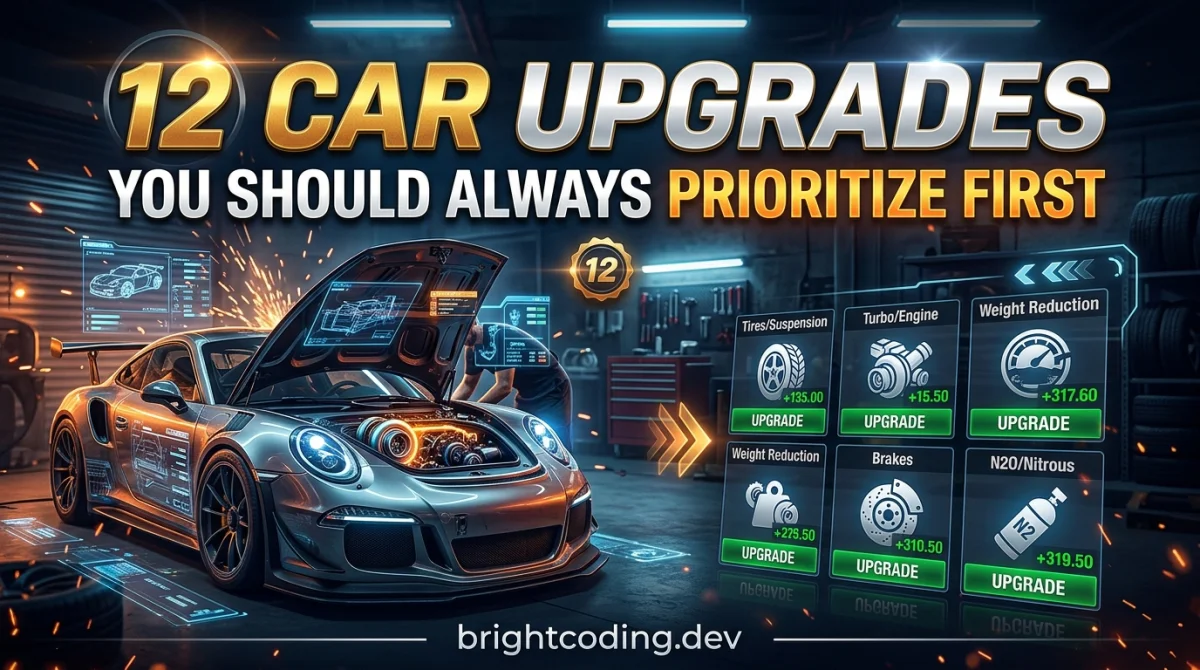
12 Car Upgrades You Should Always Prioritize First
You finally saved enough credits for that shiny new part. You bolt it on, take the car out, and... it feels worse. Slower off the line. Weird understeer in corners. Congrats, you just spent real money to make your ride handle like a shopping cart with a rocket strapped to it.
This article is about the 12 upgrade mistakes that cause exactly that. Read it before you touch the parts shop again.
Why Most People Get This Wrong
Upgrade menus lie to you. They show a green arrow and a bigger number, and your brain says "yes." But a car is a system. Everything talks to everything else, and one loud part can drown out three good ones.
The other problem is order. Games rarely tell you the right sequence, because the whole point is to let you experiment. Experimenting is fun. Experimenting with your last 40,000 credits is not.
So here is the pattern I see over and over, across racing sims, arcade racers, open-world car games and the browser stuff you can jump into during a lunch break. Same mistakes, different logos.
1 - Buying Power Before Grip
You drop a turbo on a rear-wheel-drive starter car. First corner, you are facing the wall you just passed.
People do this because horsepower is the visible, satisfying number. Grip is invisible until you need it. The consequence is a car that is fast in a straight line and terrifying everywhere else.
Fix it by upgrading tires and suspension first, then adding power once the car can actually use it.
2 - Maxing One Part Instead of Balancing the Build
Fully upgraded engine. Bone stock brakes. You will win the drag race and lose the race that matters.
It happens because the upgrade menu rewards completionism, and maxing one bar feels like progress. It is not progress, it is a spike in one stat and a cliff in another.
Spread your budget: every part should sit within roughly one or two tiers of the others before you push any single one to max.
3 - Ignoring Weight
You add a roll cage, a big wing, heavier wheels and a bigger fuel tank. The car is now a brick that corners like a fridge.
Weight is the stat nobody checks and everybody feels. If you are not sure how much a part actually costs you, check a guide before buying. The tips, tricks and guides hub at /category/tips-tricks-guides has breakdowns like this for a lot of popular titles.
Avoid it by asking one question before every purchase: does this make me faster, or just heavier?
4 - Slamming the Ride Height
Lower looks better. Lower is also how you rip your exhaust off on a curb and lose three seconds bouncing off a bump.
People do it for screenshots and stance. That is fine if you are building a show car. It is a disaster if you are building a race car.
Lower it, then raise it back up until the car stops scraping. Function first, then style.
5 - Chasing Top Speed on a Track That Has No Straights
You build a 300 mph monster for a technical circuit with nine hairpins. You will never see the top of fourth gear.
This one comes from reading the stat sheet instead of the track. The consequence is a car that is miserable in every corner and proud of a number it never reaches.
Build for the track you are actually racing. Acceleration and cornering beat top speed on almost anything tight.
6 - Upgrading the Wrong Car
You pour everything into the free starter car because it is what you have. Three hours later the game hands you something better for free.
It happens because early game money feels like it should go somewhere. Patience is boring, and buying is fun.
Check what the game gives you for finishing the next few events before you commit. If a better car is one race away, wait. For games where the early meta is genuinely unclear, browsing the best games ranked lists at /category/best-games-ranked-lists can save you from investing in a dead end.
7 - Forgetting That Tires Are a Wear Item
You buy one set of soft compound tires and never think about them again. Lap 12, you are sliding around on slicks that have turned into soap.
New players treat tires as a one-time upgrade. Veterans treat them as fuel.
Budget for replacements the same way you budget for the part itself, and pick a compound that matches your race length instead of the grippiest one on the shelf.
8 - Tuning by Feel With No Baseline
You change the gear ratios, the camber, the downforce and the brake bias all at once. The car is better. Or worse. You have no idea which change did what.
This is the classic mistake, and it is not about the parts at all. It is about method.
Change one thing, run a lap, compare. If you cannot remember what your car felt like before, you cannot tune it.
9 - Buying Cosmetic Upgrades First
A paint job, neon underglow, a spoiler that does nothing. Your car looks incredible and loses to a stock hatchback.
Cosmetics are genuinely fun, and there is nothing wrong with wanting your car to look good. The mistake is doing it in the first hour, when that money is your entire upgrade budget.
Do the cosmetics last. They are the victory lap, not the qualifying run.
10 - Skipping the Free Stuff
Games hand out free parts, free cars and free tuning unlocks constantly. People ignore them because they are not in the shop with a price tag.
Check your rewards, your event completion screens and your daily login bonuses before you spend anything.
That last one is worth building a habit around. The daily challenge at /games/daily is a good low-effort way to keep a free-currency trickle going in the games that support it.
11 - Copying a Build Without Knowing Why
You find a setup online, paste the numbers in, and the car feels awful. The build was for a different track, a different tire, or a driver who brakes way later than you do.
Copying is a great starting point. Copying blindly is how you end up with someone else's compromises.
Read one line of explanation with every setup you steal. If there is none, treat it as a guess.
12 - Never Testing Your Own Build
This is the quiet one. You finish the build, admire the stat bars, and move on to the next car.
You never actually learn what your upgrades did. So next time, you make the same mistakes.
Do three laps. Note what the car does badly. Change one thing. Repeat. That loop is the whole skill, and it carries between games.
Do This Instead
A quick checklist for your next build:
- Tires and suspension first, power second.
- Keep every part within one or two tiers of the others.
- Ask "faster or heavier?" before every purchase.
- Build for the track, not the stat sheet.
- Change one setting at a time and run a lap.
- Grab every free part, car and currency the game offers.
- Save cosmetics for after the car works.
If you want to practice this on something you can load in a browser tab, the free browser-games hub at /games is a good place to experiment without spending real money on a bad build.
FAQ
Should I ever upgrade a car I know I will replace? Only if the upgrade is cheap, reusable, or the current car is blocking you from earning the better one. Otherwise, wait.
Is maxing out one part ever the right call? Rarely, and usually only when that part is the car's known weak point, like brakes on a heavy car or cooling on a turbo build.
How many laps should I run to test an upgrade? Three is enough to feel a difference. If you cannot feel it in three laps, the change is either too small or in the wrong place.
Do cosmetics affect performance? In most games, no. In some, wings and body panels do add downforce or weight. Check before you assume.
What if I already wasted my money on a bad build? Sell the parts if the game allows it, or just drive the car until you can afford the next one. Most games are forgiving about this.
Where can I find builds for a specific game? Community forums and video guides are usually more current than anything official. Just read the reasoning, not only the numbers.
The short version: grip before power, balance before maxing, and test everything you bolt on.
Ready to play?
Puzzle, arcade, 3D, word & sports games for every age — instant play, no registration.
Comments
No comments yet. Be the first to share your thoughts!