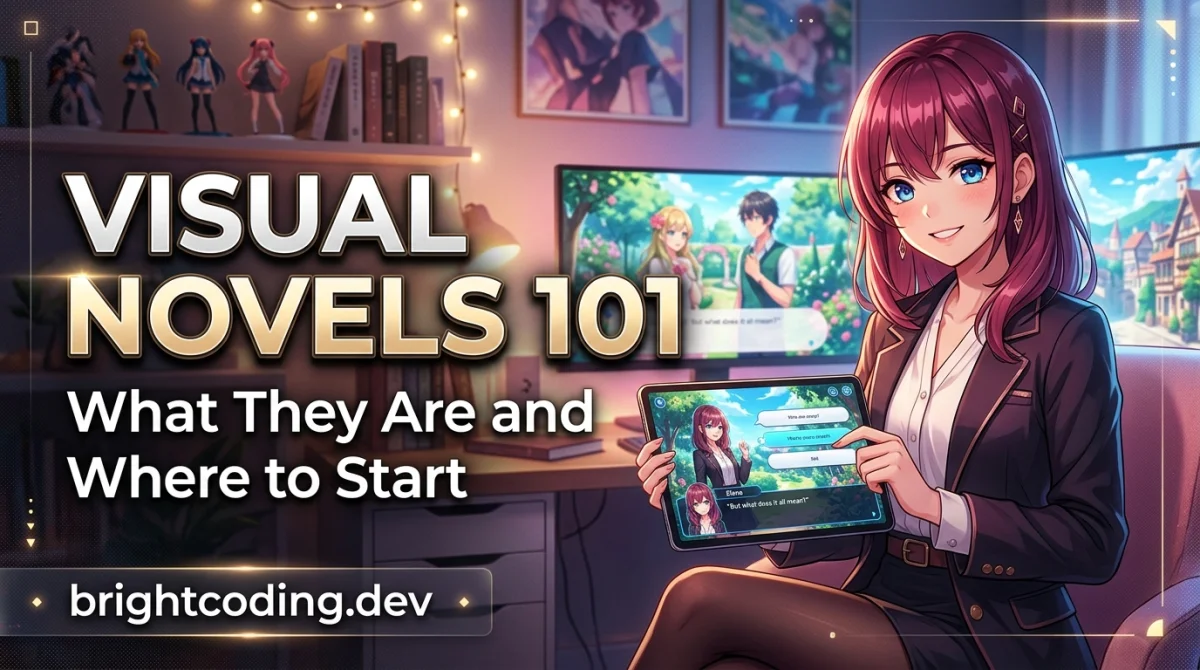
Visual Novels 101: What They Are and Where to Start
Keep reading: What Is a Soulslike? Key Traits That Define the Genre, What Is an Immersive Sim? Genre Explained, How Manga Art Style Shapes Modern Game Design, Don't Make These 6 Mistakes When Starting a New Game,, and What Is a Roguelike? A Beginner's Guide to the Genre.
Anime-styled art, a wall of text, and one decision that quietly rewrites the entire story that is a visual novel, and it is one of gaming's most misunderstood genres. A visual novel is an interactive fiction game driven by text, character art, and branching choices, closer to a digital novel you play than a traditional video game. In this guide you will learn what makes visual novels tick, where the genre came from, its major subgenres, and the best entry points for your first read.
Quick answer: A visual novel is an interactive fiction game that presents its story through text, character sprites, background art, and music, letting you pick choices that branch the narrative toward different routes and endings. The genre originated in Japan, and developer Leaf coined the term "visual novel" in the mid-1990s. Some visual novels have no choices at all those are called kinetic novels while others weave in puzzle, dating-sim, or adventure mechanics.
What Exactly Is a Visual Novel?
A visual novel presents its story through text on screen, character sprites over painted backgrounds, and music, with the player reading and making choices instead of fighting or platforming. Most of the "gameplay" is narrative: you read dialogue, advance with a click, and occasionally pick between choices that branch the story. The experience is closer to a choose-your-own-adventure book than to an action game, which is precisely what makes it so approachable.
- Text box and sprites. Dialogue appears at the bottom of the screen while characters express emotion through portrait changes.
- Choices and routes. Decisions steer you into different character routes, and route order can unlock a final "true" ending.
- Endings. Most of these games have good, bad, and secret endings, which incentivize replays to see everything.
- Reader tools. Backlog, auto-read, skip mode, and quick save make long reading sessions painless.
A Short History of Visual Novels
The genre's roots are Japanese and deep. The Portopia Serial Murder Case (1983), designed by Yuji Horii, is often cited as an early influence a mystery you investigate through menus and text. Chunsoft's Otogirisō (1992) followed with the company's "Sound Novel" branding, pushing narrative-first design further.
The term "visual novel" itself was coined by developer Leaf, which used it for Shizuku (1996) and Kizuato (1996) before To Heart (1997) helped cement the name in the public vocabulary. Studios like Key then shaped the emotional style, with Kanon (1999) and Clannad (2004) defining the "nakige" formula stories engineered to make you cry happy tears.
In the West, the genre went mainstream through freeware and console ports. Katawa Shoujo (2012), a fan-made romance freebie, became a word-of-mouth phenomenon, and Doki Doki Literature Club (2017) exploded on Steam. Hybrid hits like Phoenix Wright and Danganronpa smuggled visual novel structure inside puzzle and mystery gameplay, so most gamers have played a visual novel without realizing it.
Core Mechanics: How a Visual Novel Works
Not every visual novel plays the same, so it helps to know the three main interaction styles:
| Type | How It Plays | Example |
|---|---|---|
| Kinetic novel | No choices read start to finish | Planetarian (2004) |
| Choice-based VN | Branching decisions lead to routes and endings | Steins;Gate (2009) |
| Hybrid | Puzzle or dating-sim gameplay layered on top | Danganronpa (2010) |
A few terms come up constantly: a "route" is a story branch focused on one character or outcome; a "true ending" is the finale you unlock by meeting hidden conditions; and a "common route" is the shared opening every playthrough starts with. Understanding those three makes guides and community discussions click immediately.
Visual Novel Subgenres and Jargon
- Nakige and utsuge. Emotional tear-jerkers ("crying games") and their darker, bleaker cousins ("depressing games").
- Galge and otome. Romance games aimed at male or female players respectively, focused on romanceable partners.
- Mystery and horror. Steins;Gate, Danganronpa, and Higurashi build tension through writing alone.
- Kinetic novels. Zero-choice experiences like Planetarian just read and feel.
- Dating sims vs. visual novels. Dating sims emphasize stat management and time loops; visual novels prioritize story. The lines blur often.
Visual novels also birthed enduring franchises: Type-Moon's Fate/stay night (2004) started as a visual novel, and the Persona series borrows heavily from dating-sim and narrative design.
Where to Start: Best Visual Novels for Beginners
- Doki Doki Literature Club (2017) free on Steam, short, and it subverts every expectation (mild horror warning).
- Phoenix Wright: Ace Attorney Trilogy (2001) courtroom puzzles wrapped in a visual novel shell; endlessly charming.
- Steins;Gate (2009) the time-travel masterpiece; long, but every hour pays off.
- Katawa Shoujo (2012) free and famously accessible, a gentle romance with real emotional weight.
- Danganronpa: Trigger Happy Havoc (2010) a murder mystery hybrid with trials, logic puzzles, and unforgettable characters.
Tips for Your First Visual Novel
- Start short. A kinetic novel or a 10-hour mystery beats a 60-hour epic for your first taste.
- Use auto-read and backlog. Pace yourself like reading a book instead of clicking frantically.
- Play blind the first time. Guides spoil the best surprises; save them for completionist runs.
- Save at every choice. Branching means one save point can carry three futures.
- Try free before paid. DDLC and Katawa Shoujo cost nothing and teach you the genre.
Key Takeaways
- A visual novel is interactive fiction driven by text, art, and branching choices no reflexes required.
- Developer Leaf coined the genre's name in the mid-1990s, and its roots run deep in Japanese game history.
- Kinetic, choice-based, and hybrid visual novels offer very different experiences.
- Emotional, romance, mystery, and horror are the genre's biggest flavors.
- DDLC, Ace Attorney, and Steins;Gate are outstanding entry points.
Frequently Asked Questions
What is the difference between a visual novel and an adventure game?
Adventure games emphasize puzzles and environmental interaction, while visual novels focus on reading and dialogue choices. Hybrids like Ace Attorney combine both.
Do all visual novels have romance?
No romance is common, but the genre also spans mystery, horror, science fiction, and pure drama with no romance at all.
How long does it take to finish a visual novel?
Kinetic novels can end in two to ten hours, while sprawling choice-based titles like Steins;Gate run 30 to 60-plus hours depending on how many routes you explore.
Are visual novels anime?
Visual novels inspired modern anime storytelling and many were adapted into anime, but they are a game genre, not an animation style.
Is Doki Doki Literature Club a horror game?
It starts as a lighthearted dating parody and pivots into psychological horror which is exactly why it is famous. Go in knowing as little as possible.
Conclusion
Visual novels prove that a great story, good art, and one meaningful choice can be as gripping as any high-octane action set piece. You now know the mechanics, the history, the jargon, and the best entry points so grab a free one, settle in, and let yourself get lost in a story you help write. Your first route is one click away.
Which visual novel route or ending left you staring at the credits in silence? Tell us in the comments, share this guide with a friend who thinks a game without combat cannot be exciting, and subscribe for more genre guides and hidden gems.
Ready to play?
Puzzle, arcade, 3D, word & sports games for every age — instant play, no registration.
Comments
No comments yet. Be the first to share your thoughts!