How Tire Choice Can Completely Change Your Racing Performance
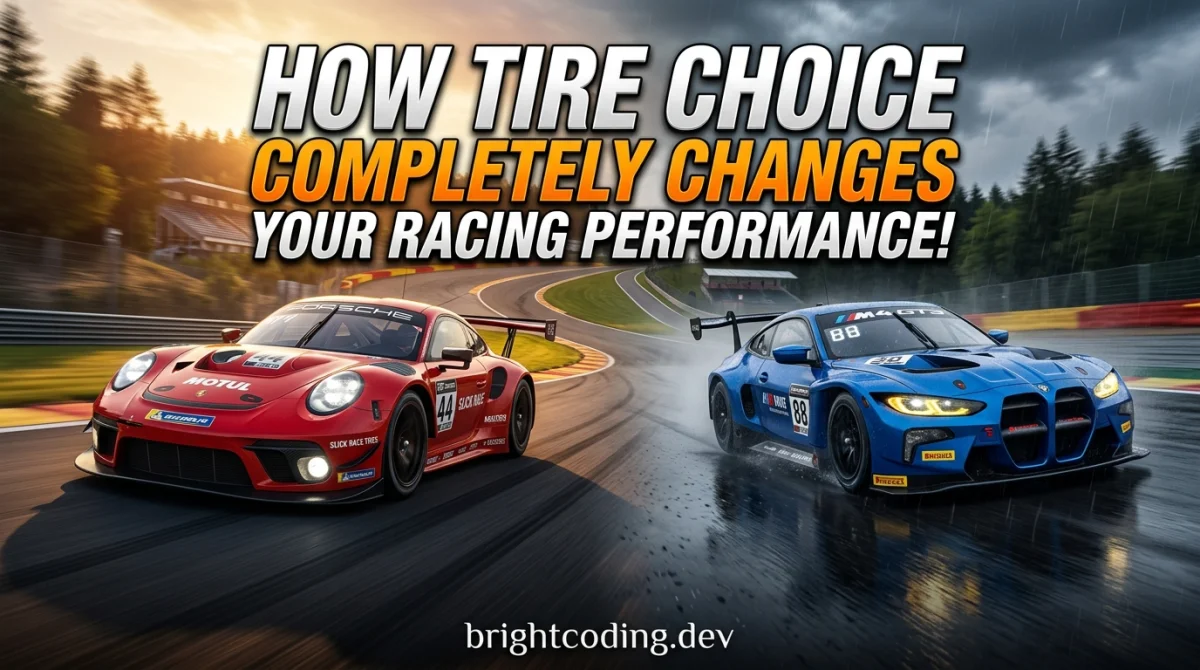
You can spend an hour tweaking gear ratios and still lose three seconds a lap to the guy running the right rubber. Tires are the single biggest performance lever in almost every racing game, and most players treat them as an afterthought.
By the end of this guide you will know how to read a tire compound, match it to a track and a car, adjust your car tuning around it, and manage wear so your pace holds up on the last lap. Read it once, then test it in your game of choice. Budget about 45 to 90 minutes for your first proper tire experiment, most of it spent driving laps.
What you need before you start
- A racing game with tire compounds or tire wear (Gran Turismo, Forza, Assetto Corsa, F1, iRacing, Project CARS, and most simcade racers qualify).
- One car and one track you already know reasonably well. Learning tires on an unfamiliar combo is chaos.
- Access to a practice or free-run mode so you can test without wrecking a championship.
- A lap timer, either in-game or the telemetry your game shows.
- Optional but useful: a notebook, or your phone. You will forget which compound felt good on lap four.
If you are starting from zero on car setup, the tips, tricks & guides hub has the basics covered before you get into the weeds here.
Step 1: Learn what your game's tire labels actually mean
Every game names compounds differently, but the logic is usually the same. Softer tires grip more and last less. Harder tires grip less and last longer. Intermediate and wet tires are for standing water and damp surfaces.
Find the tire menu and write down what each option is called in your game. In some titles the softest compound is red, in others it is a letter grade, and in a few it is a number. Do not guess. Check the in-game description or the loading screen tips, because a "medium" in one game can behave like a "hard" in another.
Why it matters: if you misread the compound you will build your whole setup around a tire you are not actually running.
Practical tip: run three laps on each available compound at the same track with no setup changes. Just note lap time and how the car feels. That is your baseline, and it takes maybe 15 minutes.
Step 2: Match the compound to the track, not to your ego
Softer is not automatically faster. On a long track with few corners, a hard tire that stays consistent can beat a soft tire that has gone off by lap five.
Ask yourself three questions. How many corners per lap? How long is a lap? How long is the race or stint? Short sprint around a tight circuit: soft. Long race on a track that eats tires: hard, or a split strategy.
Why it matters: this is where most players lose races before the lights go out. They pick the fastest single lap and then fall off a cliff.
Practical tip: if your game shows tire temperature, watch it. If temps are climbing past the sweet spot, you are overworking the tire and a harder compound will actually be quicker over a stint.
Step 3: Adjust your car tuning around the tire, not the other way round
Tires change how your car tuning behaves, so fit the tire first and tune second. A setup built for softs will feel nervous and snappy on hards.
Start with tire pressure. Lower pressure generally means more grip and more heat, higher pressure means less grip and less heat. Then look at camber, which affects how much of the tire contacts the road in corners. Then springs and dampers, because a stiff car punishes a soft tire. Make one change at a time and do at least three laps before judging it.
Why it matters: a good setup on the wrong tire is worse than a mediocre setup on the right one. The tire is the foundation.
Practical tip: change one value, run three laps, write down the lap time and one sentence about how it felt. If you cannot feel a difference, the change was too small or the tire is masking it.
Step 4: Manage wear like it is part of your lap time
Tire wear is not a pit-stop problem, it is a driving problem. You can save a set of tires by braking earlier and smoother, avoiding wheelspin on exit, and not leaning on the curb every lap.
Pick one corner per lap where you deliberately go easy. On most tracks that is a long, loaded corner where the front tires take a beating. Losing a tenth there can save you half a second per lap later in the stint.
Why it matters: in any race longer than about ten laps, tire management beats raw pace. The driver who looks after the rubber is often the one still fast at the end.
Practical tip: watch your lap times across a stint. If lap one is a 1:30 and lap eight is a 1:34, you are overdriving the tire early. Ease off in the first three laps and the drop should flatten out.
Step 5: Test wet and intermediate tires before you need them
Nobody practices in the rain until it rains, and then everyone panics. Spend one session on a wet track with the correct tires so you know how the car behaves.
In the wet, braking points move earlier, steering inputs get gentler, and the racing line often changes to avoid standing water. Intermediate tires handle damp and light rain. Full wets handle heavy standing water but overheat fast on a drying track.
Why it matters: wet races are where huge chunks of time and positions change hands. Knowing your wet tires is a free advantage over half the lobby.
Practical tip: if the track is drying, watch the tire temperature. Wets overheating means it is time to switch to intermediates or slicks. You will lose more time destroying a wet tire than you would pitting.
Step 6: Build a simple tire strategy for races
Once you know your compounds and your wear rate, plan the stint. Two stops on softs, one stop on hards, or a split where you run soft then hard. The right answer depends on your track and your driving style.
Do not copy a real-world F1 strategy into a game with different physics. Test it. Run a full race distance in practice if your game allows it.
Why it matters: a race is a math problem disguised as a driving contest. Getting the tire stints right is often worth more than a tenth of pure pace.
Practical tip: the rank-up competitive guides go deeper on race craft if you want to pair tire strategy with overtaking and defending.
Step 7: Keep a tire log and iterate
This is the step almost nobody does and the one that makes the biggest difference over time. For each track and car, write down the compound you used, the pressures, the lap times, and how the car felt. Next time you visit that track, you start from knowledge instead of a blank sheet.
Why it matters: racing games reward repetition and memory. A log turns scattered sessions into a personal setup database.
Practical tip: keep it short. Four lines per session is enough. Compound, pressure, best lap, one note on balance.
Pro tips
- Change tires before you change anything else in the setup. It is the fastest way to find lap time.
- Lower pressure by a small amount and watch the temperature. If it climbs past the sweet spot, you went too far.
- In the rain, brake earlier and turn in smoother. The tire has less grip, so every input needs to be gentler.
- If your game has a tire wear indicator, glance at it every few laps so you learn what wear feels like before it bites you.
- Practice one track with all compounds in one sitting. Comparing them back to back teaches you more than a week of random laps.
- If you are on a wheel, listen to the tires. Squealing means you are sliding, and sliding means you are burning rubber.
Common pitfalls
- Picking the softest tire every time. It is fast for two laps, then it is not. Match the compound to the stint length.
- Tuning before choosing tires. Your setup is built around the tire. Fit the rubber first, then tune.
- Ignoring tire temperature. Cold tires have no grip, overheated tires have no grip either. The window in the middle is where lap times live.
- Never practicing in the wet. When it rains in a race, you will be the one sliding into the barrier. One wet session fixes this.
- Changing five setup values at once. You will not know which change helped. One at a time, three laps each.
Useful resources
- Your game's own telemetry or setup screen. It is the most accurate tool you have and it is free.
- Community setup sharing sites and forums for your specific game. Quality varies, so treat shared setups as a starting point, not gospel.
- YouTube setup and hotlap videos for your track and car combo. Watch the tire choice, not just the lines.
- The GamingUp blog for more tuning and racing breakdowns.
- The free browser-games hub if you want a quick racing fix between practice sessions, and the daily challenge for a short competitive hit.
FAQ
Do softer tires always make me faster? No. They are faster for a short window, then they drop off. Over a long stint a harder tire is often quicker overall.
What tire pressure should I run? It depends on the game, the car, and the track. Start near the middle of the allowed range, then adjust in small steps and watch tire temperature. Verify against your game's own guidance.
How do I know when my tires are gone? Lap times drop, the car slides more, and braking distances get longer. If your game shows wear percentage, check it against how the car feels so you learn the connection.
Is tire choice more important than car tuning? Usually yes, especially in games with strong tire models. Tuning refines the tire. It cannot rescue the wrong one.
Should I copy real-world F1 tire strategies? Use them as inspiration, not instructions. Game physics differ from real life, so test any strategy in practice first.
One last thing
Tire choice is the cheapest performance upgrade in racing games. It costs you nothing but a bit of practice time, and it pays off in every single race. Pick one track this week, run all your compounds, and see what happens. You will probably find a second you did not know you had.
Ready to play?
Puzzle, arcade, 3D, word & sports games for every age — instant play, no registration.
Comments
No comments yet. Be the first to share your thoughts!