Top Speed vs Acceleration: Which Upgrade Actually Wins Races?
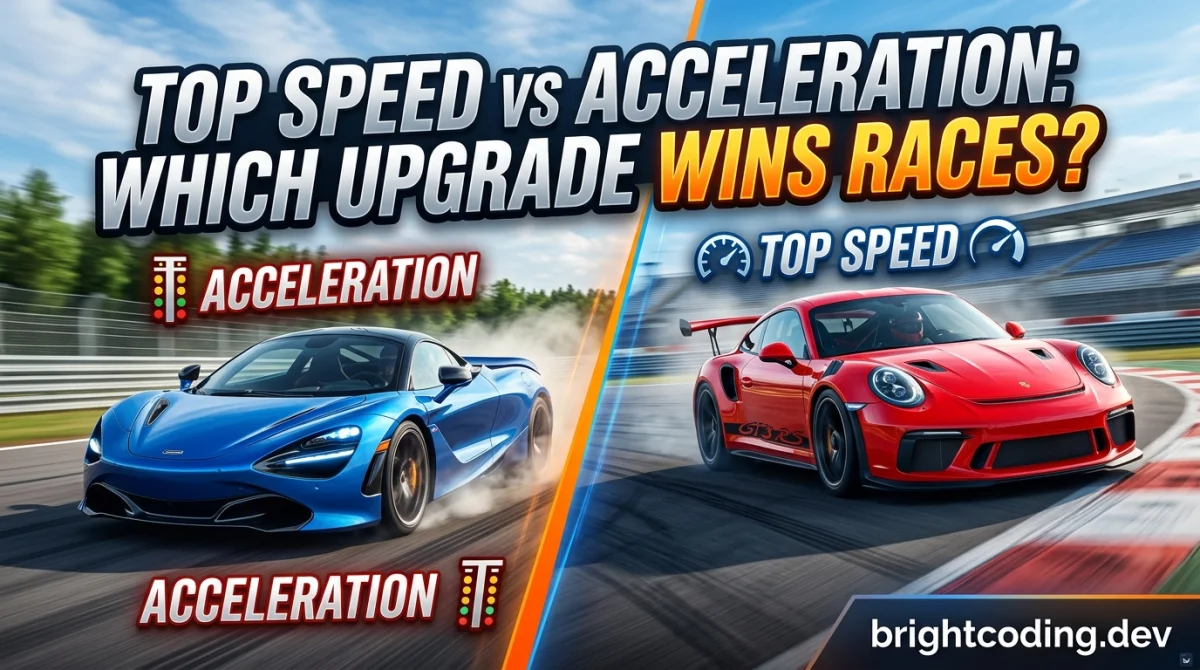
You have enough credits for one meaningful upgrade. The tuning menu is open. Two numbers stare back at you: top speed and acceleration. One promises a higher ceiling on the long straights, the other promises you will actually get there before the corner arrives.
This is one of the oldest arguments in racing games, and it never gets a clean answer because the right choice depends on the track, the car class, the driving style, and how the game's physics engine actually rewards each stat. Below is a fair breakdown of both, with the trade-offs spelled out instead of a slogan.
If you want a broader primer on how tuning systems fit into different racing subgenres, the game genres explained hub is a good place to start before you sink money into parts.
Top Speed: the upgrade that wins on the right track
Top speed is the maximum velocity your car can reach given enough road. It does nothing for you in a hairpin, but on a long straight it is the difference between drafting past someone and watching their taillights shrink.
Where it pays off:
- Tracks with long straights, oval circuits, highway-style sprints, drag-style events
- Cars that already corner well and just need a longer final gear
- Late-race scenarios where everyone is bunched up and one clean straight decides the podium
Where it hurts:
- Short, twisty circuits where you never reach the ceiling, so you paid for a stat you cannot use
- Cars with poor handling, because more speed makes every mistake more expensive
- Some games apply speed upgrades with a handling or braking penalty, which quietly undoes your gains
Rough cost: in most racing games, a top-speed-focused build runs roughly 15 to 30 percent more expensive than an acceleration build at the same tier, because it usually stacks gearing, engine, and aero parts together. Treat that as a ballpark, not a rule, since pricing varies wildly between titles.
The honest catch: top speed is a conditional stat. It only matters if the track lets you use it.
Acceleration: the upgrade that wins more often than people admit
Acceleration gets you from corner exit to your target speed faster. That sounds less glamorous than a big top-speed number, but in practice it wins more races across more track types, because most circuits have more corners than straights.
Where it pays off:
- Technical tracks with short straights and lots of braking zones
- Rolling starts and traffic-heavy races where you need to punch out of a pack
- Any game with slipstream or drafting, since better acceleration lets you close gaps and break the tow
- Lower-powered car classes, where acceleration upgrades tend to be cheaper and more noticeable
Where it hurts:
- Long straights where a higher top speed will simply drive away from you
- Cars that already spin their wheels, because more acceleration can mean more wheelspin and worse lap times
- Grinding the same short track until you memorize it, where the gains flatten out fast
Rough cost: acceleration builds are usually the cheaper entry point, often 10 to 25 percent less than a comparable top-speed build, and they tend to be more forgiving on stock suspension and tires.
The catch here is subtler: acceleration upgrades often feel less dramatic. Your speedometer still tops out at the same number, so it is easy to underrate how much time you actually gained.
The real deciding factor is the track, not the stat
Here is the part most upgrade guides skip. Neither stat wins in isolation. Your lap time is the sum of how quickly you reach your target speed and how long you can hold it.
A useful mental model:
- Corners per straight is your main signal. More corners means acceleration.
- Longest flat-out section is your secondary signal. If it is long enough to hit the ceiling, top speed matters.
- Your driving consistency matters most of all. A sloppy line wastes more time than either upgrade gives you.
If you are new to tuning and want structured practice drills, the rank-up competitive guides cover the fundamentals of consistent lap times, which is where most of your real gains live.
Head-to-head comparison
| Criterion | Top speed | Acceleration |
|---|---|---|
| Best track type | Long straights, ovals | Technical, corner-heavy |
| Typical cost (estimate) | 15 to 30 percent more | 10 to 25 percent less |
| Feel to the driver | Obvious on long runs | Subtle but consistent |
| Risk of penalty | Higher (handling, brakes) | Moderate (wheelspin) |
| Skill floor | Rewards clean lines | Rewards throttle control |
| Wins on variety of tracks | Fewer | More |
Neither column is a winner. They describe two different jobs.
Which one should you choose?
The right answer depends on who you are and how you play.
Casual player: Buy acceleration first. It is cheaper, it helps on almost every track, and it makes the car feel more responsive, which is the part you will actually notice in a twenty-minute session.
Competitive player: Build around the specific tracks in your ranked rotation. If your league runs long circuits, top speed is not optional. If it runs technical layouts, acceleration is your bread and butter. Check the schedule before you spend.
Budget gamer: Start with acceleration. It gives you more usable performance per credit, and it does not force you to also buy tires and brakes to stay safe. Spend on top speed later, once you have a car that handles well enough to survive it.
Parent buying upgrades for a kid: Acceleration is the safer pick. It makes the car easier to control and less likely to end up in a wall, and it is usually the cheaper option, which matters if the game has any real-money component.
Simulation fans: Ignore both until you fix your setup. In sims, tire pressure, gearing, and aero balance move lap times more than either headline stat. If you want a break from tuning and just want to race, the free browser-games hub has plenty of quick options, including a daily challenge that resets every day.
FAQ
Is top speed always better on long tracks? Almost always, but only if you can actually reach it. If your car is still climbing when the straight ends, acceleration would have served you better.
Can I upgrade both? Yes, but the costs stack fast, and many games apply diminishing returns or penalties when you push both stats hard. Balance your build instead of maxing one number.
Does acceleration help with cornering? Indirectly. Better acceleration means you get back on the power sooner after the apex, which smooths your exit. It is not a substitute for grip upgrades.
What about handling and braking? They are often the real winners. A car that brakes later and corners tighter will beat a faster car with a worse driver almost every time.
How do I know which upgrade helped? Run the same track with a clean baseline lap, then upgrade, then run again. Do not trust your gut, and do not trust a single lap.
Final takeaway
If you can only afford one upgrade and you do not know the track ahead of time, acceleration is the safer bet. It is cheaper, it helps on more circuits, and it makes the car feel better to drive. Top speed is the specialist's pick: brilliant on the right track, wasted on the wrong one.
The real winner is the upgrade that matches your track, your car, and your driving style. Learn to read those three, and the tuning menu stops being a gamble. For more on tuning, strategy, and everything else in between, the GamingUp blog is worth a browse.
Ready to play?
Puzzle, arcade, 3D, word & sports games for every age — instant play, no registration.
Comments
No comments yet. Be the first to share your thoughts!