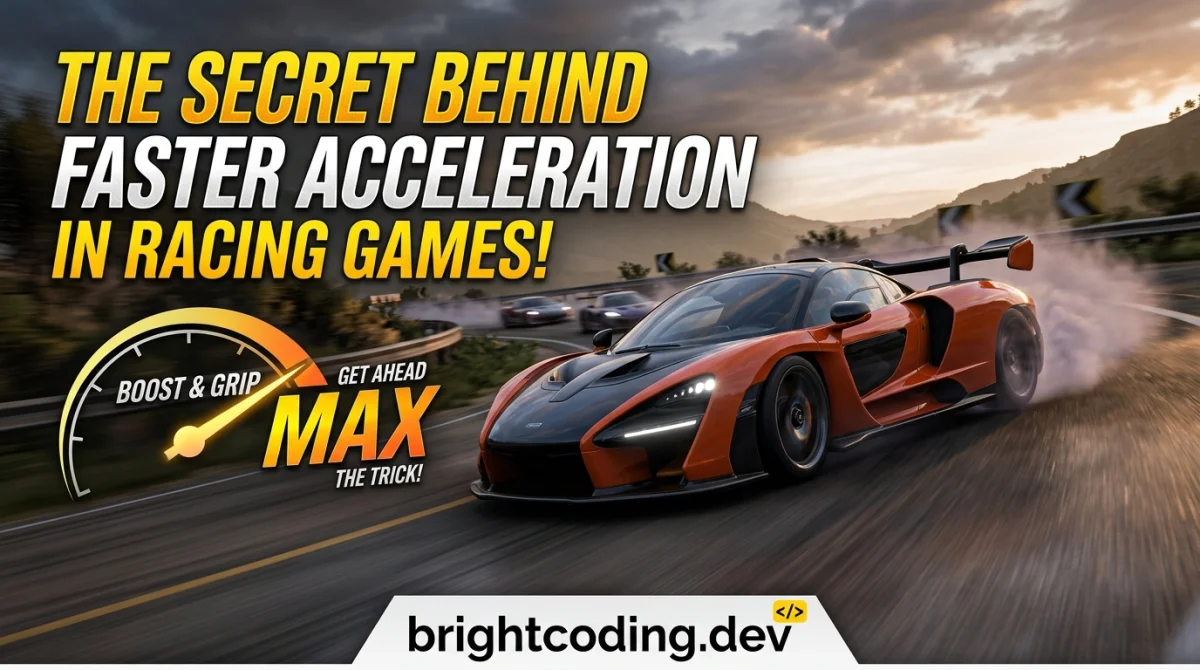
The Secret Behind Faster Acceleration in Racing Games
You mash the throttle, the engine screams, and the car crawls off the line like it is stuck in wet cement. Meanwhile the ghost ahead of you vanishes. Acceleration feels like the one thing you cannot fix, because it is just "how fast the car is," right?
It is not. Most of the gap between you and a faster launch comes down to a handful of habits you can unlearn this week. Here are seven mistakes that quietly cost you tenths every time the lights go green.
Why most people get this wrong
Acceleration gets confused with top speed. They are different problems. Top speed is about how fast you eventually go. Acceleration is about how efficiently you put power down in the first few seconds, and that is where most races are actually decided.
The second trap is treating the throttle like a light switch. Full on or full off. Real cars, and the physics engines that model them, do not work that way. Grip is finite, and if you ask for more power than the tires can handle, the game simply throws the rest away as wheelspin or a bogged-down engine.
The third issue is tuning. People copy a setup from a video, paste it in, and wonder why their car still spins. Setups are context. What works for a high-grip track on soft tires will wreck you on a slippery street circuit. Once you understand the why, you stop guessing.
1 - Slamming full throttle from a standstill
You are on the grid. Lights go out. You bury the pedal. The rear tires light up, the revs spike, and you sit there smoking while everyone else drives away.
It feels faster because it is louder and more dramatic. But wheelspin means the tires are sliding instead of gripping, and sliding tires accelerate you far slower than hooked-up ones. On a rear-wheel-drive car this is brutal, and on a high-torque build it is basically a burnout button.
Ease in. Feed the throttle progressively over the first second or two, and on pad, use partial trigger pull rather than a full press. Let the car settle before you go all in.
2 - Launching at the wrong RPM
The countdown hits one, you dump the clutch at whatever revs the engine happens to be sitting at, and the car bogs. The engine drops out of its power band and takes a full second to claw back.
Every car has a launch window where torque and grip line up. Too low and you bog. Too high and you spin. People ignore it because they never watch the tach during the launch, they just stare at the lights.
Learn the sweet spot for your car, usually somewhere in the middle of the rev range, and hold it steady before you release. A few practice launches in a time trial will teach you more than any written guide. If you want structured practice routines, the tips, tricks and guides hub has plenty to keep you busy.
3 - Fighting the car instead of the track
Tires are already working hard to accelerate you. Then you yank the wheel to correct a slide, and suddenly they are trying to do two jobs at once. Grip runs out and you lose speed.
This one is sneaky because it feels like good driving. You are being active, reacting, correcting. But every steering input during a launch steals traction from the thing you actually want, which is forward motion.
Keep the car straight on exit. If it steps out, catch it with a small, smooth counter-steer rather than a big stab, and let the throttle do the work.
4 - Wrong gear, wrong time
You short-shift early to be safe, or you hold a gear way past its power band because the engine note sounds cool. Either way, you are not using the engine where it makes its best torque.
Where the power sits matters more than how high the revs go. Short-shifting drops you into a weak part of the curve. Over-revving wastes time in a range where the car is not pulling hard anymore.
Watch your telemetry if the game has it, or just experiment. Shift near the point where acceleration starts to taper off, not at the redline by default. In the free browser-games hub you can test short, repeatable runs without waiting on a console, which makes this kind of trial and error painless.
5 - Ignoring weight and the tune
You add every performance part you can afford, the number on the stats screen goes up, and the car drives worse. More power without more grip is just a faster way to spin.
Weight distribution, gearing, tire pressure and differential settings all change how power reaches the road. A lighter car accelerates harder for the same power. A well-set diff puts torque down without lighting up one wheel.
Do not chase raw horsepower. Balance it. If a tune makes the car twitchy off the line, dial it back until the launch is clean, then add power.
6 - Restarting instead of learning the launch
The race goes badly, so you hit restart. Same mistake. Restart again. Ten attempts later you have not improved, you have just repeated the same error ten times.
Restarting feels productive because you are trying. But repetition without adjustment is just practice at being wrong. The launch is a small, learnable skill, and it rewards deliberate tweaks.
Change one thing per attempt. Throttle timing, then RPM, then shift point. When that particular start feels glued, move on. If you want to sharpen the wider racecraft around it, the rank-up competitive guides go deeper on the mental side.
7 - Blaming the car for a bad setup fit
Your friend's tune is a monster on one track and a disaster on yours. You assume you just need to "get good," when the real problem is the setup was never built for this surface.
Every track has its own grip level, corner types and elevation. A setup tuned for a fast circuit with long straights will feel awful on a tight, bumpy street layout. It is not you, it is the mismatch.
Treat setups as a starting point, not gospel. Adjust for the track in front of you, and test before you commit to a race. A quick browse through the game genres explained hub helps you understand how different racers model grip and power, which makes tuning far less of a mystery.
Do this instead
- Feed the throttle in, do not slam it.
- Find your car's launch RPM and hold it.
- Keep the car straight and let grip do its job.
- Shift near peak torque, not at the redline out of habit.
- Balance power with grip, never the other way round.
- Change one variable per practice run.
- Tune for the track you are actually driving.
FAQ
Does a controller hold me back compared to a wheel? Not as much as people claim. A wheel gives finer throttle control, but with trigger modulation and a bit of patience you can launch a car cleanly on a pad. The bigger factor is technique, not hardware.
Is full throttle always wrong off the line? Not always. In high-grip cars with traction control or all-wheel drive, you can often go near-full early. The key is reading the car, not following a fixed rule.
How many practice launches should I do? Enough to feel the car hook up consistently, which is usually a few focused attempts, not dozens of mindless restarts. Quality over quantity.
Do assists make acceleration slower? Some traction and stability assists cut power to keep you straight, which can cost you a little time. Test with them off once you are confident, but do not switch everything off at once.
Why does my car spin even though I have good tires? Usually too much torque for the grip available, or a diff and gearing setup that sends power to one wheel. Check the tune before you blame the tires.
Faster acceleration is not a secret stat, it is the discipline of putting power down smoothly and learning your car instead of fighting it.
Ready to play?
Puzzle, arcade, 3D, word & sports games for every age — instant play, no registration.
Comments
No comments yet. Be the first to share your thoughts!