How to Overtake Opponents Without Losing Speed
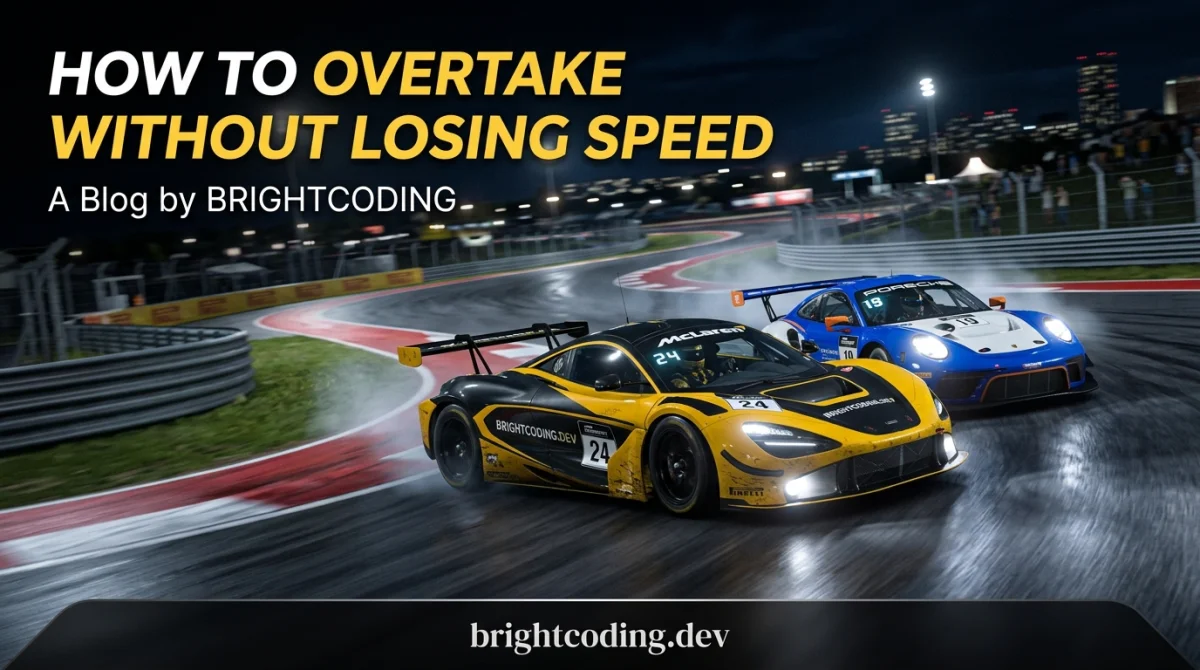
Overtaking looks easy when someone else does it. They pull alongside, the gap opens, they're gone. When you try it, you end up braking too early, running wide, or worse, losing three positions while wrestling the car back onto the racing line.
By the end of this guide you'll know how to set up a pass before you even reach the corner, where to actually place your car, and how to defend what you just won. Reading takes about ten minutes. Practicing the first two steps properly takes an evening.
What you need before you start
- A game you actually know. Overtaking tips transfer between titles, but braking points do not. Pick one racer and stick with it for a week.
- A stable setup. Not a fast setup, a stable one. A car that snaps on exit makes passing nearly impossible.
- Consistent lap times. If your laps swing by two seconds, you have a pace problem, not an overtaking problem.
- A way to watch replays. Onboard or chase cam, either works. You need to see what actually happened, not what you think happened.
- Patience. Passing is a waiting game disguised as an aggressive one.
If you're still deciding what to play, the game genres explained hub breaks down sim racers versus arcade racers versus kart racers, and the difference matters a lot for technique.
Step 1: Fix your pace before you fix your passing
You cannot overtake someone who is genuinely faster than you. That's the uncomfortable truth nobody wants to hear.
Before you spend hours on racecraft, get your baseline lap time within a second of the leaders. Use time trial mode, run ten clean laps, and note where you consistently lose time. Usually it's two or three corners, not the whole track.
Why it matters: A pass only sticks if you can pull away afterward. If your pace is equal or worse, you'll get re-passed on the next straight and burn your tires doing it.
Practical tip: Write down your worst three corners. Those are your overtaking zones, because that's where the other guy is also weak.
Step 2: Learn the braking zone, not the corner
Most players memorize "brake at the 100 board." That's a qualifying habit. In a race, you need a range.
Do this: on your next practice session, brake at your normal point, then brake five meters later, then ten meters later. Find out where you actually lose control. That gap between your safe point and your limit is your overtaking window.
Why it matters: Out-braking someone is the most reliable pass in racing, and it only works if you know exactly how late you can go without locking up or missing the apex.
Practical tip: Do this with fuel and tire wear on, not in a fresh-car time trial. Race conditions change your braking distance by several meters.
Step 3: Set up the pass two corners early
Here's the part beginners miss entirely. The overtake doesn't happen where you make the move. It happens one or two corners before.
If you want to pass on the main straight, you need a good exit from the final corner. To get a good exit, you need to be close enough on entry that you're not losing time in the dirty air of the car ahead.
Why it matters: Closing a two-second gap on a straight is nearly impossible. Closing a half-second gap through a corner sequence is routine.
Practical tip: Pick your target corner, then work backward. What corner feeds it? What feeds that one? That's your actual plan.
Step 4: Get close without wrecking your exit
Following closely costs you downforce and grip, especially in sims that model dirty air. You'll feel the car slide more, brake later than you want, and lose front-end bite.
The fix is positioning. Instead of sitting directly behind, offset your car slightly to one side. You get cleaner air, better visibility, and you're already lined up for the move.
Why it matters: Sitting in someone's slipstream is great on a straight and terrible in a corner. Knowing when to move out of it separates decent racers from quick ones.
Practical tip: Offset to the inside if you plan to pass on the inside, outside if you're going around the outside. Seems obvious. Almost nobody does it in advance.
Step 5: Commit to a side before the braking zone
Half-committed overtakes are the most dangerous thing in racing. If you're still deciding at the braking point, you'll brake late, miss the apex, and take both of you off track.
Decide before the braking marker. Inside or outside. Then drive that line like it's the only line.
Why it matters: The car ahead reacts to where you are. If you're wishy-washy, they can't predict you, and unpredictable drivers get hit.
Practical tip: The inside line is safer but slower on exit. The outside line is faster on exit but you need serious confidence. If you're new to wheel-to-wheel racing, take the inside every time.
Step 6: Use the switchback when they defend the inside
Your opponent covers the inside. Fine. You go outside, let them brake deep, and cut back underneath as they run wide on exit.
That's a switchback, and it's the single most useful overtaking tool for arcade and sim racers alike.
Why it matters: It punishes over-defending without requiring you to out-brake anyone. Low risk, high reward.
Practical tip: You need a car with decent traction out of slow corners for this. If your car spins up on exit, the switchback won't work and you'll just get left behind.
Step 7: Make the pass stick on exit
Getting alongside is half the job. Getting ahead by the next corner is the other half.
Once you're past, get back on the racing line as soon as it's safe. Don't drift across, but do close the door early and cleanly. Then focus entirely on your exit speed so they can't get a run on you.
Why it matters: A pass you lose on the next straight costs you time and tires. Two or three of those and your race is done.
Practical tip: If you're side by side through a corner, give space. Trading paint is fun until you're both in the gravel and the guy in third drives past you both.
Pro tips
Brake in a straight line, always. Trail braking is fast, but not while you're fighting someone. Straight-line braking keeps you predictable and stable.
Watch their mirrors, not their car. If they're checking their mirror, they know you're there. If they're not, they might turn in on you.
Pass the slow car, not the fast one. Sounds dumb, but a lot of players fixate on the leader when there's an easy position sitting right in front of them.
Use the first lap. Everyone is cold, tires are cold, and gaps open up. Some of the easiest passes of your race happen in the first ninety seconds.
Practice with AI before you go online. Set the difficulty slightly above your comfort level and just focus on clean passes. Twenty minutes of that beats an hour of getting wrecked in ranked lobbies.
If you're grinding ranked and want a broader plan, the rank-up competitive guides cover the mental side of climbing, which is often the real bottleneck.
Common pitfalls
Braking way too late and missing the corner. Happens when you're desperate. Fix it by practicing your late-braking limit in solo sessions, not in a race.
Trying to pass on the outside of a fast corner. Unless you have a serious pace advantage, this ends badly. Save the outside moves for slow corners and hairpins.
Following too closely for too long. You cook your tires and your brakes, and you get no benefit. Back off half a car length and you'll actually be faster over a stint.
Passing and then immediately relaxing. The moment you're ahead, the pressure flips. Keep pushing for two more corners until the gap is real.
Ignoring damage and tire wear. A pass that costs you a damaged front wing is not a pass, it's a gift to everyone behind you.
Useful resources
- Replay tools inside your game. Most racers have an onboard view. Watch your own failed overtakes and find the moment it went wrong.
- Track guides on video platforms. Search your specific track and car. Lap guides show braking markers you can copy directly.
- The tips, tricks and guides hub on GamingUp for genre-specific mechanics that change how passing works.
- The free gaming tools page if you want to track lap times or setups without buying anything.
- Telemetry apps. If your game supports them, they show exactly where you're losing time. Worth the setup time if you're serious.
If you'd rather warm up with something low-stakes before a ranked session, the free browser-games hub has quick racers that are perfect for a five-minute reflex tune-up. The daily challenge is a good habit too, since it forces you to adapt instead of repeating the same track.
FAQ
How long does it take to get good at overtaking? Expect a few weeks of deliberate practice. The mechanics are simple. The judgment (when to go, when to wait) is what takes time.
Is it better to pass on the inside or outside? Inside, in most cases. You control the corner and you force the other driver to give space. Outside passes are faster on exit but require more precision and more trust.
What if the other driver keeps blocking me? Change your approach. If they're covering the inside every lap, switch to the outside and use the switchback. Predictable defenders are easy to beat once you stop doing the predictable thing.
Do overtaking skills transfer between racing games? The principles do. Braking points, grip levels, and dirty air modeling do not. Give yourself a few hours in any new title before judging your racecraft.
Should I practice overtaking against AI? Yes, at least at first. AI is predictable, which makes it perfect for drilling the mechanics. Real players add the mind games later.
Go win one
Overtaking is a skill, not a talent. Every clean pass you've ever seen on a stream was built from the same boring loop: know your braking limit, set up early, commit, and make it stick. Pick one step from this guide, practice it tonight, and don't worry about the rest yet. One good pass will teach you more than ten articles ever could.
Ready to play?
Puzzle, arcade, 3D, word & sports games for every age — instant play, no registration.
Comments
No comments yet. Be the first to share your thoughts!