10 Car Tuning Mistakes That Ruin Your Performance
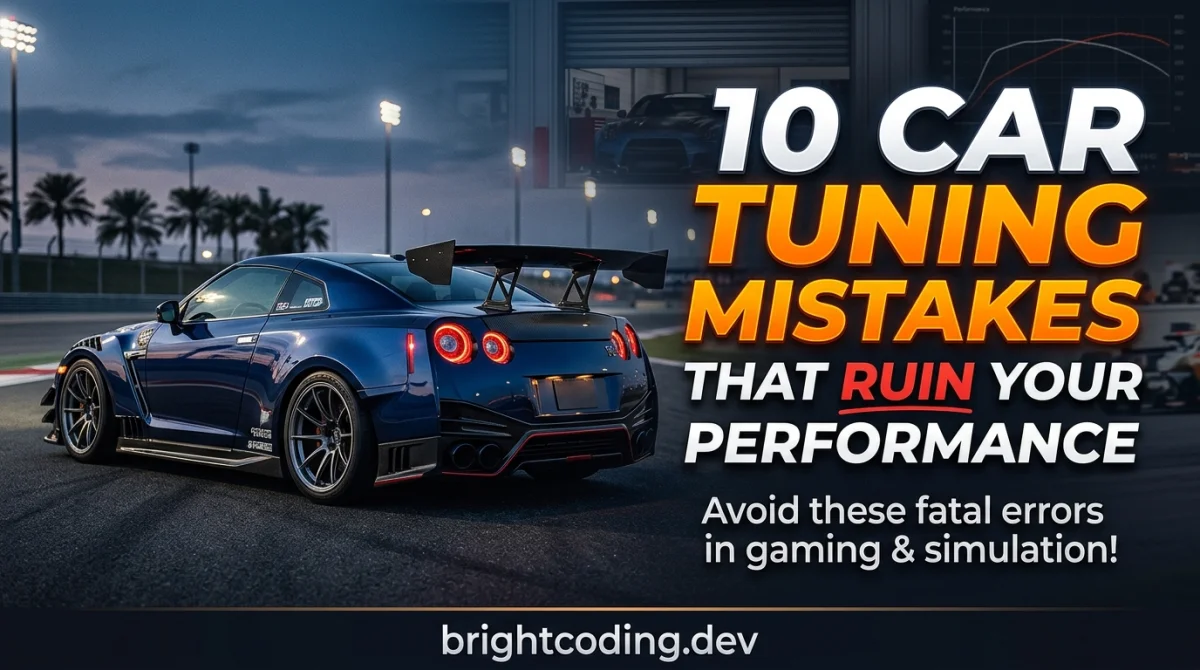
You spend three hours in the garage menu, swap the turbo, drop the suspension, slap on the biggest wing the game will let you buy. Then you hit the first corner and the car understeers into a wall. Tuning is where a lot of players quietly lose races they should win, and the frustrating part is that the mistakes are almost always the same handful. This is a list of the ones that actually cost you lap time.
Why most people get this wrong
Tuning feels like shopping. More power, more grip, more downforce, so the car must be faster. That logic works right up until it doesn't, and it usually stops working the moment you touch a corner.
The other problem is that games rarely explain what a slider does in plain language. You get a number, a bar, and a vague tooltip. So people either crank everything to max or copy a setup from a forum without knowing whether it suits their car, their track, or their driving style.
I've done both. The fix is boring: change one thing, drive the same corner, compare. Everything below comes back to that.
1 - Chasing peak power and ignoring the power band
A friend of mine once built a car that made huge numbers on the dyno screen and then lost to a stock hatchback on a tight circuit. All that power arrived at the top of the rev range, and he never got there because the corners came too fast.
People do this because big horsepower is the only tuning stat the game shows you up front. It looks like progress. The consequence is a car that spins its wheels out of every slow corner and feels like it's fighting you.
Look at where the power actually sits, not just the peak. If most of your driving happens between 4,000 and 6,000 rpm, that's the range you tune for.
2 - Lowering the car until the wheels clip the arches
Slammed cars look great in the photo mode. Then you hit a curb and the suspension has nothing left to travel, so the car skips across the surface instead of absorbing it.
It's an easy trap because low equals stable in most people's heads. In reality, you've removed the part of the suspension that keeps the tires planted on uneven ground. Bumps turn into slides.
Leave enough ride height that the springs can still compress. If your car gets nervous over curbs and painted lines, you went too low.
3 - Maxing downforce on a track that doesn't need it
Big wings are the most visible tuning decision in any racing game, which is exactly why they get overused. On a long straight, that wing is just a parachute.
The reasoning is usually "more grip is always better." On a circuit with two long straights and three slow corners, you've traded your top speed for grip you barely use. You lose the drag race down the back straight and never make it back.
Match downforce to the track layout, not to how aggressive you want to look. Fast circuits want less, technical circuits want more. There's a whole breakdown of how different racing subgenres handle this in our game genres explained hub if you want the wider picture.
4 - Copying a setup from someone else's car
A setup thread gives you exact numbers, you punch them in, and the car drives like garbage. Of course it does. That tune was built for a different car, a different track, and a driver who brakes later than you do.
People copy because it feels like skipping the hard part, and honestly, it sometimes works. But a setup is a set of compromises, and someone else's compromises don't match your inputs.
Use shared setups as a starting point, then adjust the two or three sliders that bother you most. Don't treat them as a finished answer.
5 - Ignoring tire pressure and camber
These are the sliders nobody touches because the effects are subtle and the labels are confusing. They're also where a lot of hidden lap time lives.
Run pressures too high and the tire only touches the road in the middle, so you lose grip and wear the center out. Too much negative camber and the inside edge does all the work while the outside does nothing. The car feels fine for two laps and then falls apart.
Change one click at a time and watch your tire temperatures if the game shows them. Small moves, not big ones.
6 - Tuning for the first lap instead of the tenth
You nail a setup in a three lap test, then join a longer race and the car turns into a different animal by lap eight. Fuel burns off, tires wear, and your carefully balanced car is now too stiff or too loose.
This one catches people because short test runs feel conclusive. They aren't. A setup that's perfect for a sprint can be actively bad for a stint.
Test over a distance that matches the race you're actually entering. If the car only feels right when it's heavy with fuel, you've tuned for the wrong moment.
7 - Fixing a driving problem with a setup change
Understeer into every corner? Add more front grip. Still understeering? Add more. Eventually the car is a mess and you still can't take the corner cleanly, because the real issue was braking too late and turning in too hot.
This is the most common mistake on the list, and it's the hardest to admit. Tuning feels productive, so it becomes the default response to any problem.
Before you open the tuning menu, do five clean laps and ask whether the car is actually the problem. Sometimes you just need to brake earlier. Our rank-up competitive guides go deeper on that side of things.
8 - Never saving a baseline
You spend an evening tuning, the car gets worse, and now you can't remember what the original settings were. So you start over from scratch and lose the two changes that were genuinely good.
People skip this step because it feels like paperwork in a game. But a saved baseline is the difference between experimenting and gambling.
Save your stock or current setup under a clear name before you touch anything. Then every experiment has a way back.
9 - Tuning one car and calling it a skill
You've got one car dialed in perfectly. Then the game hands you something rear-engined and you're spinning at every corner exit because you're applying the same instincts.
Specializing isn't wrong, but a setup that works on one drivetrain can be actively dangerous on another. Weight distribution changes everything about how you brake and how you get on the power.
Drive a few different layouts on purpose. It makes you faster in your main car too, because you stop confusing "my setup" with "how cars work."
Do this instead
- Save a baseline setup before you change anything.
- Change one slider at a time and test on the same corner.
- Tune for the race distance, not the three lap test.
- Match downforce and gearing to the track, not to the spec sheet.
- Check tire pressure and camber before you touch anything expensive.
- Do clean laps before you blame the car.
If you want a low pressure way to practice the fundamentals, the free browser-games hub has plenty of quick driving and racing titles that don't punish you for experimenting, and the daily challenge is a decent five minute warm up before a long session.
FAQ
Does tuning actually matter in racing games, or is it mostly cosmetic?
It matters on most sims and simcades, and it matters less in arcade racers where the handling model is simplified. If the game gives you sliders, assume they do something. If it only gives you paint and rims, they don't.
Should I max out every upgrade?
No. Max power with stock tires and brakes is a car that can't use any of it. Upgrade grip and stopping power before you go chasing horsepower.
How long should a tuning session take?
Long enough to test one change properly. Fifteen focused minutes on one slider beats two hours of random tweaking.
Why does my setup feel great in practice and bad in a race?
Fuel load and tire wear. Practice usually runs light and short. If your race is longer, test under race conditions.
Is copying a pro setup ever a good idea?
As a reference point, yes. As a final answer, rarely. Their inputs and your inputs aren't the same.
Tune one thing at a time, and stop using the setup menu to fix problems that live in your braking foot.
Ready to play?
Puzzle, arcade, 3D, word & sports games for every age — instant play, no registration.
Comments
No comments yet. Be the first to share your thoughts!