The Ultimate Guide to Drafting and Slipstreaming in Racing Games
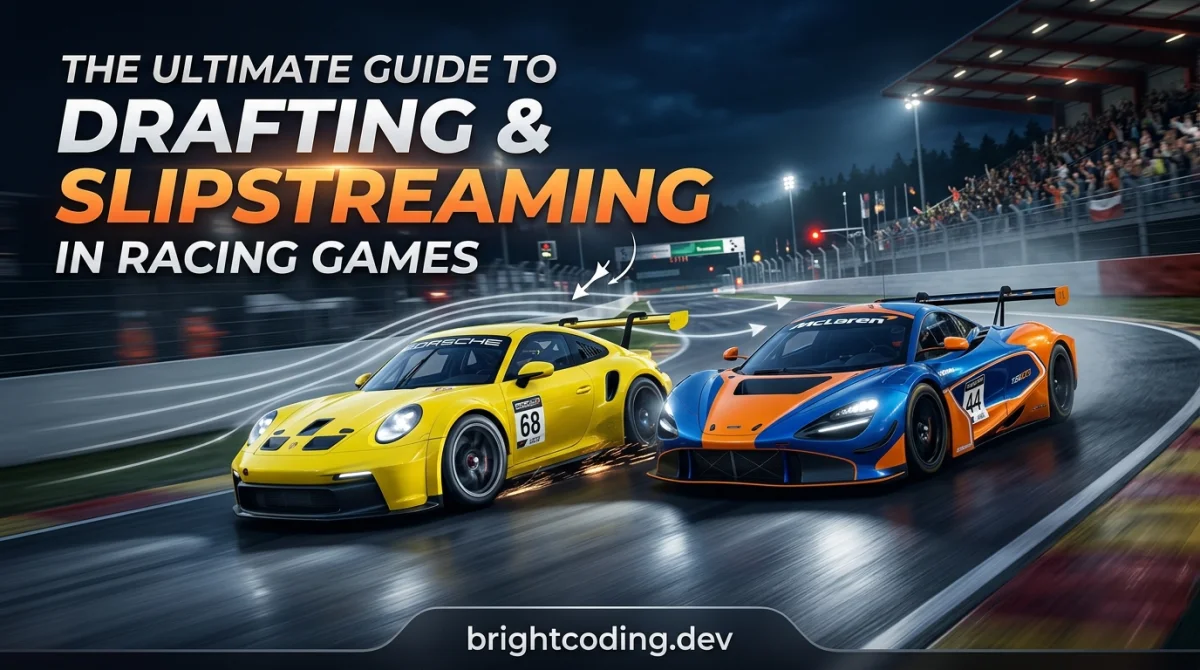
I lost a race last Tuesday by 0.038 seconds. I know the exact gap because the results screen refused to let me look away. I had the faster car through the final sector, I had the run, and I threw it all away by pulling out of the slipstream one corner too early. My front wing was already level with his rear tire when I lifted. That tiny hesitation cost me the win.
That race taught me more about drafting than the previous fifty hours combined. So let me save you some of that pain.
The backstory
I am not an esports driver. I am the guy who plays Assetto Corsa Competizione on a mid-range wheel, dabbles in Gran Turismo 7, and spent an embarrassing number of evenings in arcade racers before I understood why faster cars kept catching me on straights. For a long time I thought drafting was a magic button. Get close, go fast. Done.
It is not that. Drafting is a negotiation with physics and with the other driver's ego.
The first real lesson: what is actually happening behind that car
When you tuck in behind another car, you are sitting in the low-pressure pocket it punches through the air. Less air resistance on your nose means you can carry more speed for the same throttle. That is the whole trick, and it works in basically every racing game worth its salt.
The problem is the word behind. Too far back and the pocket is weak. Too close and you get dirty air, which makes your front end feel vague and floaty right when you want to place the car precisely.
I learned the distance by feel, not by numbers, because every game models this differently. In Gran Turismo 7 the tow kicks in hard and early, which makes it forgiving. In ACC on a controller it is subtler and the dirty air bites harder. Roughly one to two car lengths back is where I start feeling the pull, but you need to test it in your own game.
There is a whole genre split here worth knowing. Arcade racers hand you a fat, obvious slipstream. Sim racers make you earn it. If you want a primer on how these categories differ, the game genres explained hub on GamingUp is a decent place to start.
The night I finally understood the slingshot
Here is the scenario that changed things. Short straight, then a hard braking zone into a hairpin. I was second, chasing a guy who braked a touch earlier than me.
My old habit was to swing out the moment I felt the draft, which killed my speed because I left the pocket too soon. Instead I stayed glued, waited until his brake lights flickered, and then pulled out. By that point I had maybe 6 to 8 km/h on him, which does not sound like much until you realize that translates into arriving at the corner with a better line and a car that is already positioned to defend.
He braked. I braked later. I was past before the apex. That single rep rewired how I race.
The counter-mistake is pulling out too late and getting stuck in dirty air through the corner entry. I still do this when I am impatient. You end up with a nervous front end exactly when you need it planted.
A quick word on which games teach this best
If you are learning, pick your classroom deliberately.
- Gran Turismo 7: generous draft, clear feedback, great for building the instinct.
- ACC: punishing but honest. Dirty air will humble you.
- F1 games: the DRS plus slipstream combo is its own skill tree, and the braking zones punish greed.
- Arcade racers: fun, but the draft is so strong it can teach bad habits.
I put probably 20 hours into deliberate drafting practice across these before it became automatic. Not 20 hours of racing. 20 hours of watching gaps, which is a different, slower, more boring kind of practice.
If you want structured practice ideas rather than just grinding, the rank-up competitive guides section has breakdowns that apply across genres, not just shooters.
The part nobody warns you about: defending the slipstream
Once you can attack with the draft, you have to learn to defend against it, because now everyone is doing to you what you did to them.
The first thing I learned is that weaving like a maniac does not help. It looks desperate and it slows you down. What actually works is breaking the tow early. Move off the racing line a car width before the braking zone so the car behind loses the pocket and has to react. You give up a little exit speed, but you take away their easy pass.
The trade-off is real though. Break the tow too early on a long straight and you just hand them the run anyway, plus you compromised your own line. It is a gamble, and I get it wrong plenty.
This is also where I started caring about setups, which I used to ignore entirely. A car with more rear wing is harder to pass but slower in a straight line, which means you are more dependent on defending the draft. There is no free lunch.
Honest pros and cons
What drafting gives you:
- Free speed on straights, no setup changes required
- A way to pass cars that are genuinely faster than yours
- Better fuel and tire saving in endurance events, since you are not fighting the air alone
What it costs you:
- Dirty air wrecks your front-end feel at the worst moment
- It is reactive, so a smart leader can bait you into a bad move
- In close online lobbies, everyone knows the trick, so the edge is smaller than you think
- On some tracks with long straights, it turns racing into a game of chicken
What I learned
-
Patience beats aggression almost every time. The pass happens at the braking zone, not on the straight. I spent years attacking too early.
-
Feel the pocket, do not measure it. Distances vary by game and by speed. Your hands know before your brain does.
-
Dirty air is the real opponent. The car in front is not blocking you. The turbulence is. Learn to recognize that floaty feeling and adjust your steering inputs.
-
Defending is a skill you learn second, and it hurts. Getting passed by someone using the draft you just mastered is a special kind of annoying.
-
Practice deliberately, not just repeatedly. Ten focused laps watching your gap to the car ahead taught me more than a hundred laps of mindless racing.
Quick practical tips
- Stay roughly one to two car lengths back to stay in the pocket without eating dirty air.
- Do not pull out until the car ahead commits to braking.
- When defending, break the tow a car width early, but not so early you lose your own speed.
- In endurance racing, use the draft to save fuel and tires, not just to overtake.
- If your front end feels vague, you are too close. Back off a fraction.
- Turn off the racing line assist when practicing this. You need to read the car ahead, not a painted arrow.
FAQ
Does drafting work the same in every racing game? No. The strength and the range of the slipstream vary a lot, and dirty air is modeled differently too. Arcade games are generous, sims are stingy. You have to recalibrate every time you switch games.
Is slipstreaming the same as drafting? Basically yes, people use them interchangeably. Some games and communities use "slipstream" for the effect and "draft" for the act of following closely. The physics is the same idea.
Can I learn this without a wheel? Absolutely. I learned most of it on a controller. A wheel helps with precision in dirty air, but the instinct for when to pull out is the same either way.
How long does it take to get good at this? For me, a few evenings to understand it and a couple of months to stop making the obvious mistakes. Your mileage will vary, and that is fine.
Where to go next
If you want to keep sharpening this, mix in some lighter racing between serious sessions so you do not burn out. The daily challenge is a good low-stakes way to keep your reactions fresh, and the free browser games hub has quick racers you can jump into without loading a full sim.
I still lose races by 0.038 seconds. But I lose them for better reasons now, and honestly, that is the whole point.
Ready to put this into practice? Browse the free browser games to train the skill, explore the tips, tricks & guides hub for related reads, or check the latest articles on the GamingUp blog.
Ready to play?
Puzzle, arcade, 3D, word & sports games for every age — instant play, no registration.
Comments
No comments yet. Be the first to share your thoughts!