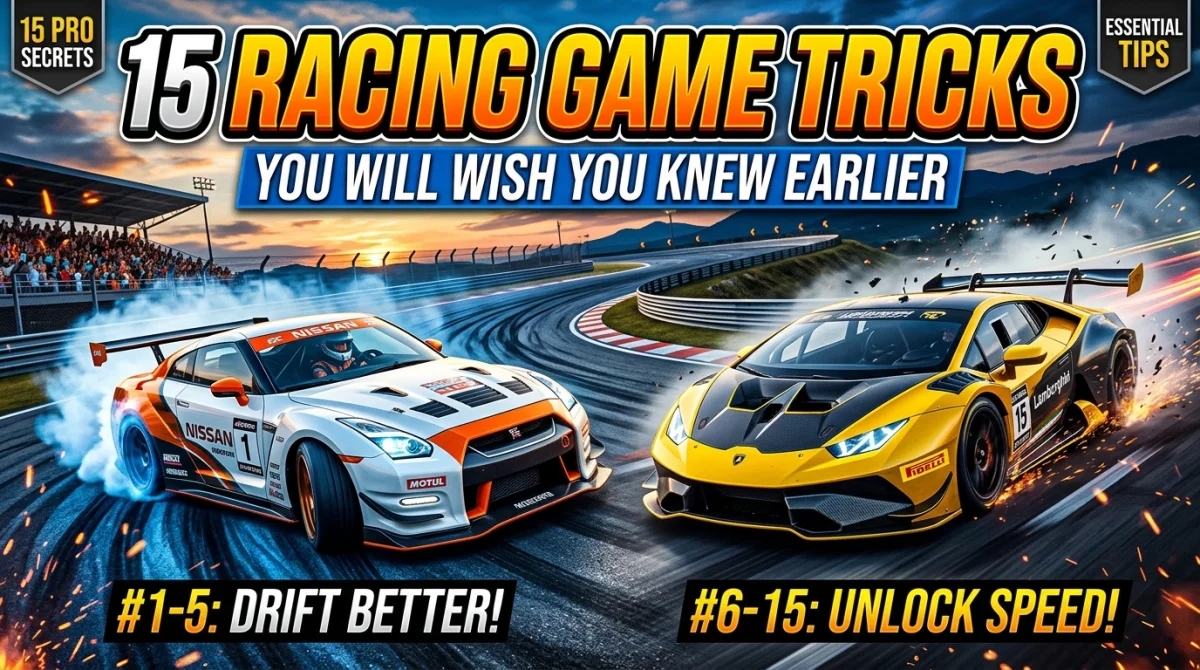
15 Racing Game Tricks You Will Wish You Knew Earlier
Most racing games hide their real speed in the details: a brake pedal you're using wrong, a camera angle that's costing you tenths, a setup menu you've never opened. This guide walks through 15 concrete tricks, from basic braking habits to the small menu tweaks that quietly shave seconds off your lap times. Read it once (about 10 minutes), then spend a focused session or two testing each one. You'll come out knowing exactly where your time is going and how to get it back.
What you need before you start
- A racing game you know reasonably well (any sim, arcade racer, or kart game works).
- A controller or wheel you're comfortable with, and a stable seating position.
- Access to the game's settings, telemetry, or replay system.
- 30 to 60 minutes of uninterrupted practice per trick you want to drill.
- Optional: a notebook or phone note for lap times. You'll forget your baseline otherwise.
1. Learn the track before you learn the car
Drive five clean laps at 70 percent pace and say the next corner out loud as you approach it. You're building a mental map, not chasing a record.
Why it matters: most people blame the car for a bad lap when they simply don't know where the track goes. Knowing the corner sequence lets you plan braking points instead of reacting late.
Practical tip: pick one reference point per corner (a curb, a sign, a patch of tarmac) and stick to it. Roughly 15 minutes per track gets you most of the way there.
2. Brake in a straight line, then turn
Get all your heavy braking done before you start rotating the wheel. Trail off the brake as you turn in, rather than holding full pressure into the corner.
Why it matters: locked or overloaded front tires don't steer. You lose the corner and the exit in one go.
Practical tip: if the car won't turn, you braked too late or too hard. Try braking about half a car length earlier next lap and see what happens.
3. Use the whole track, not just the racing line
The painted "ideal line" in most games is a suggestion. Widen your entry, clip the apex, and let the car run wide on exit.
Why it matters: a wider arc means less steering angle, which means more speed carried through the corner.
Practical tip: watch a replay from a chase camera and check whether your tires ever touch the outer edge of the track. If they don't, you're leaving space (and time) on the table.
4. Fix your camera before you fix your driving
Switch to a hood, bumper, or cockpit view for a few laps, even if it feels wrong at first.
Why it matters: a distant chase camera hides your car's actual position and makes small corrections harder to judge.
Practical tip: give any new camera at least 10 laps before judging it. If it still feels off, go back, but at least you'll know it was a choice and not a habit.
5. Set your field of view properly
In the display settings, adjust field of view (FOV) so the track ahead fills a comfortable amount of the screen without looking distorted.
Why it matters: too narrow and you can't see corner entries; too wide and everything looks warped and distances feel wrong.
Practical tip: there's no universal number. Adjust, do three laps, adjust again. Stop when your braking points feel consistent.
6. Turn off assists one at a time
Don't switch everything off at once. Kill traction control first, then stability assist, then ABS if the game allows it.
Why it matters: assists mask your mistakes, so you never learn what the car is actually doing. But stripping them all in one go just teaches you frustration.
Practical tip: spend one session per assist. Expect to be slower for the first 20 minutes each time. That's normal, not a sign you should switch it back on.
7. Learn to left-foot brake if you have pedals
If you're on a wheel with pedals, practice braking with your left foot and keeping your right foot on the throttle.
Why it matters: it cuts the dead time between lifting off and braking, and it opens the door to brake-throttle overlap techniques later.
Practical tip: start in a slow car on a wide track. Left-foot braking in a fast car on your first attempt ends in the gravel, guaranteed.
8. Short-shift for grip, not for speed
In cars that spin their wheels easily, shift up slightly before the redline to keep the tires hooked up.
Why it matters: peak power isn't always peak grip. Short-shifting through slow corners keeps the car settled.
Practical tip: test it in one corner you keep spinning at. Shift up early and see if the car stays planted. If it does, use it there every lap.
9. Tune tire pressures before anything else
Open the setup menu and adjust tire pressures first. Leave springs, dampers, and gearing alone until you understand the car.
Why it matters: pressure changes grip and temperature behavior across the whole lap. It's the highest-impact, lowest-risk setting most players never touch.
Practical tip: change pressures in small steps (a couple of clicks at a time) and do three laps per change. Big jumps tell you nothing.
10. Use replay and telemetry to find your lost time
Watch your own replay next to a faster ghost or reference lap, and compare where you brake and turn in.
Why it matters: your memory of a lap is unreliable. The replay shows exactly where you're losing time, corner by corner.
Practical tip: pick one corner per session to compare. Trying to fix everything at once is how you end up slower and confused.
11. Practice pit stops and race starts separately
Set up a short practice session and drill only the start, or only the pit entry and exit, ten times in a row.
Why it matters: races are often won or lost in the first 30 seconds and in the pit lane, and almost nobody practices those moments.
Practical tip: brake markers into the pit lane are easy to overshoot. Note the exact marker in a session and reuse it every race.
12. Change one thing per lap
Write down your lap time, change exactly one variable (braking point, gear, line), and compare.
Why it matters: change three things and you have no idea which one helped. This is the single biggest reason players plateau.
Practical tip: a simple note on your phone works. "T3: brake 2 car lengths later, 0.3s faster" is enough.
13. Adjust your controller settings, not just your driving
On a pad, tune deadzone, sensitivity, and trigger vibration to suit your hands.
Why it matters: default settings are a compromise. A smaller deadzone can make small steering inputs far more precise.
Practical tip: change one slider, do five laps, decide. If you can't tell the difference, revert it. There's a solid breakdown of input and setup habits in the rank-up competitive guides if you want to go deeper.
14. Race against a slightly slower ghost, not a faster one
Download or set a ghost that's around half a second quicker than your best, not several seconds quicker.
Why it matters: a ghost that's way ahead disappears into the distance and teaches you nothing. A close ghost shows you exactly where it pulls away.
Practical tip: beat the ghost, then replace it with the next one up. Small, repeated wins keep you improving instead of demoralized.
15. Take breaks and review, don't grind
After 45 to 60 minutes, stop, watch a replay, and note two things to work on next time.
Why it matters: fatigue makes you sloppy and ingrains bad habits. Short, focused sessions beat long, frustrated ones every time.
Practical tip: if you're on a browser racer, the free browser-games hub is a low-pressure place to test these habits without a full sim setup. And if you want a daily target to keep sharp, the daily challenge is a good five-minute warmup.
Pro tips
- Warm up with five slow laps before chasing a fast one. Cold hands and cold focus cost more time than cold tires.
- Learn the track in a slow car first. Everything feels slower, which gives your brain time to actually learn the corners.
- Turn off the racing line assist after you've learned a track. It teaches you to follow a line instead of reading the corner.
- Set a target lap time before each session. Aimless practice is just driving.
- Watch real onboard footage of the same track if it exists. You'll pick up braking points and lines the game's tutorial never mentions.
- Check your braking pedal calibration. A pedal that never reaches 100 percent is quietly costing you stopping distance.
Common pitfalls
- Changing five settings at once. You'll never know what worked. Change one thing, test it, keep or revert.
- Braking later than you can handle. Late braking feels fast and usually is slower because you ruin the exit. Brake earlier, get on the power sooner.
- Ignoring the setup menu entirely. Even one tire pressure adjustment can transform a car. Spend 10 minutes there.
- Grinding for hours without review. Time spent driving badly is time spent practicing badly. Review replays every session.
- Copying a pro's setup blindly. Their car, tires, and driving style aren't yours. Use their setup as a starting point, then tune for your own habits.
Useful resources
- The tips, tricks and guides hub for broader gaming technique, not just racing.
- The game genres explained hub if you want to understand why sim, arcade, and kart racers reward different habits.
- The best games ranked lists when you're choosing your next racer.
- The cheat codes and easter eggs hub for the odd hidden unlock, though nothing beats practice.
- The free gaming tools section for anything that helps you track times or plan sessions.
- The gaming deals and free games hub if you want to try a new racer without spending much.
FAQ
How long until I actually get faster? Most players see a clear improvement within two or three focused sessions of around 45 minutes each. Big jumps come from fixing braking and camera habits first, not from tuning.
Do I need a wheel to use these tricks? No. Tricks 1 to 4, 6, 10, 12, and 15 work on any controller. Wheel-specific tips like left-foot braking (trick 7) obviously need pedals, but everything else applies.
Should I turn off all assists straight away? No. Remove one at a time and expect to be slower for a session each time. Ripping them all off at once usually just makes you frustrated.
Is the racing line assist actually bad? It's useful for learning a new track, then it becomes a crutch. Turn it off once you know the corners and you'll start reading the track yourself.
What's the single most important trick on this list? Braking in a straight line and trail-braking into the corner (trick 2). Fix that and most other things improve on their own.
You don't need talent or a fancy rig to get faster. You need one clean habit at a time, a notebook, and the patience to be slower for a session while it clicks. Pick two tricks from this list, run them today, and check the blog for more guides when you're ready for the next batch.
Ready to play?
Puzzle, arcade, 3D, word & sports games for every age — instant play, no registration.
Comments
No comments yet. Be the first to share your thoughts!