The Ultimate Racing Game Car Setup Guide for Beginners
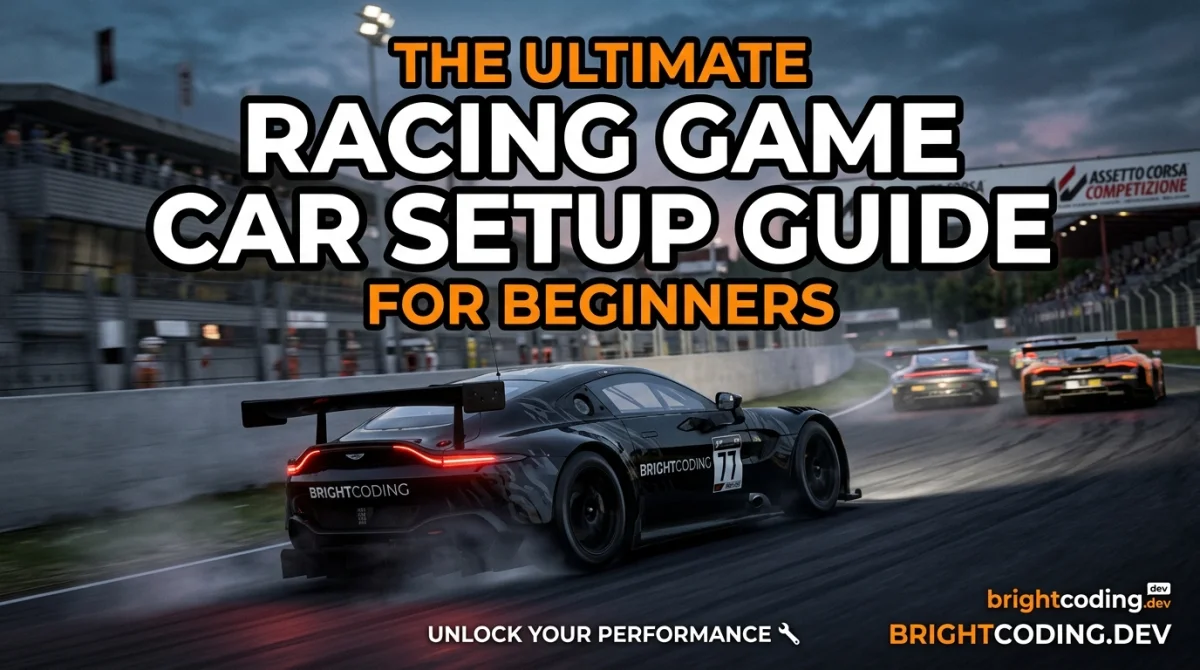
I spun out on the second corner of a wet Suzuka lap, three laps in a row, in a car I genuinely thought I'd tuned well. The rear just let go. No warning, no slide, just a snap and a face full of gravel trap. I remember sitting there listening to the rain hiss through the speakers, wondering why my lap times were getting worse the more I fiddled with the settings.
That was maybe six months into my sim racing detour, and it taught me the single most useful thing I know about car setup: you are usually the problem, not the car. Most of the time.
The backstory
I'm not a mechanic. I've never changed a real gearbox. My first proper racing game was a controller-and-sofa situation, and my first "tune" was copying numbers off a forum post from someone driving a completely different car on a completely different track. Surprise: it didn't work.
I play on a mid-range PC with a wheel I bought secondhand, and I still use a controller for arcade racers. That mix matters, because the setup advice that works for a wheel and pedals is not always the same as what works with trigger braking. So treat everything below as one player's field notes, not gospel.
Beat 1: stop changing five things at once
My early mistake was tactical, not technical. I'd come in from a sloppy lap, open the setup menu, and start tweaking everything: tyre pressures, downforce, brake bias, suspension. Then I'd go out, feel something different, and have no idea what caused it.
The fix is boring and it took me an embarrassingly long time to accept it. Change one thing. Do three clean laps. Compare. Change it back if it's worse. That's it.
If you want a structured way to build that habit, the tips, tricks and guides hub has a bunch of pieces that apply to racing games even when they're not about cars specifically. The discipline transfers.
Beat 2: the four settings that actually matter for beginners
You do not need to understand every slider. You need four of them. I'd honestly ignore the rest for your first few hours.
Tyre pressure. Lower pressure gives more grip but more drag and heat. On a wet track I go lower, on a long straight-heavy track I nudge it up. Small changes. If a slider moves in steps of 0.1 psi, move one or two steps, not ten.
Brake bias. This is the front-to-rear split of your braking. Too far forward and the front locks; too far back and the rear steps out under braking. This one setting fixed most of my early spins. Move it a percent or two toward the rear if you're locking fronts, toward the front if you keep losing the back end on corner entry.
Downforce. More wing means more grip in corners and less speed on straights. On a track with one big straight and lots of slow corners, you're balancing two different needs. Start with the default and only adjust if you notice a clear problem.
Gearing. If you're bouncing off the rev limiter on the main straight, your gearing is too short. If you're nowhere near the top of the rev range, it's too long. This is the easiest one to hear, which makes it a good place to start learning.
Everything else (springs, dampers, anti-roll bars) is real and it matters, but it's second-season stuff. I still get lost in damper settings.
Beat 3: learn the track before you touch the car
Here's what actually dropped my lap times more than any setup change: knowing which corners I was taking badly. A car that understeers into a specific hairpin might just be a car you're entering too fast.
I started doing a "baseline session" where I don't touch the setup at all. Ten laps, default everything, just trying to be consistent. Then I look at where I'm losing time. Nine times out of ten the answer is a driving line, not a spring rate.
This is also why I got into watching replay ghosts and comparing my braking points. If you like the competitive side of this, the rank-up competitive guides cover the mindset stuff that applies across any competitive game, not just racing.
Beat 4: the wet race that humbled me
Back to that Suzuka spin. I'd been running a dry setup, and when the rain came I just... kept driving it. Low downforce, stiff suspension, high tyre pressures. The car was a skateboard.
What I should have done, and now do: as soon as conditions change, reset toward a safer baseline. Softer suspension, more downforce, lower pressures, brake bias a touch further forward. It won't be fast. It'll be predictable, and predictable beats fast when you're learning.
I lost that race badly. But I learned more from one wet session than from a week of dry tinkering, because the car told me very clearly when I'd gone too far.
Beat 5: when to just drive a different car
Sometimes the setup isn't the problem and the car is. Some cars in some games are just badly balanced for certain tracks, and no amount of tuning saves them. I spent two evenings trying to make one particular car work at a tight circuit before accepting I should have picked something else.
If you're bouncing between games and genres trying to find one that clicks, the game genres explained hub is a decent map of what's out there. And if you want a low-pressure way to keep your reflexes sharp between sim sessions, the free browser games hub has quick stuff you can play in a tab, no install.
Honest pros and cons
The good: Once setup clicks, you stop blaming the car and start solving problems. Lap times become something you can actually chase. There's a real satisfaction in feeling a change work on the very next corner.
The annoying: It's slow. You'll spend an hour to find half a second. The interface in most racing games is genuinely bad at explaining what each slider does. And you can absolutely tune yourself into a worse car and not notice for twenty laps.
What I learned
- One change at a time. I can't stress this enough. If you change four things and it feels better, you've learned nothing you can repeat.
- Your driving is usually the bigger variable. Before you open the setup menu, do a clean baseline run and watch where you're actually losing time.
- Wet conditions are a reset button. They expose bad setups instantly. Use them to learn, not to avoid.
- Defaults exist for a reason. Game developers spend real time on stock setups. They're a fine starting point and often good enough to be competitive.
- Write things down. I keep a note on my phone with track, car, and what I changed. It sounds fussy. It saved me from repeating the same mistake twice.
Quick practical tips
- Do ten clean laps on default before touching anything. Yes, even if it feels slow.
- Change one setting, run three laps, then decide. No exceptions.
- Fix brake bias first if you're spinning under braking. It's the highest-leverage slider for beginners.
- Listen for the rev limiter on straights to judge gearing. Your ears are a better tool than the numbers here.
- Keep a simple log. Track, car, change, result. Four columns.
- If a setup makes the car unpredictable rather than just slow, scrap it and start over.
If you want more reading between sessions, the GamingUp blog has plenty of this kind of thing, and the daily challenge is a nice way to keep a little competitive edge without a full sim rig.
FAQ
Do I need to understand real car mechanics to tune a racing game? No, but a little helps. The sliders map to real physics loosely, so knowing that more downforce means more grip and less top speed gets you most of the way. The rest you learn by feel.
How long does it take to get decent at setups? For me, a few weeks of casual messing around before things clicked, and I'm still learning. Expect it to be slow and slightly frustrating at first. That's normal.
Should I copy setups from the internet? You can, and sometimes it works, but they're built for someone else's driving style and often a different version of the game. Use them as a starting point, not a magic fix.
Is setup more important than driving skill? Driving skill, by a wide margin. A good driver in a stock car will beat a mediocre driver in a perfectly tuned one almost every time.
I still spin out sometimes. But now I know why, and that's the whole difference.
Ready to play?
Puzzle, arcade, 3D, word & sports games for every age — instant play, no registration.
Comments
No comments yet. Be the first to share your thoughts!