How to Take Corners Faster Without Losing Control
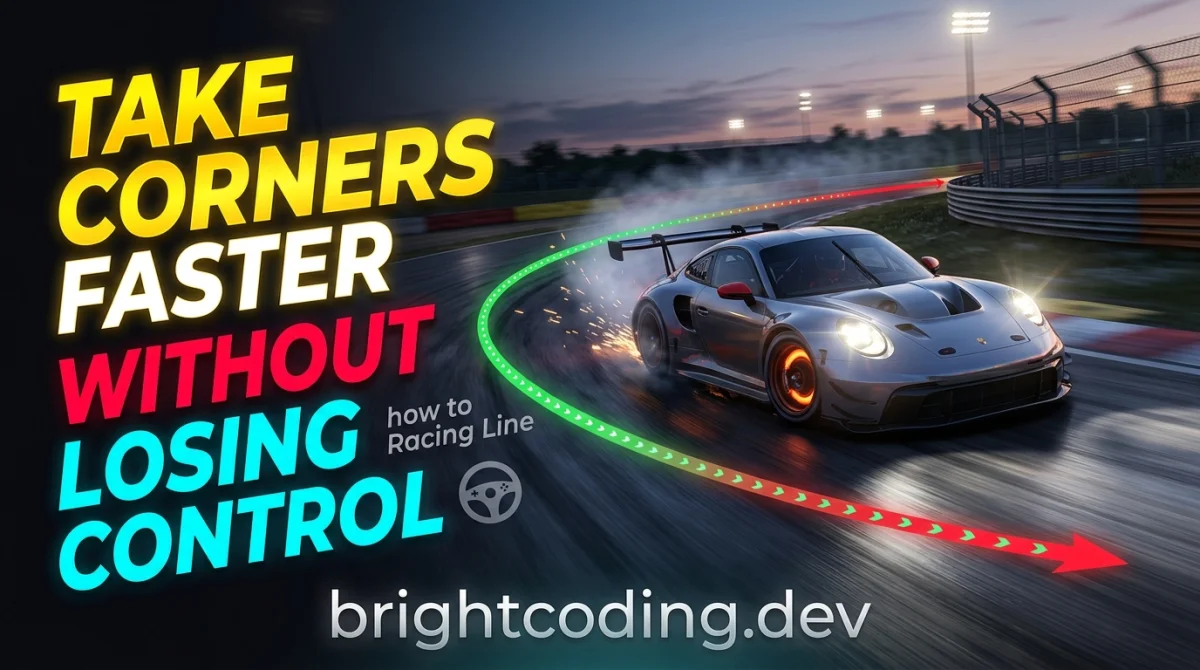
You already know the corner is where lap time lives. You just keep losing it: braking too early, steering too much, or worse, feeling the rear end step out and panicking.
By the end of this guide you will know how to enter a corner faster, hold a line you actually chose, and get back on the throttle without the car snapping sideways. Nothing here needs expensive gear. Most of it is technique you can practice in 20 to 30 minutes per session, and you will feel a difference within a few sessions if you are honest about what you are doing wrong.
What you need before you start
- A racing game with a decent physics model and a replay or telemetry feature. Sim or simcade titles work best; arcade games hide your mistakes.
- A stable framerate. If your game is stuttering, you cannot learn braking points, so drop settings until it is smooth.
- A controller, wheel, or keyboard you are comfortable with. A wheel is not required. Plenty of fast players use a pad.
- One car and one track you know well. Changing both every session resets your learning.
- Patience for 10 to 15 laps before you judge yourself. Corner speed is a habit, not a single input.
Step 1: Learn the corner before you attack it
Before you try to go fast, drive the corner slowly and answer three questions. Where does the corner actually start turning? Where is the apex, the tightest point? Where does the car want to run wide on exit?
This matters because most people brake at the same spot every lap out of habit, not because it is correct. Once you know the shape, you can decide where the car should be at each phase.
Practical tip: do 3 to 4 slow laps in a row and say the phases out loud. "Brake, turn in, apex, power." It sounds silly. It works, because it forces you to plan instead of react.
Approximate time: 10 minutes.
Step 2: Brake in a straight line, then release smoothly
Brake hard while the car is still pointed straight, then start easing off the pedal as you begin to turn. This is the core of the whole technique: tires can brake hard or turn hard, but not both at maximum at the same time.
The reason this matters is physics. Your front tires have a fixed amount of grip, and braking consumes most of it. If you are still standing on the brakes when you turn in, the front tires give up and you understeer straight past the apex.
Practical tip: think of it as a handoff. Brake pressure goes down while steering input goes up. If you can hear your tires locking or feel the wheel go light mid corner, you braked too long.
Approximate time: 15 to 20 minutes of focused laps to feel the handoff.
Step 3: Slow your steering, not your corner speed
Here is the counterintuitive part. Fast drivers often use less steering angle than slow drivers, not more. Jerky, full-lock inputs scrub speed and unsettle the car.
Aim for one smooth movement to the apex, then a gradual unwind as you exit. If you are sawing at the wheel mid corner, your entry speed is probably too high for your line, or your line is wrong.
Practical tip: try a corner using deliberately gentle steering. You will often carry more speed through it, because the tires are not fighting your inputs.
Step 4: Use the whole track, but on purpose
Wide entry, tight apex, wide exit. That is the classic line, and it exists for a reason: it straightens the corner, which means less steering and more throttle.
This matters most on exit, where you spend the longest time accelerating. A late apex lets you get on the power earlier, and that often beats a faster entry.
Practical tip: on a track you know, pick one corner and try a deliberately late apex, one car width later than usual. Time the next straight. You may be surprised which version wins. If you want a deeper look at how different racing subgenres reward different lines, our breakdown of game genres explained is a good companion read.
Step 5: Get back on the throttle progressively
Do not stab the throttle at the apex. Feed it in as you unwind the steering. The more the wheel straightens, the more power the rear tires can take.
This is where most spins happen. You hit the apex cleanly, then dump full throttle while still turning, the rear loses grip, and you are facing the wrong way.
Practical tip: if the car is rear-wheel drive, aim for a throttle squeeze that takes about a second to reach full. In an all-wheel drive car you can be more aggressive, but the principle is the same.
Step 6: Trail brake, but only after the basics feel automatic
Trail braking means keeping a light amount of brake pressure past the turn-in point, easing to zero as you reach the apex. It rotates the car and lets you brake later.
This matters because it is one of the biggest real lap-time gains available. It is also the fastest way to spin if your other inputs are not smooth yet.
Practical tip: start with maybe 10 to 20 percent brake pressure after turn-in on a single corner. If the rear steps out, you are carrying too much. Build up over several sessions, not one.
Approximate time: expect a few weeks of practice before it feels natural, depending on how often you play.
Step 7: Review one corner per session
After your laps, watch a replay or check telemetry for a single corner. Compare your braking point, apex speed, and exit speed with your best lap. Do not try to fix everything at once.
This matters because you cannot feel a 2 km/h difference in the moment, but you can see it in data.
Practical tip: keep a note on your phone with one goal per session, like "brake 5 meters later at turn 3." Measurable, small, repeatable.
Pro tips
Look where you want to go, not at the wall. Your hands follow your eyes. If you are staring at the outside barrier mid corner, you will drift toward it.
Brake later, but only by a car length at a time. Big changes hide mistakes. Small changes build real confidence.
Short shift out of slow corners. Changing up early reduces wheelspin and keeps the car settled, especially in cars with lots of torque.
Use a ghost or rival lap. Chasing a slightly faster ghost teaches you braking points better than any tutorial.
Practice on a track you dislike. Weak tracks expose bad habits that fast, familiar tracks hide.
Warm up before you push. Do 3 to 4 easy laps first. Cold focus leads to cold crashes. If you want a low-pressure way to warm up your hands and eyes, a few rounds on the free browser-games hub work fine.
Common pitfalls
Braking too early, then coasting. This feels safe but costs you time and often makes the car harder to rotate. Fix it by moving your braking point forward in small increments, not by braking harder.
Steering and braking at full force together. The front tires cannot do both. Ease off the brake as you turn in.
Turning in too early. It feels fast and ruins your exit. Wait, then commit.
Fighting the car when it steps out. Countersteer quickly but gently, and get off the throttle. Overcorrecting turns a small slide into a spin.
Changing car and track every session. You never build a reference. Pick one combo and stick with it for a week.
Useful resources
- Your game's built-in telemetry or replay tools. Free, and more useful than most external apps.
- Community forums and subreddits for your specific game, where braking points and setups get shared.
- YouTube lap guides, which are handy for seeing a reference line, though they assume a specific car and setup.
- Our tips, tricks and guides hub for related technique breakdowns.
- The free gaming tools page if you want lightweight utilities while you practice.
FAQ
Do I need a steering wheel to corner fast? No. A controller with good trigger control can be very fast. A wheel mostly helps with consistency and feel, not raw pace.
How long until I actually get faster? Most players see a clear improvement in a few sessions if they practice one corner at a time. Real consistency takes weeks, not days. Be suspicious of anyone promising overnight gains.
Should I use assists like traction control? For learning, yes. Turn them off gradually as your inputs get smoother, or you will rely on them forever.
Why do I keep spinning on exit? Usually too much throttle too early, or steering still cranked while you accelerate. Unwind the wheel first, then add power.
Is trail braking worth learning? Yes, if you plan to keep improving. It is one of the biggest gains available, but only after basic braking and steering are smooth.
One last thing
You do not need to be the fastest player in the lobby to enjoy this. You just need to stop guessing. Pick one corner today, work the braking handoff, and watch what happens to your exit speed. If you want more guides like this, the GamingUp blog has plenty more, and the daily challenge is a good excuse to practice something new every day. Now go take that corner properly.
Ready to play?
Puzzle, arcade, 3D, word & sports games for every age — instant play, no registration.
Comments
No comments yet. Be the first to share your thoughts!