The Secret Braking Technique Used by Pro Racing Gamers
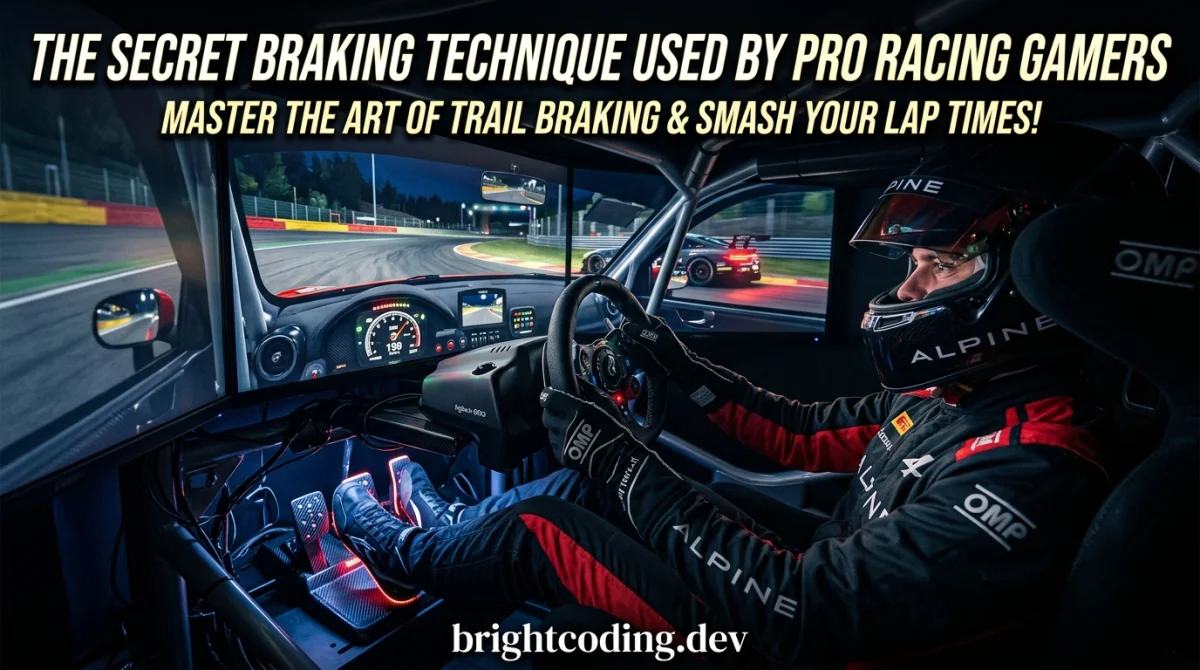
The "secret" isn't a magic button - it's trail braking: staying on the brake pedal while you start turning in, then easing off gradually as steering angle increases. Most casual players brake in a straight line, let go completely, then turn. Pros overlap the two. This article answers the questions people actually search about it - what it is, why it's faster, how to practice it, and which games reward it - with honest caveats about where the technique doesn't apply.
Quick answers
- What is trail braking? It's a technique where you keep light brake pressure applied past the turn-in point and release it progressively as you add steering, rather than finishing all your braking before you turn.
- Why is trail braking faster? It keeps the front tires loaded, which gives you more grip for turning, and it lets you start rotating the car earlier - so you can get back on the throttle sooner.
- Do you need a wheel and pedals to trail brake? No, but it's much harder on a controller trigger. Analog triggers work; a load-cell brake pedal makes it dramatically easier to modulate.
- Which racing games reward trail braking the most? Sim-style titles with real tire models - think Assetto Corsa, iRacing, rFactor 2, and Gran Turismo 7 with assists off. Arcade racers usually don't care.
- How long does it take to learn? You'll feel the concept in an afternoon and get genuinely consistent at it in weeks. It's a habit change, not a knowledge problem.
What is trail braking, exactly?
Braking has two phases. The first is the big, straight-line stomp - maximum pressure while the car is pointed straight. The second is the trail: as you turn the wheel, you bleed off brake pressure smoothly instead of releasing it all at once.
The name comes from the brake-pressure trace on telemetry, which "trails" off in a curve rather than dropping vertically. Nothing mystical. It's just a smooth, overlapping transition from braking to turning.
Here's the mental model that finally made it click for me: your tires only have so much total grip, and that grip gets split between braking and turning. Brake at 100% and you have nothing left for steering. Turn at 100% and you have nothing left for braking. Trail braking lives in the overlap - you're trading one for the other, gradually, instead of flipping a switch.
Why is trail braking actually faster?
Two reasons, and they're worth separating because people mix them up.
The grip reason. When you brake, weight shifts forward and the front tires get pushed into the road. That's load, and load creates grip. If you release the brakes completely before turning, the nose lifts back up, the front tires unload, and you're turning with less grip than you could have had. Trail braking keeps that weight on the nose through the first part of the corner.
The rotation reason. With the front loaded and the rear relatively light, the car rotates more willingly. You can point it at the apex earlier. Earlier rotation means earlier throttle, and on most corners the exit is where the lap time lives.
There's a third, less sexy benefit: it's more stable. Sudden brake release mid-corner upsets the car. A smooth trail-off doesn't.
How do you actually do it?
Start with the brake trace, not the lap time.
- Pick one corner. Not a whole lap. A medium-speed corner where you currently brake, release, then turn. A hairpin is too punishing; a fast sweeper is too subtle. Something like a second-gear 90-degree turn is ideal.
- Brake later and harder than usual. Most beginners brake too early and too gently. If you're going to trail off, you need a firm initial application to trail from.
- Start turning while still on the brake. This is the part that feels wrong. Your hands and feet are doing opposite things and your brain will object. Do it anyway, gently.
- Release in one smooth motion, matched to your steering. The more you turn, the less you brake. By the apex, you should be at zero.
- Watch for the tell. If the car snaps into oversteer the moment you release, you released too abruptly. If you run wide on exit, you didn't release enough.
Twenty laps of that single corner beats two hundred laps of "trying to trail brake everywhere."
If you want a low-stakes place to build the underlying timing and rhythm before you commit to a sim, browser racing games are genuinely useful for this - the stakes are zero and you can restart instantly. Our free browser-games hub has a decent spread of driving titles, and the daily challenge is a nice way to force yourself into short, focused sessions instead of endless free practice.
Can you trail brake on a controller?
Yes, but be realistic about the ceiling.
A DualSense or Xbox trigger gives you maybe an inch of travel to represent 0-100% brake pressure. That's a brutal resolution for a technique that's entirely about fine modulation. You can absolutely learn the concept on a controller and get faster. But you'll plateau.
If you're on controller and serious, the order of upgrades that matters most is: brake pedal first, then wheel, then everything else. A load-cell pedal (which measures force rather than travel) is the single biggest quality-of-life jump for trail braking specifically, because your foot is much better at controlling pressure than position. Budget estimates vary wildly by region and stock - somewhere in the low-to-mid hundreds of dollars for a decent entry-level load-cell set, but check current prices before you commit.
Controller players can also lean on trigger sensitivity settings and, in some titles, brake deadzone adjustments. It's a workaround, not a fix.
Which games reward it - and which ignore it?
This is where a lot of people waste time. Trail braking only matters if the game's tire model actually simulates load transfer and slip. Plenty of racers fake it.
| Game | Does trail braking matter? |
|---|---|
| Assetto Corsa / Competizione | Yes, heavily |
| iRacing | Yes, heavily |
| rFactor 2 | Yes, heavily |
| Gran Turismo 7 (assists off) | Yes, noticeably |
| F1 24 and similar annual titles | Yes, but the braking model is more forgiving |
| Forza Motorsport | Yes, with assists off |
| Forza Horizon | Somewhat, but the handling is looser |
| Mario Kart, most arcade racers | Barely - drifting mechanics dominate |
The pattern: the more the game punishes you for sloppy inputs, the more trail braking pays off. If you can smash the brake to 100%, release instantly, and still nail the corner, the game isn't modeling it.
If you're deciding what to play next, our game genres explained hub breaks down where sim, simcade, and arcade racing actually diverge - that distinction matters more than the marketing on the box.
Related questions
Is trail braking the same as left-foot braking?
No, and people conflate them constantly. Left-foot braking is about which foot you use - it lets you overlap brake and throttle, which is useful in rally and some FWD racing. Trail braking is about when you release the brake relative to steering. You can trail brake with your right foot. You can left-foot brake without trailing at all. Different tools.
Do real racing drivers trail brake?
Yes - it's standard practice in circuit racing, taught in most serious driver development programs. But it's not universal across every discipline. Rally drivers on loose surfaces often brake differently, and some cars with particular weight distributions or brake bias setups respond poorly to it. It's a technique, not a law.
Why do I keep spinning when I try this?
Almost always one of three things: you're releasing the brake too fast, your brake bias is too far rearward, or you're carrying too much speed into the corner and asking the front tires to do two jobs at once. Fix the release first - it's the most common culprit and the easiest to correct.
Should I learn trail braking before or after I learn racing lines?
Lines first. Trail braking is a refinement on top of a decent line, not a replacement for one. If you don't know where the apex is, no amount of pedal finesse will save you. Get consistent, then get fast.
Bottom line
Trail braking isn't a secret - it's just a skill most players never bother to isolate and practice. Brake hard in a straight line, keep a little pressure as you turn in, and release smoothly as your steering angle grows. Pick one corner, do twenty focused laps, and check whether you're running wide or snapping loose. That feedback loop is the whole method.
When you're ready to go deeper on racecraft, our rank-up competitive guides cover the habits that actually move you up the order - and the tips, tricks & guides hub is the fastest way to find the specific technique you're stuck on.
Ready to play?
Puzzle, arcade, 3D, word & sports games for every age — instant play, no registration.
Comments
No comments yet. Be the first to share your thoughts!