How to Win More Races Without Buying the Fastest Car
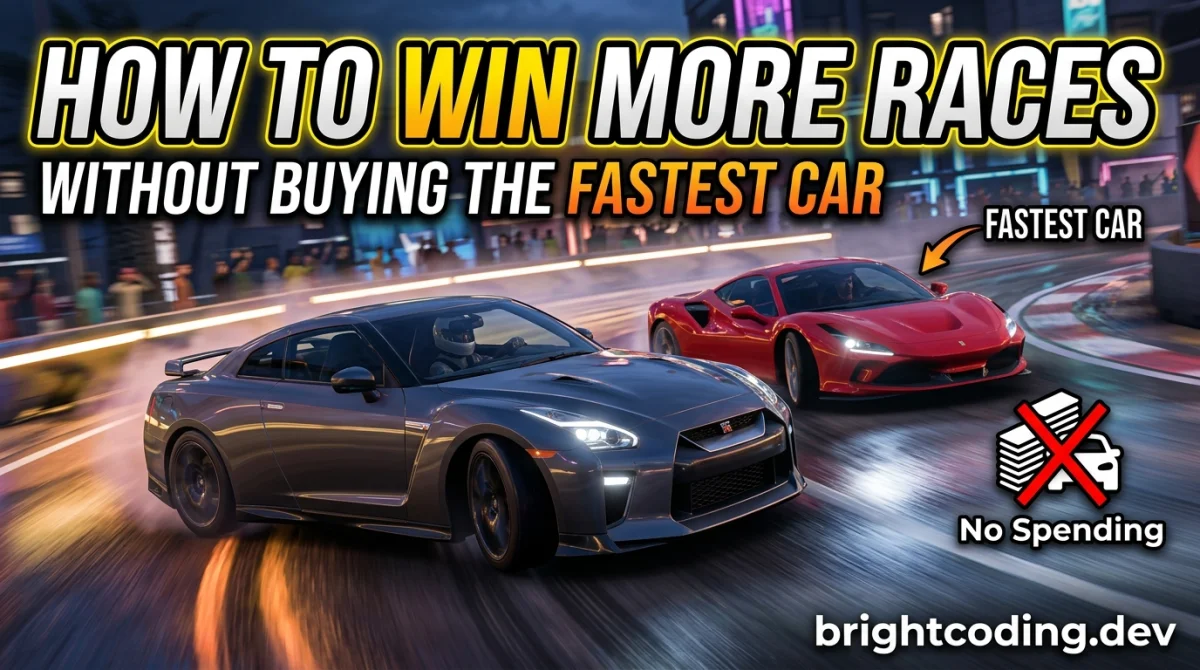
You don't need the most expensive car in the lobby. You need to stop losing races in the same three corners every time.
By the end of this guide you'll know how to read a track, tune a car you already own, pick upgrades that actually matter, and manage a race from lights to flag. Most of it costs nothing but attention. Set aside an hour to work through the steps properly - the first 20 minutes will probably teach you more than your last ten hours of grinding.
Some of this is genre-agnostic, so it applies whether you're in a sim, an arcade racer, or a mobile game with a suspicious energy meter. Where a specific game matters, I'll say so.
What you need before you start
- A car you're comfortable in, not necessarily a fast one. Comfort beats spec sheets.
- Access to a practice or time trial mode, ideally with sector times.
- A way to record your screen, even a phone pointed at the TV works.
- Pen and paper, or a notes app. You will forget what you learned.
- Patience for lap one. Nobody wins a race in turn one, but plenty of people lose it there.
Step 1: Pick the right car, not the fastest one
The fastest car is usually the one with the worst manners. High top speed means poor braking, twitchy corner entry, and a car that punishes every small mistake. In a 5-lap race against humans, consistency beats peak performance almost every time.
Look for a car that's easy to place on the track. If you can hit your marks repeatedly without fighting the wheel, you'll beat faster cars driven by people who are constantly correcting.
Practical tip: In most games, the car class and tyre compound matter more than the specific model. Two cars in the same class on the same tyres will be within a second or two of each other on most tracks. Verify this in your game's own testing - don't take my word for it.
Time cost: 15-20 minutes of test laps in two or three cars. That's it.
Step 2: Learn one track properly before moving on
This is the single biggest shortcut in racing strategy, and almost nobody does it. Pick one track. Run it until you can describe every corner out loud without looking.
You're looking for three things: braking points, the ideal line, and which corner leads into which. Most tracks have two or three corners that decide the whole lap. Find yours.
Why it matters: Track knowledge transfers. Once you've learned one circuit deeply, you'll learn the next one twice as fast, because you're recognising patterns instead of memorising turns. Our rank-up competitive guides cover the same principle for shooters and fighters - mastery is local before it's global.
Practical tip: Drive the track slowly on purpose. Five laps at 70% effort will teach you the layout better than five laps at 100% where you're just surviving.
Step 3: Fix your braking before you touch anything else
Most players lose more time under braking than anywhere else. They brake too late, too hard, and too long, then wonder why they're slow out of the corner.
Brake in a straight line, release smoothly, and get back on the throttle early. Late braking feels fast and usually isn't - you carry a bad angle through the whole corner and lose the exit.
Practical tip: Pick a fixed braking reference - a marker, a kerb, a shadow, a specific tree - and brake there every single lap. Consistency first, then move the reference later by tiny increments.
Step 4: Prioritise car upgrades that match your problem
Upgrades are where people waste money. Buying the biggest power upgrade on a car that can't stop or turn is like giving a sprinter heavier shoes.
Match the upgrade to the weakness you actually have. If you're losing time on corner exit, you want grip and traction. If you're getting passed on straights, you want power. If you're spinning, you want tyres and suspension before anything else.
| Your symptom | Upgrade to consider first | Approximate in-game cost |
|---|---|---|
| Spinning out of corners | Tyres, suspension | Usually cheap, often free |
| Slow on straights | Engine, weight reduction | Mid to expensive |
| Can't brake late | Brakes, downforce | Mid range |
| Inconsistent lap times | Anything that improves grip | Varies |
Costs vary wildly by game, so treat that column as a rough ordering, not a quote. In most titles, the cheap handling parts give a bigger lap-time gain per credit than the expensive power parts.
Practical tip: Upgrade one thing, then test. If your lap time doesn't improve, you bought the wrong part. Sell it back if the game allows.
Step 5: Practice race pace, not hot laps
A qualifying lap and a race lap are different animals. In a race you have cold tyres, traffic, fuel load, and a body that's slowly getting tired.
Set up practice with realistic conditions: full fuel, worn tyres, other cars on track if the game allows it. Then run 5-10 laps without resetting. Your goal is a lap time you can repeat, not a lap time you can fluke.
Time cost: Roughly 20-30 minutes per track once you know the layout. Do it once and it sticks.
Practical tip: Note your lap times down. The pattern matters more than any single number - if lap 4 is always your fastest, you know your warm-up routine needs work.
Step 6: Race the people, not the clock
Once you're on track with others, the game changes. You're no longer chasing a lap time, you're managing space, pressure, and risk.
Defend the inside line into slow corners. Give up a position early if fighting for it will cost you three seconds. Let the aggressive driver past and watch them bin it two corners later - it happens constantly.
Why it matters: Positions gained through other people's mistakes are free. Positions gained through forcing a pass usually aren't.
Step 7: Manage your tyres and fuel like they're money
In any game with tyre wear or fuel, the race is won in the last third. Drivers who burn everything in the first two laps get swallowed at the end.
Smooth inputs preserve tyres. Avoid locking brakes, avoid wheelspin on exit, avoid kerbs that unsettle the car. If your game has fuel modes or engine maps, use the lean setting when you're stuck in traffic and the rich setting when you're clear.
Practical tip: If you're unsure how much tyre life you have left, do a full-length practice run. It's boring. It also tells you exactly when to pit.
Step 8: Review your own replay
This is the step everyone skips and it's worth more than any upgrade. Watch your last race back. Look for the same mistake happening twice.
Common findings: you turn in too early on the same corner every lap, you brake a metre later than your reference under pressure, you take a defensive line that ruins your own exit.
Practical tip: Watch at half speed. Mistakes that feel instantaneous on track are obvious in replay. If you want more general gaming habits that carry across genres, the tips, tricks and guides hub is a good place to browse.
Pro tips
- Follow a faster driver for a full lap. Copying a good line teaches you more than any tutorial. Stay close enough to see their braking points, far enough not to punt them.
- Set your brake bias slightly rearward in the wet, forward in the dry. Small change, noticeable difference. Check your game supports it.
- Qualify on low fuel if the game allows it. Free lap time, zero risk.
- Learn the pit entry and exit. Races are won and lost there more often than people admit.
- Turn off the racing line if you're relying on it. It teaches you to react instead of plan. Your lap times will get worse for a week, then much better.
- Run the daily challenge in whatever browser game you're playing. Cheap, low-stakes practice for reading a new track fast. The GamingUp daily challenge is a decent warm-up if you want something quick.
Common pitfalls
Buying power first. Power without grip makes a car that's fast in a straight line and slow everywhere else. Fix handling before horsepower.
Practising only hot laps. You'll qualify well and fade in the race. Always practice at race pace.
Braking too late under pressure. When someone's behind you, the instinct is to brake later to look fast. It's the opposite of what works. Brake at your reference, hit your apex, get a clean exit - that's what actually defends a position.
Ignoring the setup menu entirely. Even one or two clicks on brake bias or downforce can transform a car. You don't need a PhD in suspension geometry.
Switching cars every session. Every car has its own habits. Jumping between them means you never build the muscle memory that makes you fast.
Useful resources
- Your game's built-in telemetry or sector timing, if it has one. Free and specific to you.
- Community wikis and subreddits for your specific title. Setup sharing is usually excellent there.
- YouTube channels that do track guides rather than highlight reels. Look for ones that show braking points on screen.
- The free gaming tools on GamingUp for quick calculators and trackers.
- The game genres explained hub if you're moving between racing sub-genres and want to understand what changes.
FAQ
Do I really need to upgrade my car at all? No. A well-driven slow car beats a badly-driven fast car in most lobbies. Upgrades help, but they're the last 5% not the first 50%.
How long does it take to get noticeably faster? If you focus on one track and one car, most people see clear improvement within a few hours. Broad improvement across many tracks takes longer - weeks, honestly.
Is a wheel better than a controller? It can be, especially in sims, but a controller is entirely capable of winning races. Track knowledge beats hardware every time. Don't buy gear to avoid learning.
What if my game has pay-to-win cars? Some do. In those cases, focus on the free or cheap cars that suit your driving style and exploit their strengths - usually handling or fuel economy. It's an uphill fight, but not an unwinnable one.
Should I use assists? Use them while you learn, then remove them one at a time. Traction control off is usually the biggest single gain in lap time once you can handle it.
One last thing
You're going to lose races to people with better cars. That's fine - it happens, and it doesn't mean your approach is wrong. The players who improve fastest aren't the ones with the biggest garage. They're the ones who can tell you exactly why they lost three seconds on lap two.
Go learn one track properly this week. Just one. You'll feel the difference by the weekend.
Ready to play?
Puzzle, arcade, 3D, word & sports games for every age — instant play, no registration.
Comments
No comments yet. Be the first to share your thoughts!