How to Drift Like a Pro in Any Racing Game
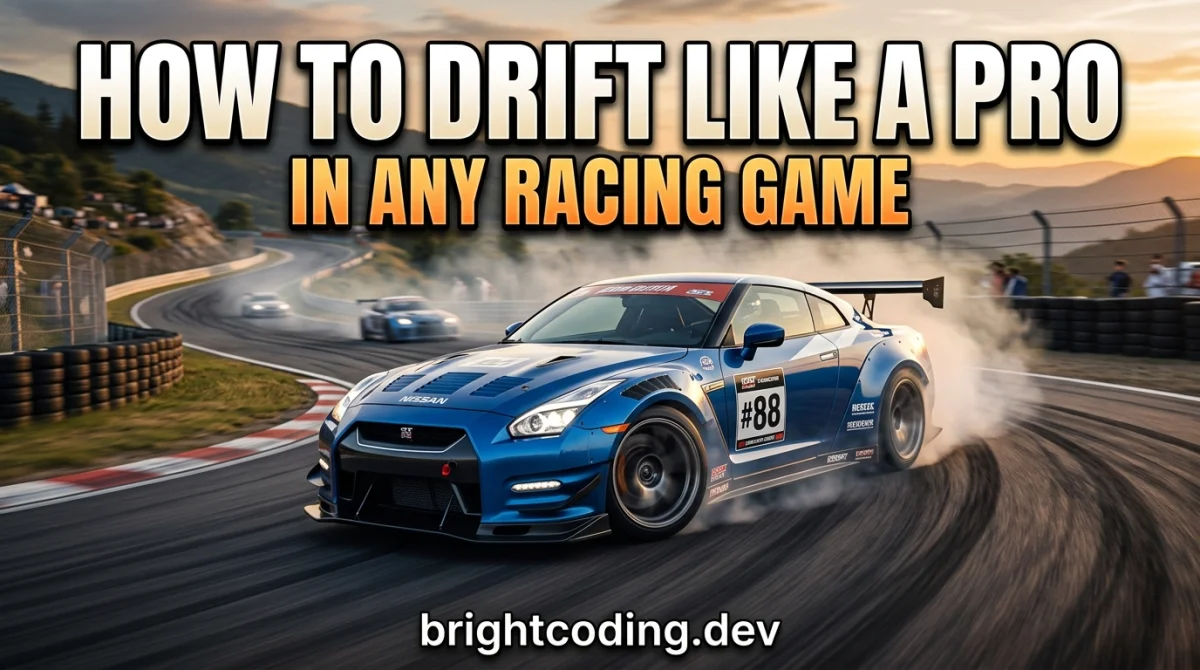
Drifting looks like magic from the outside. The car slides, the rear tires smoke, and somehow the driver keeps it together through the corner. It isn't magic. It's a repeatable set of inputs you can learn.
By the end of this guide, you'll understand what actually makes a car drift, how to trigger and hold a slide on purpose, and how to turn that into faster lap times. Give it a solid hour of focused practice and you'll feel the difference. Master it over a few sessions and you'll be the person your friends ask to teach them.
What you need before you start
- A racing game with a decent physics model. Arcade racers (think Need for Speed or Forza Horizon) are more forgiving than sims, but the fundamentals are the same.
- A controller or wheel you're comfortable with. A wheel helps with throttle control; a controller is fine to start.
- Fifteen minutes of patience per session. Drifting rewards repetition, not marathon grinding.
- A track with a wide, empty corner. Find one and use it as your test bed.
- Ideally, a car you can tune. Even a basic setup menu lets you adjust tire pressure and rear grip, which changes everything.
Step 1: Understand what a drift actually is
A drift is just the rear tires losing grip while the front tires keep it. That's it. The car rotates more than it would in a normal turn, and you're steering into the slide to control it.
Why it matters: if you don't know what you're trying to make happen, you'll fight the car instead of guiding it. Every input you make should either break rear traction or manage it.
Tip: Say it out loud before you start: "rear loose, front gripping." Sounds silly. Works.
Step 2: Pick the right car and tune it loose
Not every car drifts well. Rear-wheel-drive cars slide most naturally. All-wheel-drive cars can drift but tend to snap back. Front-wheel-drive cars drift with the handbrake, but it's a different style.
Why it matters: fighting a stubborn car teaches you bad habits. Start with something that wants to slide.
Tip: If your game has tuning, soften the rear suspension slightly and lower rear tire grip a touch. Small changes. You're nudging the car, not flipping a switch. Exact values vary wildly by game, so test and adjust.
Step 3: Learn the throttle, not the handbrake
Beginners yank the handbrake. Pros use throttle. Lifting off the gas shifts weight forward, which unloads the rear tires and lets them break loose. Then you get back on the throttle to keep the slide alive.
Why it matters: handbrake drifts are a crutch. Throttle control is the real skill, and it transfers to every racing game you'll ever play.
Tip: On a controller, treat the trigger like it's made of glass for the first ten minutes. Feather it. You're looking for a smooth arc, not an on/off switch.
Step 4: Initiate on entry, not mid-corner
The drift starts before the corner does. Turn in slightly early, lift, then add steering and throttle together. The car rotates as you approach the apex.
Why it matters: initiating late means you're reacting to a slide you didn't plan. Initiating early means you're controlling it.
Tip: Pick a visual reference - a curb, a sign, a specific patch of tarmac - and start your input there every lap. Consistency beats instinct when you're learning.
Step 5: Countersteer and hold it
The moment the rear steps out, your steering input should point into the slide. If the back swings left, you steer left. Then you hold it there, making tiny corrections.
Why it matters: this is the part everyone gets wrong. You're not steering where you want to go. You're steering to keep the car balanced while the throttle carries you through.
Tip: Look where you want to exit, not at the wall you're worried about hitting. Your hands follow your eyes.
Step 6: Modulate the throttle to control the angle
More throttle = wider angle. Less throttle = the car straightens. That's your main dial.
Why it matters: throttle is your steering wheel for the back of the car. Once you feel that connection, drifting stops being scary and starts being fun.
Tip: If the car spins, you gave too much throttle too early. If it grips up and kills the drift, you lifted too much. Adjust in small increments.
Step 7: Practice one corner until it's boring
Don't lap the whole track chasing a perfect run. Pick one corner. Drift it fifty times. Then do it fifty more.
Why it matters: repetition builds the muscle memory that makes drifting automatic. Racing a full lap means you're practicing twenty things badly instead of one thing well.
Tip: Roughly 20-30 minutes on a single corner is a good session. Come back the next day and you'll be shocked how much stuck.
Step 8: Graduate to chained drifts and full laps
Once one corner feels natural, link two together. Then a whole section. Then a lap. The goal shifts from "can I drift?" to "can I drift fast?"
Why it matters: a drift that doesn't carry speed is just a slow way to turn. The point is exit velocity.
Tip: Watch your exit speed, not your style points. If you're sliding beautifully but losing a second per corner, you're doing it wrong. For more on turning raw skill into actual wins, our rank-up competitive guides break down the racecraft side of things.
Pro tips
Trail-brake into the corner. Brake hard, then ease off the pedal as you turn in. The weight transfer helps the rear break loose smoothly instead of snapping.
Use a lower gear than you think. Downshifting keeps revs high and the rear tires closer to their grip limit. Just don't overdo it or you'll spin.
Steer with your feet. Most drift corrections are throttle and brake, not steering. Your hands are just managing what your feet started.
Watch the pros in replay mode. Slow it down. Watch their inputs, not the car. You'll see how early they commit.
Set your controller deadzone low. A tight deadzone gives you finer steering control, which matters a lot when you're making constant micro-corrections. Check your game's settings menu.
Practice in the wet or on low-grip surfaces. It exaggerates everything. If you can drift on ice, you can drift anywhere. Our tips, tricks & guides hub has more setup and control tweaks worth a look.
Common pitfalls
Yanking the handbrake constantly. It works, but it teaches you nothing. Save it for hairpins and tight switchbacks where throttle alone won't rotate the car.
Panicking and lifting completely. When the car slides, your instinct is to let off everything. That's exactly when the rear grips up and spits you off. Stay on the throttle, just less of it.
Staring at the car instead of the exit. You'll hit whatever you're looking at. Eyes up, toward where you want to go.
Practicing for hours without a target. Mindless laps don't build skill. Set one goal per session - "hold the angle through turn three" - and chase it.
Copying a setup you found online. Setups are car-specific and track-specific. What works for someone else's build might make yours undriveable. Tune for your own feel, and verify any numbers you find.
Useful resources
- Your game's replay and telemetry features. Most modern racers have them. Watching your own inputs back is the fastest way to spot bad habits.
- YouTube channels dedicated to your specific game. Search "[game name] drift tutorial" and sort by upload date, since physics patches change things.
- Community forums and subreddits for your game. Great for setup questions, but always test advice yourself before trusting it.
- The in-game driving school or license tests, if your game has them. They're boring and they work.
FAQ
How long does it take to learn to drift? You'll feel a basic slide within an hour. Consistent, controlled drifts take several sessions spread over a week or two. Real mastery is a longer road, but it's a fun one.
Do I need a steering wheel? No. A controller is perfectly capable. A wheel gives you finer throttle and steering control, which helps at the high end, but it won't teach you anything a controller can't.
Why does my car keep spinning out? Almost always too much throttle too early. Ease in and add power as the car settles. If it still spins, soften your rear setup.
Can you drift in any racing game? Most, yes, though arcade games often have simplified physics. Sims reward precise inputs more. The technique is the same; the forgiveness level isn't.
Should I use the handbrake or not? Use it as a tool, not a habit. It's great for initiating tight corners. For everything else, learn throttle control first.
One last thing
Drifting is the most satisfying skill in racing games because it's the one that feels impossible right up until it clicks. It will click. Probably sooner than you expect.
Pick a car, find an empty corner, and give it twenty minutes today. Then do it again tomorrow. That's the whole secret.
Ready to play?
Puzzle, arcade, 3D, word & sports games for every age — instant play, no registration.
Comments
No comments yet. Be the first to share your thoughts!