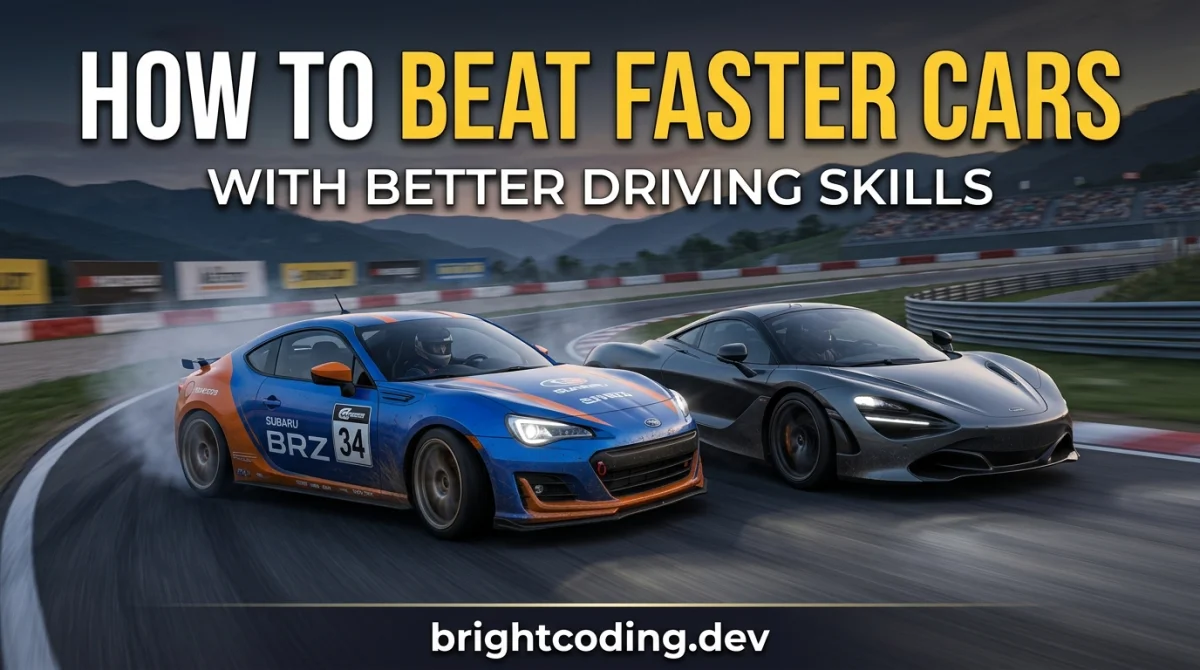
How to Beat Faster Cars With Better Driving Skills
A faster car should win. That is the whole point of spending credits, cash, or real money on it. But it does not always work out that way, and that gap is where the most satisfying wins in racing games live. Give me ten minutes and you will know how to read a track, brake like someone who actually wants to make the corner, and turn a horsepower deficit into a corner-exit advantage. No setup wizardry required, just the boring fundamentals that most players skip.
This works in sims, arcade racers, kart games, and mobile drivelike. The physics change, the principles do not.
What you need before you start
- One track you can run repeatedly. Pick it, learn it, stop track-hopping.
- A car you are comfortable in, even if it is slower than the field. Comfort beats theoretical pace.
- 20 to 30 minutes of practice time, ideally without a race timer breathing down your neck.
- Replays or a ghost car if your game has them. If it does not, record your own screen.
- Tuning access is nice but not required. Most of what follows is driving, not setup.
That is it. No special wheel, no paid coaching. A controller is fine.
Step 1: Learn the track like you have to draw it from memory
Before you fight anyone, you need to know what is coming. Not vaguely. You should be able to say "long right, short straight, tight left, then the chicane" without looking.
Spend your first laps at 70 percent effort and just watch. Where does the track fall away? Which corner tightens up on exit? Where is the surface change? Once you stop being surprised, you stop wasting grip on corrections.
Practical tip: Do five slow laps in a row with zero ambition to be fast. You will feel ridiculous. You will also be quicker on lap six than you were on lap one. If you want a low-pressure way to build this habit, the free browser games at /games are great for short, repeatable laps without a ranked penalty hanging over you.
Step 2: Brake earlier than you think, and get it done in a straight line
This is the single biggest gap between fast and slow players in most racing games. Slower drivers brake late, brake while turning, and then wonder why the car will not rotate.
Brake in a straight line before the corner, get the speed down, then turn. That is the whole trick. Braking and turning at the same time asks the tires to do two jobs and they will only do one well.
Why it matters: A car that enters a corner under control can get on the power earlier. Early power on exit is where you actually beat a faster car, because it cannot use its extra straight-line speed if you are already gone.
Practical tip: Pick a brake marker (a curb, a sign, a shadow) and hit it every lap. Consistency first, then move it later.
Step 3: Use the whole track, not just the middle
Most players drive a narrow ribbon down the center and leave a car's width on both sides. That width is free cornering radius you are throwing away.
On entry, start wide. Clip the inside of the corner. Let the car run out wide on exit. A wider arc means less steering angle for the same corner, and less steering angle means more grip available for speed.
Practical tip: If your game has a racing line assist, turn it off for a few laps. You will drive worse immediately and learn the actual geometry faster. Turn it back on later if you want, but do not let it think for you.
Step 4: Smooth inputs beat fast inputs every time
Jerky steering and stabby throttle feel fast. They are not. Every sharp input upsets the car and costs grip you cannot get back until the next corner.
Think of it as one continuous motion: brake, turn in, ease to the apex, squeeze the power, unwind the wheel. If you can hear your own inputs, they are too aggressive.
Why it matters against faster cars: They will pull away on the straights. You claw it back in the corners by not scrubbing speed. Smoothness is the budget you spend on lap time.
Practical tip: On a controller, practice rolling the stick rather than flicking it. On a wheel, aim to move it less than you think you need to.
Step 5: Get on the power early, not hard
Corner exit is where races are actually won. The car ahead of you might have 50 more horsepower, but if you are pointed straight and on the throttle while it is still fighting understeer, you will pass it.
Ease onto the throttle as you unwind the steering. Full power while the wheel is still turned just spins the tires or pushes you wide.
Practical tip: If your car steps out or understeers every time you get on the gas, you are too early or too aggressive. Wait half a beat.
Step 6: Defend the inside line, but do not park on it
When a faster car is behind you, you do not have to outrun it. You have to make it spend time.
Take the inside line into corners so it has to go the long way around. But do not weave or brake-check. Most games have contact rules or penalties, and wrecking yourself to block someone is a terrible trade.
Why it matters: A faster car stuck behind a well-driven slower car will burn its tires, its patience, and often its own race. You just have to be predictable.
Practical tip: Move once to defend, then commit. Wobbling across the track invites a dive-bomb you cannot react to.
Step 7: Learn one overtaking spot and master it
You do not need to pass everywhere. You need one corner where you are consistently quicker than the car in front, and the discipline to wait for it.
Find the corner where your car's strengths line up, usually a slow corner leading onto a long straight, and set up your exit there every single lap. Then pounce.
Practical tip: If you are faster in a corner but slower on the straight after it, do not pass there. You will just get re-passed. Wait for the corner before a long straight instead. If you want more structured ways to think about race craft, the competitive rank-up guides at /category/rank-up-competitive-guides dig into this without the fluff.
Step 8: Tune for corners, not for top speed
If your game lets you tune, the instinct is to chase top speed. Resist it when you are already down on power.
Softer suspension and a bit more downforce (or grip, depending on the game) help you carry speed through corners, which is exactly where you are beating a faster car. Lower gearing can help you out of slow corners too.
Practical tip: Change one thing at a time and run three laps before deciding. Changing five settings at once tells you nothing. Exact values vary wildly between games, so verify against your game's own tuning guides rather than copying someone else's numbers.
Pro tips
- Brake with your eyes, not your reflexes. Look at the corner exit while braking. Your hands will follow where you look, and you will stop over-slowing.
- Short-shift out of slow corners. In many games, shifting up early keeps the car settled and puts power down cleaner than redlining.
- Follow a faster driver for a lap. Do not try to pass. Just watch their lines and braking points. It is free coaching.
- Practice the corner you hate. Everyone avoids their worst corner. That is exactly the one costing you three tenths a lap.
- Turn off the music. Engine sound tells you when you are on the limit of grip. You cannot hear it over a soundtrack.
- Race the clock, not the car. If you beat your own best lap, you are improving even if you lose the race.
Common pitfalls
Braking too late. It feels heroic and it ruins your exit every time. Brake earlier, get on the power sooner, gain time.
Fighting the car instead of driving it. If you are constantly correcting, your inputs are too aggressive. Smooth out and the corrections disappear.
Copying a setup from someone faster. Their setup suits their driving and their car. Copy the principles, not the numbers.
Passing in the wrong place. Passing into a corner where the other car is stronger just hands the position back. Be patient.
Ignoring tire wear and fuel. In longer races, a faster car that runs out of grip or fuel is not faster anymore. Manage your race, not just your lap.
Useful resources
- Your game's own replay and ghost features. Free, built in, and more useful than any external tool.
- Telemetry overlays that show throttle and brake traces side by side with a faster lap. Search your game's name plus "telemetry comparison."
- Community forums and subreddits for your specific game. Tuning numbers vary by title, so always check you are reading advice for your game, not a different one.
- Video guides from drivers who explain why they brake where they do, not just where. The "why" is the part you can transfer to other tracks.
- The GamingUp tips, tricks and guides hub at /category/tips-tricks-guides if you want more of this style of breakdown across other genres.
FAQ
Do I need a racing wheel to do this? No. Every technique here works on a controller. A wheel can help with fine steering, but smooth inputs matter far more than the hardware.
How long until I actually beat a faster car? Give it a few sessions on one track. Most players see their lap times drop noticeably within an hour of focused practice, but beating a genuinely faster car takes consistent corner-exit discipline.
What if my game has no tuning at all? Then skip the tuning step entirely. Reading the track, braking in a straight line, and getting on the power early still work in every racing game ever made.
Should I use racing line assist? Use it to learn a new track, then turn it off. Relying on it permanently stops you from reading corners yourself.
Is it worth practicing against AI before racing real people? Yes, for learning the track. But AI does not defend or make mistakes like a human, so switch to online races once you know the layout.
Before you go
You are not going to out-horsepower everyone, and you do not need to. The players who win races in slower cars are not doing anything secret. They brake in a straight line, use the whole track, and get on the power before you do. That is the entire trick, repeated until it becomes habit.
Pick one track this week. Run it until your worst lap is close to your best. Then go find a faster car and make it work for the win. And if you want a quick, low-stakes way to warm up before you do, the daily challenge at /games/daily is a solid five-minute habit.
Ready to put this into practice? Browse the free browser games to train the skill, explore the tips, tricks & guides hub for related reads, or check the latest articles on the GamingUp blog.
Ready to play?
Puzzle, arcade, 3D, word & sports games for every age — instant play, no registration.
Comments
No comments yet. Be the first to share your thoughts!