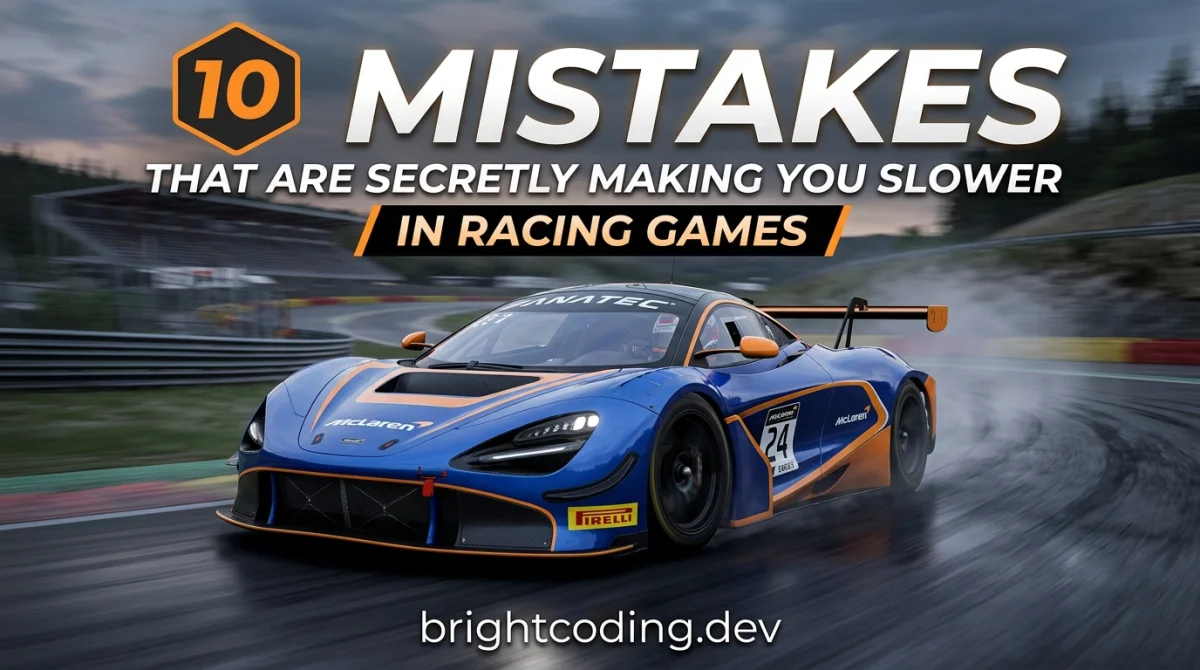
10 Mistakes That Are Secretly Making You Slower in Racing Games
You're braking too early, shifting too late, and treating the racing line like a law instead of a suggestion. Most of the time you lose to a rival isn't lost in the corners you think - it's lost in a dozen small habits that feel fast but aren't. This article breaks down the ten most common ones, answers the questions people actually search for, and gives you something concrete to fix in your next session.
Quick answers
- Why am I slow in racing games even though I know the track? Because knowing the layout and knowing your braking points are different skills. You probably brake too early and coast too long into corners, which costs more time than an early apex ever will.
- Is it better to brake late or accelerate early? Accelerating early almost always wins. A clean exit carries speed down the whole next straight; a late brake just gets you to the apex first, often sideways.
- Should I use manual or automatic transmission in racing games? Manual is faster once you're comfortable, mainly because it lets you hold gears through corners and downshift for engine braking. Automatic is fine while you're still learning the line.
- Does the racing line assist actually make you slower? It makes you dependent, not necessarily slower. Turn it off for practice, learn your own reference points, then use it again only if you're learning a brand-new track.
- How do I stop spinning out on corner exit? Get your braking done before the corner, then feed the throttle in gradually. Most spins come from applying full throttle while the car is still rotating.
Why am I slow even though I know the track?
Track knowledge and pace are two different things. You can memorize every corner and still lose two seconds a lap because you're braking at the same point you learned on your first lap - and that point was probably too early.
The fix is boring but effective: pick one corner per session and brake later than you're comfortable with, lap after lap, until you find the limit. Not the whole track. One corner. Do that five times in a row and you'll feel where the car actually stops cooperating. That feeling is your real braking point, and it's usually later than your gut says.
Also worth checking: are you coasting? A lot of players lift off the throttle, wait, then brake. That dead time is free lap time for whoever's behind you.
Is it better to brake late or to accelerate early?
Accelerate early. This is the single biggest misconception in racing games, and it's why aggressive drivers plateau.
A late brake gets you to the apex first. An early throttle gets you out of the corner first, and the exit speed compounds all the way down the next straight. If you're choosing between the two, sacrifice your entry every time. Brake a touch earlier, rotate the car, and get back on the power before your rival does.
Watch any fast lap replay and you'll notice the quickest drivers aren't the ones diving deepest into corners. They're the ones who are already at full throttle while everyone else is still settling the car.
Should I use manual or automatic transmission?
Manual, eventually. Automatic is genuinely fine while you're learning a track, and there's no shame in it. But manual gives you two things automatic can't: the ability to hold a gear through a long corner instead of getting an awkward upshift mid-turn, and engine braking on corner entry, which settles the car and saves your brakes.
The catch is that manual is slower until it's automatic. If you're constantly thinking about which gear you're in, you're not thinking about your line. Give yourself a few sessions where you're slower and worse, then it clicks.
If you're on a controller, remap your shift buttons to something your fingers can reach without moving off the triggers. This matters more than people admit.
Does the racing line assist make you slower?
Not directly - but it makes you lazy, which amounts to the same thing.
The assist shows you a generic line that works for a generic car. It doesn't know your car's balance, your tire wear, or that you're braking 15 meters too early because you're following the red zone instead of your own reference points. The moment you turn it off, you have no idea where to brake.
Here's the honest version: use it to learn a new track's basic shape, then turn it off and build your own braking markers - a curb, a shadow, a sign, a specific patch of tarmac. Those are the reference points that survive when the assist is gone.
How do I stop spinning out on corner exit?
You're asking the rear tires to do two jobs at once. They're trying to put down power and they're still trying to rotate the car. Something has to give, and it's usually your rear end.
Unwind the wheel before you commit to full throttle. As you straighten the steering, the rear tires get more grip available for acceleration, so you can get on the power progressively instead of stabbing it. If you're in a rear-wheel-drive car, short-shifting out of slow corners helps too - less torque at the wheels means less chance of breaking traction.
And if you're spinning on corner entry, that's a different problem: you're braking too hard while turning. Straighten the car before you brake, then turn in.
Why do I keep losing time on straights?
Because you lost it in the corner before. Straights just expose it.
This is the part most players never internalize. A tenth of a second lost at corner exit becomes three or four tenths by the end of a long straight, because the guy behind you exits faster and just keeps pulling. You can't fix a straight with more straight-line speed.
If you want to actually diagnose this, use the game's telemetry or ghost replay if it has one. Compare your speed at the corner exit against a faster lap. The gap will show up immediately, and it'll almost always be before the straight, not on it.
Do I need a wheel to be fast in racing games?
No. Plenty of genuinely fast players use a controller, and some use a keyboard, though keyboard is the hardest to be smooth with.
A wheel helps with consistency and immersion more than raw pace. Where it genuinely matters is fine throttle and brake control - you can trail-brake and modulate power more precisely. On a controller, you compensate with trigger sensitivity settings and a lot of practice.
If you're deciding where to spend money first, spend it on a stable setup and a decent screen before you spend it on a wheel. And if you'd rather test your instincts without buying anything, there are free browser games on GamingUp that'll teach you basic corner discipline without the hardware investment.
How much does setup actually matter?
Less than driving, more than most people admit.
Setup matters most when you're already consistent. If your lap times swing by two seconds, changing your differential settings won't save you - you'll just be inconsistent in a slightly different way. Get your driving repeatable first, then tune.
That said, a few setup changes make a real difference for almost everyone: brake bias slightly rearward to help rotation, softer rear suspension to put power down, and lower downforce on tracks with long straights. Test one change at a time and do at least three laps before you judge it. Chasing setup on a single lap is how people convince themselves nonsense works.
If you want to go deeper into how different racing subgenres handle physics and setup, the breakdown of game genres explained is a decent starting point.
Related questions
Is it better to practice one track or many?
One track, until it's automatic. Learning ten tracks badly teaches you nothing about your own habits. Pick a short circuit - something under two minutes - and grind it until you can hit your braking markers without thinking. Then the skill transfers.
This is also why daily challenges are so useful. A single track, a single goal, repeated. It builds the same muscle that grinding does, with a bit of variety.
Why do I drive worse when I'm being chased?
Because you start driving to defend instead of driving to go fast. Your braking points shift, you take weird lines to cover the inside, and you lose more time than the position is worth.
The counterintuitive fix: ignore the car behind you and drive your normal lap. Defend only on the straight or into a genuinely tight corner. Most players lose more positions by panicking than by being overtaken.
How long until I actually get faster?
Weeks, not sessions. Improvement in racing games tends to come in steps - you'll feel stuck for a while, then something clicks and you're consistently a second quicker. Pushing harder during a plateau usually makes it worse.
Take breaks. Sleep on it. Come back and your braking points will feel more natural than they did when you were grinding. It sounds like nonsense but it's the most reliable pattern in sim racing.
Bottom line
Speed in racing games comes from three things in this order: braking later than feels safe, getting on the throttle earlier than feels safe, and doing both the same way every single lap. Everything else - setup, hardware, assists - is a multiplier on those habits, not a replacement for them.
Pick one mistake from this list. Fix it this week. That's faster than trying to fix all ten at once.
Ready to put this into practice? Browse the free browser games to train the skill, explore the tips, tricks & guides hub for related reads, or check the latest articles on the GamingUp blog.
Ready to play?
Puzzle, arcade, 3D, word & sports games for every age — instant play, no registration.
Comments
No comments yet. Be the first to share your thoughts!