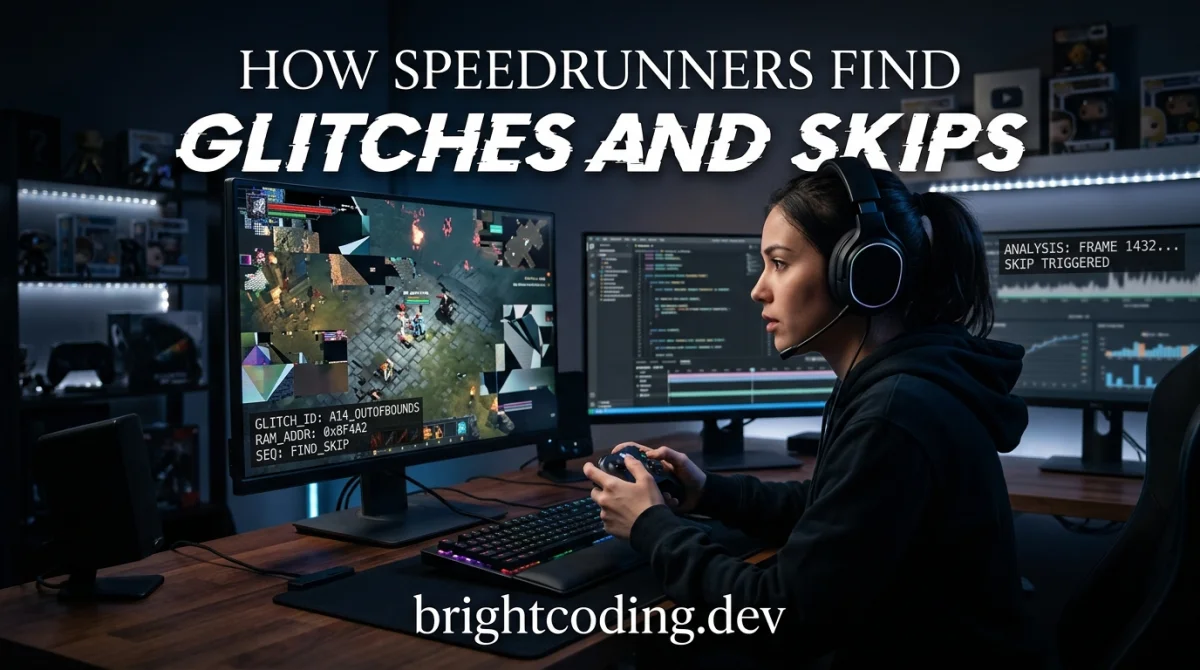
How Speedrunners Find Glitches and Skips
Keep reading: Debug Menus and Dev Rooms Hidden in Famous Games, Secret Levels Hidden Behind Unusual Triggers, Unlockable Game Modes Most Players Never Find, and Hidden Mechanics Most Players Never Discover.
Speedrunners don't just play games fast they find glitches and skips that the developers never knew existed, turning 50-hour epics into 40-minute runs. This guide explains how speedrunners find glitches and skips, from the tool-assisted science lab to the community Discords where a single discovery reshapes an entire category. You'll learn the actual methods behind wrong warps, barrier clips, and out-of-bounds travel plus how you can start glitch-hunting yourself. No cheats required; curiosity is the whole toolkit.
Quick answer: Speedrunners find glitches by studying a game frame by frame, testing edge cases (what happens if I jump here with a pause?), and using tool-assisted speedruns to brute-force possibilities. Super Mario 64's backwards long jump (BLJ), Ocarina of Time's wrong warps, and Metroid's barrier clips are all famous discoveries. Communities on speedrun.com and Discord document and verify every find.
Step One: Learn the Game's Rules Then Break Them
Every glitch starts with understanding what the game assumes. Collision is the biggest target: games check if a character is touching a wall, then move them out and if you interrupt that check at the wrong frame, you clip through.
That's why the first lesson speedrunners teach is "poke everything." Jump against every wall, pause during transitions, mash buttons at doorways. The bugs are always there; finding them is a matter of systematically testing what the developer never expected.
The Tool-Assisted Speedrun (TAS) as Glitch-Discovery Machine
A TAS is a replay created frame by frame by software a TAS isn't a real-time human run, it's a laboratory result. A tool-assisted speedrun (TAS) on TASVideos uses save states and frame stepping to test millions of inputs, exposing glitches that humans could never reproduce reliably.
Classic example: Super Mario 64's backwards long jump (BLJ) was refined through TAS work, then humans learned to perform it with real controllers. TAS is where many of gaming's wildest skips are born.
Wrong Warps, Barrier Clips, and Out-of-Bounds
The big three categories of speedrun glitches:
- Wrong warp: trigger a warp intended for one room while positioned for another, sending you straight to the credits. Ocarina of Time has a famous wrong warp that skips almost the entire game.
- Barrier clip: squeeze through a collision seam between two walls by manipulating your hitbox. Metroid and Castlevania runs lean on these.
- Out-of-bounds (OOB): get outside the map geometry entirely, then walk across the void to skip huge sections.
All three rely on the same core: collision and transitions are the least-tested code in any game.
Frame Rules and Movement Tech
Not every skip is a teleport some are just math. In Super Mario Bros., levels run on "frame rules": the game only counts you as having started a level at certain 21-frame intervals, so perfectly timed jumps save whole seconds that pile up across a run.
Movement tech like bunny hopping in Half-Life and Quake isn't a bug; it's strafing math that rewards skilled input. Knowing which mechanics are "legal" (developer-intended) versus exploited is the difference between a trick and a glitch.
Where the Community Documents Everything
Glitch-hunting is a team sport, and the infrastructure is public:
- speedrun.com the hub for leaderboards, categories, and run videos.
- TASVideos the archive for tool-assisted runs that prove skips are possible.
- Discord servers per-game communities where runners report new glitches and verify each other's findings within days.
- Games Done Quick (GDQ) the charity marathon that turned glitch-hunting into a spectator sport.
New discoveries spread in hours now, not years. The moment someone finds a skip, the whole community stress-tests it.
A Short Glossary of Speedrunning Terms
- TAS: Tool-Assisted Speedrun a computer-perfect replay used to explore possibilities.
- Wrong warp: warping to the wrong map or point in time, often skipping huge sections.
- Clip: passing through a wall or floor via a collision seam.
- Frame rule: an in-game timing interval that punishes mistimed starts.
- OOB: out-of-bounds travelling outside the intended map area.
Key Takeaways
- Glitch-hunting is systematic testing of collision, transitions, and edge cases not luck.
- TAS runs on TASVideos are the main discovery engine for new skips.
- Wrong warps, barrier clips, and OOB travel are the three big skip categories.
- speedrun.com, Discord, and Games Done Quick are where discoveries get verified and shared.
Frequently Asked Questions
What is a TAS in speedrunning?
A Tool-Assisted Speedrun is a frame-perfect replay created with emulation tools it's a proof of what's possible, and many human-achievable glitches were discovered in TAS runs first.
How do speedrunners find new glitches?
They test edge cases deliberately jumping at walls, pausing mid-transition, and using TAS software to brute-force input combinations a human would never land on.
What is a wrong warp?
A wrong warp happens when a game loads a warp target from the wrong memory address, teleporting you to an unintended location famously used to skip nearly all of Ocarina of Time.
Where can I learn speedrunning tricks?
Start with speedrun.com leaderboards and per-game Discord servers; TASVideos explains how the most extreme tricks work, and GDQ showcases them live.
Conclusion
Speedrunning is applied curiosity: learn the rules, question them, and you'll find the cracks. Whether it's a wrong warp, a barrier clip, or a frame-rule win, every skip started as someone poking a wall and refusing to let go.
Ever found a glitch in a game by accident? Tell us in the comments what it was you might have discovered a future skip. Share this guide with your speedrun-curious friends, and subscribe for more deep dives into how games actually work.
Ready to play?
Puzzle, arcade, 3D, word & sports games for every age — instant play, no registration.
Comments
No comments yet. Be the first to share your thoughts!